Component Test Rig
The component test rig has up to six prescribed motions to determine the dynamic stiffness and loss angle for each degree of freedom of an elastic component.
The test rig consists of an upper and lower part. The lower part is fixed to ground and the upper part is controlled by a six degree-of-freedom motion marker. You can activate or deactivate each motion degree of freedom.
The test component in the test-rig assembly defines its own mount location and communicates the location through a marker communicator. The upper mount point is at the upper part and the lower mount point is at the lower mount part of the test rig.
You can initialize multiple runs in one setup. For each simulation, you can compare measured data of dynamic stiffness and loss angle, or loss work, with the simulation result. This means that the component model being tested is excited with constant frequency and amplitude sinusoid until either of these conditions are met:
■The excitation has been repeated N times where N = the maximum number of cycles you set.
■The energy sensor is on and the loss angle has converged according to the error criteria in the help entry for the Energy Sensor.
Convergence means that the component model has reached steady-state behavior. Dynamic stiffness and loss angle are only defined for a steady-state condition.
The test rig is also used for quasi-static analyses, which maintain a constant velocity motion between a minimum and maximum displacement. You can define a preload for each motion degree of freedom or for an initial displacement. The motion can be a constant-frequency or a linear-frequency sweep. The motion is defined between the marker lower_mount_point and upper_mount_point with respect to cfs_testrig_reference.
Note: | You must set up the test rig before you can run a meaningful analysis. |
Analysis Types and Test-Rig Setup
Test rig setup: | Excitation function: | Driver type: | Results: | ||||||
|---|---|---|---|---|---|---|---|---|---|
Analysis types: | Constr. | Initial Displ. | Preload | Amplitude | Phase | Motion | Force | Loss Angle | Std. Req |
Set of Frequencies | x | x | x | A set of amplitudes | Initial Step | x | x | x | x |
Range of Frequencies | x | x | x | A set of amplitudes | Initial Step | x | - | x | x |
Continuous Sweep | x | x | x | A set of amplitudes | Direct | x | - | - | x |
Quasi Static | x | x | x | A set of amplitudes | Initial Step | x | - | - | x |
User Function | x | x | x | - | - | x | x | - | x |
Damper Sweep | x | x | x | A set of amplitudes | - | x | - | - | x |
The test-rig setup determines the constraints for each component as motion, locked, or constraint released. The initial displacement and preload are exclusive options. The initial displacement or preload is applied during the initial static and its values are used as the start condition for the subsequent analysis.
The constraints you can choose depend on the actuation type:
■Motion - The available constraints are: Locked, Released, or Motion. The initial displacement or preload is only for Locked or Motion constraints.
■Force - The available constraints are: Locked, Released, or Force. The initial displacement or preload is only for Locked constraint. The Force option allows you to enter a force offset value.
Excitation Function
The excitation function is defined in the dialog box, Component Analysis.
Amplitude - The amplitude is a single value or a set of amplitudes separated by commas. Each amplitude performs an analysis with the same test rig setup.
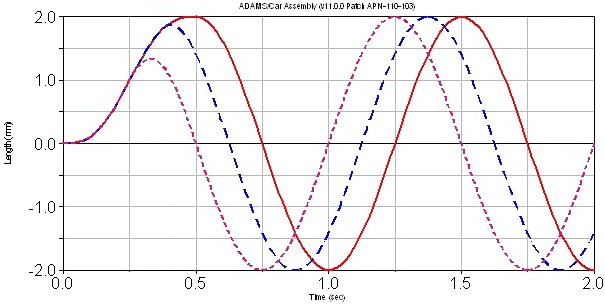
Phase - The phase of a sinusoidal motion during a constant or sweep frequency is achieved in different ways. The motion always starts with velocity = 0 and increases in a quarter of a period to the specified amplitude value. The sine function starts after a fourth of a period minus the phase shift value. The initial displacement or preload is held during the static analysis. The sinusoidal motion starts at the initial displacement.
For example see the following figure: phase 0, 45 and 90 Deg, 1 Hz, initial displ. 0.
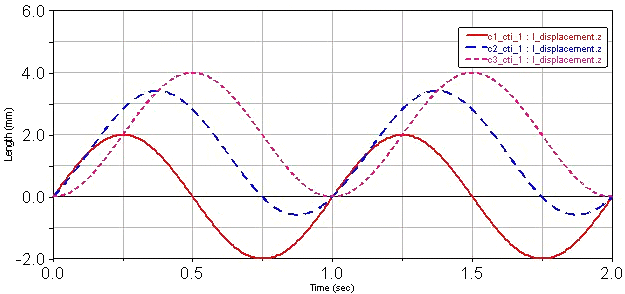
Direct - This method is used for the continuous sweep only. The sinusoidal motion starts with its phase and its initial displacement at time = 0, which causes a shift in displacement. The shift can be compensated with the initial displacement.
d = - amplitude * sin(phase)
If a preload was defined, the compensation is iterative.
For example see the following figure: phase 0, 45 and 90 Deg, 1 Hz, initial displ. 0.
Results
Each analysis contains request data of the test rig. The test rig has two measure points: at the upper mount point, the I marker, and at the lower mount point, the J marker.
Name: | Component: | Units: | Comments: |
|---|---|---|---|
I_Force | fx, fy, fz | FORCE | Force on I marker of motion generator Test_MOTION_* with respect to cfs_testrig_reference |
= | tx, ty, tz | TORQUE | Torque on I marker of motion generator Test_MOTION_t* with respect to cfs_testrig_reference |
I_Displacement | x, y, z | LENGTH | Displacement between I and J marker of Test_MOTION_* with respect to cfs_testrig_reference |
= | psi, theta, phi | ANGLE | Euler angle displacements of the I marker with respect to the J marker |
I_Velocity | vx, vy, vz | VELOCITY | Velocity on I marker with respect to cfs_testrig_reference |
= | wx, wy, wz | ANGULAR VELOCITY | Angular velocity |
I_Acceleration | acc_x, acc_y, acc_z | ACCELERATION | Acceleration on I marker with respect to cfs_testrig_reference |
= | dwx, dwy, dwz | ANGULAR ACCELERATION | Angular acceleration |
J_Force | fx, fy, fz | FORCE | Force on J marker with respect to cfs_testrig_reference |
= | tx, ty, tz | TORQUE | |
Force_Characteristics_$disp_comp | dyn_stiffness loss_angle fmin fmax loss_energy | STIFFNESS ANGLE FORCE/TORQUE FORCE/TORQUE FORCE/LENGTH | MinMax Method: user 112 Fourier Method: user 113 |
TestMotion_$disp_comp | ampl, freq | AMPLITUDE FREQUENCY | - |
Analysis name = Transfer_Function_i Result name = Force_Characteristics_$disp_comp | dyn_stiffness loss_angle Frequency | STIFFNESS ANGLE FREQUENCY | Last values of a Set or Range of Frequency Sweep i |
Construction Frames
The cfs_testrig_reference is the basis for motion and measurements.
Name: | Location dependency: | Expression: | Reference(s): |
|---|---|---|---|
cfs_testrig_reference | Delta location from coordinate | 0,0,0 | cis_upper_mount_point |
cfs_lower_mount_point | Delta location from coordinate | 0,0,0 | cis_lower_mount_point |
cfs_upper_mount_point | Delta location from coordinate | 0,0,0 | cis_upper_mount_point |
Expressions
The location expressions for cfs_lower_mount_point and cfs_upper_mount_point are nonstandard Adams Car expressions. The cis_lower_mount_point and cis_upper_mount_point are marker communicators.
The displacement between cfs_upper_mount_point and cfs_testrig_reference is a zero displacement.
Test Rig Communicators
Name: | Class: | From minor role: | Matching name: | Comment: |
|---|---|---|---|---|
cis_lower_mount_point | marker | inherit | lower_mount_point | mount point of component |
cis_upper_mount_point | marker | inherit | upper_mount_point | mount point of component |
cos_lower | mount | inherit | lower | mount part |
cos_upper | mount | inherit | upper | mount part |
cis_active_x, _y, _z, _ax, _ay, _az | parameter integer | inherit | active_x, _y, _z, _ax, _ay, _az | constraint active = 1, deactive = 0 |