Mesh Refinement for Stress Recovery
The FEM is an approximate method, employing a mesh with elements of finite length. This means that there will be some error in the results related to the mesh size or discretization. The convergence rate of the mesh discretization error can be expressed in the L2-Norm.
For displacements, the error is: 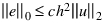
For stress or strain, it is: 
where:
■c is a constant independent of h and u.
■u is the phenomenon being approximated (x for displacements or  for stresses)
for stresses)■h is the mesh parameter characterizing the refinement of the mesh (0<h<1)
The mesh parameter, h, can also be thought of as the inverse of n, the number of elements in the mesh (1/n). In the limit, as h -> 0, the error also goes to zero. However, the convergence rate of error for displacements is better than that for stress or strain. The dynamics of a flexible component depend on the ability of its mesh to capture deformations or displacements. Therefore, a mesh suitable for dynamics may not necessarily be suitable for stress recovery.
Therefore, you should consider mesh refinement if you are interested in recovering stress for the component. In the case of MSR, this means that you must perform the mesh-refinement stage before the initial modal analysis in the FE code. There is no assurance that the modal coordinates computed by Adams for a given mesh density can be suitably applied to another mesh density of the same component or geometry. In fact, the opposite has been observed and you should only combine modal coordinates with modal stresses or strains from the same FE run that produced the mode shapes.