Helical Gear (Simplified and 3D Contact)
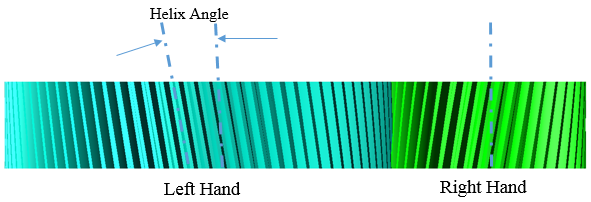
Helical gear | |
|---|---|
For the option | Do the following |
If Simplified method is selected, the following options will be displayed: | |
Module (Normal Plane) | Enter a value for the module expressed in the normal plane (MN). The module is the pitch diameter divided by the number of teeth. |
Pressure Angle (Normal Plane) | Enter a nominal pressure angle (α) in current modelling Units (default value = 20.0 deg) expressed in the normal plane. The angle between the line of action and the common tangent to the pitch circles at the pitch point is the pressure angle. |
Helix Angle (at pitch circle) | Enter a value for the helix angle (beta) in current modelling Units expressed at the pitch circle. Note that the sign of the helix angle will decide the rotation of the helicoid (right/left). |
Axis of Rotation | Axis of Rotation of Gear 1 and Gear 2 can be one of the following: ■Orientation ■Pick (Marker) ■Global Z ■Global X ■Global Y |
GEAR PAIR | |
Name | Enter the name for Gear 1 and Gear 2. ■New ■Existing: Select Gear options available. |
Center Location | Enter the coordinates or Pick (Markers, View location and so on.) |
No. of Teeth | Enter the number of teeth (Z) for Gear 1 and Gear 2. |
Gear Width | Enter the face width for Gear 1 and Gear 2 (only used for graphics). |
Bore Radius/Ring Radius | Enter the radius for the hole in the external gear or outer radius for internal gears. Note: Internal gear option is supported only for gear 2. |
Hand of Helix | ■LH/RH Select if the Helix Angle should be Left Hand (LH) or Right Hand (RH). The choice decides the sign of the Helix Angle (Left Hand of gear 1 = Positive). |
Geometry Settings | ■Number of Profile Points Defines the number of points for the half tooth profile (the other half is mirrored) through which a curve is fit. ■Number of Helix layers Defines the number of "layers" of the helical gear width should be divided into. This number should increase with increasing helix angle and gear width. For helix angle equal to 0 degrees (spur gear) this value will be automatically set to 2, otherwise the value specified in this field is used. Note: Increasing this value may improve resolution of geometry especially for wider gears but at the expense of increased time to create gear pair. |
If 3D Contact method is selected, the following options will be displayed: | |
Module (Normal Plane) | Enter a value for the module expressed in the normal plane (MN). The module is the pitch diameter divided by the number of teeth. |
Pressure Angle (Normal Plane) | Enter a nominal pressure angle (α) in current modelling Units (default value = 20.0 deg) expressed in the normal plane. The angle between the line of action and the common tangent to the pitch circles at the pitch point is the pressure angle. |
Axis of Rotation | Axis of Rotation of Gear 1 and Gear 2 can be one of the following: ■Orientation ■Pick (Marker) ■Global Z ■Global X ■Global Y |
GEAR PAIR | |
Name | Enter the name for Gear 1 and Gear 2. ■New ■Existing: Use the Select Gear options to load the existing gear. |
Center Location | Enter the coordinates or Pick (Markers, View location and so on.) |
No. of Teeth | Enter the number of teeth (Z) for Gear 1 and Gear 2. |
Gear Width | Enter the face width for Gear 1 and Gear 2 (only used for graphics). |
Bore Radius/Ring Radius | Enter the radius for the hole in the external gear or outer radius for internal gears. Note: Internal gear option is supported only for gear 2. |
Hand of Helix | ■LH/RH Select if the Helix Angle should be Left Hand (LH) or Right Hand (RH). The choice decides the sign of the Helix Angle (Left Hand of gear 1 = Positive). |
Profile | Select how the involute profile should be described using the Standard Involute Profile parameters (Profile Shifting, Addendum Factor and Dedendum Factor) or if the parameters for the Modified Involute Profile (Tip Radius, Root Radius and Tooth Thickness) should be used. ■Standard ■Modified |
If you select Standard Profile, the following three options will be displayed: | |
Profile Shift Coeff. | Enter a value for the Profile Shift Coefficient (Addendum Modification Coefficient) for the gear (positive or negative value). Default value = 0.0. If this field is left blank, no profile shifting will be used. |
Addendum Factor | Enter a value for the Addendum Factor (default value = 1.0). The Addendum Factor is used to calculate the Addendum: Addendum (Normal) = Module (Normal) * Addendum Factor |
Dedendum Factor | Enter a value for the Dedendum Factor (default value = 1.25). The Dedendum Factor is used to calculate the Dedendum: Dedendum (Normal) = Module (Normal) * Dedendum Factor |
If you select Modified Profile, the following three options available: | |
Tooth Thickness (along the pitch circle) | Enter a value for the tooth thickness at the pitch circle in the transversal plane. Must be less than 10 times the value of module. For module = 2, tooth thickness needs to be <20, not 0.2. Tip: The Tooth Thickness for Internal Gear is the "Space Width". |
Tip (Outside) Radius | Enter a value for the tip radius. For an external gear this is the outermost radius, for an internal gear the innermost. The addendum circle, or outside circle, is the circle that contains the tips of the teeth, and its radius is the outside radius (tip radius). In the database navigator this will appear as 'tip_rad'. |
Root Radius | Enter a value for the root radius. The dedendum circle, or root circle, is the circle that contains the ends of the tooth spaces, and its radius is the root radius (foot radius). In the database navigator this will appear as 'foot_rad'. |
Tooth Modification Parameters | |
Tip Relief Start | Tip relief is a modification of a tooth profile whereby a small amount of material is removed near the tip of the gear tooth. 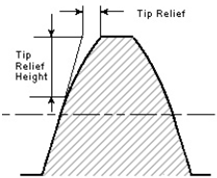 The Tip Relief Start parameter defines the position on the tooth at which the Tip Relief will start. The resulting starting radius on the gear will be: Start Radius = Tip Radius - Tip Relief Start * Module (Transverse) The Module (Transverse), MT is defined as below: MT = MN / cos(ß) If the gear is defined by Standard Involute Profile, the Tip Radius is defined as below: Tip Radius = 0.5 * MT * Z + MT * (Addendum Factor + Profile Shift Coefficient) Note: Default value is 0.0. The limit is 0.0 -1.0. |
Tip Relief Coefficient | This coefficient defines the maximum Tip Relief reached at the Tip Radius of the gear. The Tip Relief is defined by: Tip Relief = Tip Relief Coefficient * MT The tip relief will have zero value at the Tip Relief Start point and increase linearly out to the Tip Radius. Note: Default value is 0.0. The limit is 0.0 -1.0. |
Crown Magnitude | Crowning is the removal of a slight amount of tooth from the center on out to reach edge, making the tooth surface slightly convex. This method allows the gear to maintain contact in the central region of the tooth and permits avoidance of edge contact with consequent lower load capacity. Crowning also allows a greater tolerance in the misalignment of gears in their assembly, maintaining central contact. 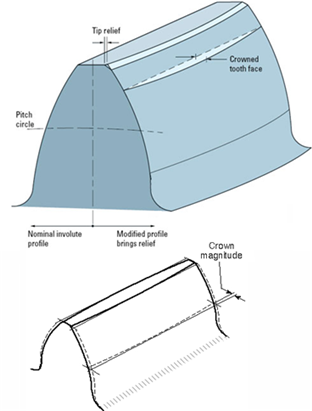 The crown magnitude is reached at the edges of the tooth and crowning is zero at the center of the tooth. The crowning is described as an arc. The Crown Magnitude is entered in length units. Note: Crowning magnitude is dependent on width of gear and is a non-negative value. The number of helix layers specified in the geometry settings must be > 2 to achieve proper crowning. |
Geometry Settings | ■Number of Profile Points Defines the number of points for the half tooth profile (the other half is mirrored) through which a curve is fit. ■Number of Helix layers Defines the number of "layers" of the helical gear width should be divided into. This number should increase with increasing helix angle and gear width. For helix angle equal to 0 degrees (spur gear) this value will be automatically set to 2, otherwise the value specified in this field is used. Note: Increasing this value may improve resolution of geometry especially for wider gears but at the expense of increased time to create gear pair. |