Adams SmartDriver
Adams SmartDriver is an advanced driver simulator that can bring a vehicle to its dynamic limits or near targets you define. You must supply a path over which the vehicle will be driven and a target (either vehicle limits or user-defined limits). The typical Adams SmartDriver application is for a single mini-maneuver for which you require maximum or target performance.
Adams SmartDriver lets you improve handling, durability, or ride performance of the vehicle model based on predicted performance Adams SmartDriver computes. It gives you the ability to investigate system-level dynamics of the vehicle model, while requiring minimal setup.
The following figure summarizes the Adams SmartDriver internal architecture:
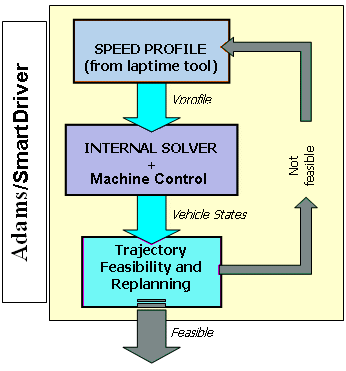
Adams SmartDriver calculates the speed profile using a built-in quasi-static solver. This solver can take into account tire limits, engine and brake system limits, as well as full load transfer and aerodynamics.
The internal solver is a fast simplified vehicle model, with rigid suspensions. It inherits all vehicle data (initial conditions, geometry, inertial values, tires, and so on) from the full model, and integrates forward in time dynamics, taking into account inertial effects, load transfer, aerodynamics, and driver demands. Powertrain and tires are fully compliant with Adams (PAC2002 and PAC96 tire models are fully compliant; PAC94 and PAC89 are supported for compatibility).
You provide Adams SmartDriver with a path and start a dynamic simulation. Adams SmartDriver inherits all vehicle data from the full Adams vehicle model, and performs one of the following two tasks:
■Vehicle Limits - Adams SmartDriver iteratively performs the following steps:
1. Calculates a limit (maximum performance) speed profile over the reference path.
2. Checks the speed profile using a fast, simplified vehicle model (driven by the same Driving Machine as the full Adams model) to take into account transient dynamics during tracking of the speed generated by the quasi-static solver.
3. Performs an analysis of vehicle states over the trajectory, searching for path locations that cannot be traveled with the current target speed during the full dynamic simulation. If Adams SmartDriver finds an unfeasible point, it notifies the lap-time simulator, which modifies the speed profile and repeats the entire procedure until it finds all feasible points.
■Used-Defined Limits - If you choose a user-defined vehicle limits maneuver, Adams SmartDriver acts in a slightly different way, as explained next. First, you must provide four additional parameters:
■% of maximum longitudinal acceleration
■% of maximum longitudinal deceleration
■% of maximum lateral acceleration during a left turn
■% of maximum lateral acceleration during a right turn
Then, Adams SmartDriver calculates a speed profile that brings the vehicle over those limits, as follows:
1. Calculates four additional limits using the parameters specified and theoretical limits of the vehicle. First, Adams SmartDriver finds the vehicle limits, and then, using the given percentages, it calculates the actual limits.
2. Taking into account both vehicle limits and user-defined ones, Adams SmartDriver creates a speed profile that brings the vehicle to those limits.
See the section Adams File Types for more information on Adams SmartDriver file types.