AKISPL
The AKISPL data access subroutine uses the Akima cubic-curve fitting method to interpolate data from the SPLINE statement (C++ or FORTRAN).
Use
Called By
Any user-written subroutine
Prerequisite
SPLINE statement in the dataset
Calling Sequence
CALL AKISPL (xval, zval, id, iord, array, errflg)
Input Arguments
xval | A double-precision value that specifies the x value at which AKISPL is to interpolate y. |
zval | A double-precision value that specifies the z value at which AKISPL is to interpolate y. |
id | An integer variable that specifies the identifier of the corresponding SPLINE statement. |
iord | An integer variable that specifies the order of the derivative that AKISPL is to return. The order is usually zero, but it can be one or two. |
Output Arguments
array | A double-precision array of length three. If iord equals zero, array(1) returns the value of y that AKISPL calculates. If iord equals one, array returns:  and and  , respectively. If iord equals two, array returns: , respectively. If iord equals two, array returns:  , ,  , and , and  , respectively. , respectively. Note that: 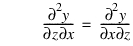 |
errflg | A logical (true or false) variable that AKISPL returns to the calling subroutine. If AKISPL detects an error in its calculations, it sets errflg to true before it returns errflg to the calling subroutine. |
Extended Definition
AKISPL accesses data in a SPLINE statement (C++ or FORTRAN), using the Akima cubic-curve fitting method to fit a spline to the data (that is, to add interpolated points), and returns one of the following:
■A value for the dependent variable (y) for each value it receives for the independent variable or variables.
■The first partial derivatives of the dependent variable.
■The second partial derivatives of the dependent variable.
If the spline data input with the SPLINE statement has one independent variable, Adams Solver uses a cubic polynomial to interpolate between points. If the spline data has two independent variables, Adams Solver first uses a cubic interpolation method to interpolate between points of the first (x) independent variable, and then uses a linear method to interpolate between curves of the second (z) independent variable.
In addition to the AKISPL data access subroutine, Adams Solver includes the CUBSPL data access subroutine, which uses the traditional cubic curve fitting method. Use CUBSPL if the primary usage is in MOTIONs. Use AKISPL if the primary concern is with the forces or torques acting on a model.
If the spline data incorporates sudden changes in value, the CUBSPL data access subroutine gives more oscillatory results for the curve or surface than AKISPL gives. However, the first and second derivatives of CUBSPL are smoother than those AKISPL calculates.