AO
The AO (Action Only) function isolates certain portions of a scalar expression from a reaction force when the expression appears in the context of a general constraint (GCON). The AO function has no effect in expressions that are not constraint expressions.
Format
AO(exp)
Arguments
exp | The subexpression which is to be isolated from a reaction force. |
Extended Definition
To understand the purpose of the AO function, it is best to examine Lagrange's equations for a constrained system:
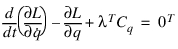

where L is the system Lagrangian, q are the generalized coordinates, C are the constraints, and  are the Lagrange multipliers.
are the Lagrange multipliers.The equation illustrates how Adams Solver (C++) uses the constraint Jacobian Cq to project Lagrange multipliers (reaction forces) into the generalized equations of motion. The AO function has the effect of making certain generalized coordinates, q, exempt from these reaction forces.
Examples
GCON/1, FUN=DX(1) - AO(DX(2))
GCON/2, FUN=DY(1) - AO(DY(2))
GCON/3, FUN=DZ(1) - AO(DZ(2))
GCON/2, FUN=DY(1) - AO(DY(2))
GCON/3, FUN=DZ(1) - AO(DZ(2))
This set of GCON elements is similar to a spherical joint in that Adams Solver (C++) ensures that markers 1 and 2 are coincident. Unlike the spherical joint, however, a constraint force will only be applied to marker 1 without a corresponding reaction force acting on marker 2.
A physical interpretation is that Adams Solver(C++) pushes marker 1 toward marker 2 without pushing marker 2 back toward marker 1.
The next example demonstrates how a displacement constraint could be influenced by velocity, without the velocity being influenced by the constraint.
GCON/10, FUN=DM(1,2) - AO(VR(3,4))/200
Note: | Excessive use of AO may lead to systems which are impossible to solve. For example, the following constraints: GCON/1, FUN=AO(DX(1,2)) GCON/2, FUN=AO(DY(1,2)) GCON/3, FUN=AO(DZ(1,2)) instruct Adams Solver (C++) to keep markers 1 and 2 coincident, but render it powerless to do so. Because a constraint force will not be applied to either marker, the constraint is unlikely to be satisfied and a convergence failure will occur. |