AZ
The AZ function returns the rotational displacement (in radians) of marker i about the z-axis of marker j, and accounts for angle wrapping.
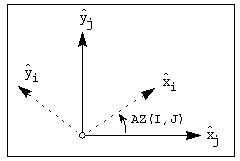
Marker j defaults to the global coordinate system if it is not specified. This value is computed as follows: assume that rotations about the other two axes (x-, y-axes) of marker j are zero. Then AZ is the angle between the two x-axes (or the two y-axes). AZ is measured in a counter- clockwise sense from the x-axis of the J marker to the x-axis of the I marker (see the figure below).
Measurement of AZ
Format
AZ(i [,j ])
Arguments
i | The marker whose rotations are being sought. |
j | The marker with respect to which the rotations are being measured. |
Extended Definition
Mathematically, AZ is calculated as:

where:
■ is the x-axis of marker i
is the x-axis of marker i■ is the x-azis of marker j
is the x-azis of marker j■ is the y-axis of marker j
is the y-axis of marker jTip: | If you want to change the AZ function so it does not account for angle wrapping, use the MOD function. For example, use the function: (MOD(AZ(2,1)+PI,2*PI)-PI) The MOD function achieves the cyclic effect and the +PI and -PI shift the curve accordingly. |
Caution: | For large rotations (greater than 10 degrees) about the x-axis or y-axis of marker j, the AZ function becomes increasingly non-physical. Moreover, AZ is undefined when both arguments to ATAN2 are zero. This occurs when the x-axis of marker i is orthogonal to the plane defined by the x and y-axis of the j marker. |
Examples
VTORQUE/1, I=21, JFLOAT=31, RM=41
, TX=-10*(AX(21,32)-10D)/
, TY=-15*(AY(21,32)-15D)/
, TZ=-30*(AZ(21,32)-25D)
, TX=-10*(AX(21,32)-10D)/
, TY=-15*(AY(21,32)-15D)/
, TZ=-30*(AZ(21,32)-25D)
This VTORQUE statement applies a moment at Marker 21. The reaction moment is at the floating Marker 31. The torques are expressed in the coordinate system of Marker 41.
See other Displacement measures available.