DZ
The DZ function returns the z-component of the translational displacement vector from marker j to marker i as expressed in the marker k coordinate system. Marker j defaults to the global coordinate system if it is not specified. Similarly marker k defaults to the global coordinate system if it is not specified.
Format
DZ(i[,j][,k])
Arguments
i | The marker whose origin is being measured. |
j | The marker whose origin is the reference point for the displacement calculation. Set j=0 if you want j to default to the global coordinate system while still specifying i. |
k | The marker in whose coordinates the z-component of the displacement vector is being calculated. Set k = 0 if you want the results to be calculated along the z-axis of the global coordinate system. |
Extended Definition
Mathematically, DZ is calculated as follows:
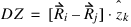
where:
■ is the displacement of marker i in the global coordinate system.
is the displacement of marker i in the global coordinate system. ■ is the displacement of marker j in the global coordinate system.
is the displacement of marker j in the global coordinate system. ■ is the unit vector along the z-axis of marker k.
is the unit vector along the z-axis of marker k. Examples
VARIABLE/1, FUNCTION=DZ(21,11,32)**2
This VARIABLE statement specifies a user-defined, algebraically-determined state variable. Its value is the square of the z-displacement of Marker 21 with respect to Marker 11 as computed in the coordinate system of Marker 32.
See other Displacement measures available.