UV
The UV function returns the unit vector in the direction of an arbitrary vector function expression.
Format
UV(exp)
Arguments
exp | An arbitrary vector function expression. |
Extended Definition
Mathematically, UV is calculated as:
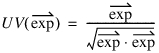
where  is an arbitrary vector function expression.
is an arbitrary vector function expression.Note that Adams Solver (C++) attempts to handle the singular case when the vector function expression is the zero vector. For instance, the expression UV(DXYZ(i,j)) is problematic if markers i and j become coincident. In this case, Adams Solver (C++) will reuse the last valid direction of the unit vector. It is recommended that you avoid computing the unit vector in the direction of expressions that start with a zero value or are persistently zero (such as velocity measurements during a static equilibrium analysis).
Examples
VARIABLE/1, FUN=VXYZ(i,j)*UV(DXYZ(i,j))
VARIABLE/2, FUN=VR(i,j)
Variables 1 and 2 are synonymous. They both compute the separation velocity of markers i and j: the projection of the relative velocity vector on a unit vector in the direction of the position vector between the markers.
See other Vector functions available.