VXYZ
The VXYZ measure returns the difference between the velocity vector of marker i and the velocity vector of marker j resolved in the coordinate system of marker k. All vector time derivatives are taken in the reference frame of marker l.
Format
VXYZ(i[,j][,k][,l])
Arguments
i | The marker whose origin is being measured. |
j | The marker with respect to which the velocity is being measured. If j is not specified, it defaults to the global origin. Specify j = 0 if you want to use this default and you need to specify k or l. |
k | The marker in whose coordinate system the velocity vector is being expressed. If not specified, k defaults to the global coordinate system. Specify k = 0 if you want to use this default and you need to specify l. |
l | The reference frame in which the first-time derivative of the displacement vector is taken. Set l = 0 or omit the argument if you want the time derivatives to be taken in the global reference frame. |
Extended Definition
Mathematically, VXYZ is calculated as follows:
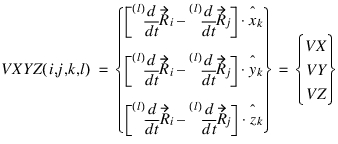
where:
■ is the displacement of marker i in ground.
is the displacement of marker i in ground.■ is the displacement of marker j in ground.
is the displacement of marker j in ground.■ denotes time differentiation in the reference frame of the l marker.
denotes time differentiation in the reference frame of the l marker.Examples
This variable statement:
VARIABLE/1, FUNCTION = VXYZ(21,11) * UV(DXYZ(21,11))
computes the projection of the velocity vector of marker 21 from marker 11 on a unit vector along the line of sight to marker 21 from marker 11. This quantity is also known as the radial velocity and can be written more compactly as:
VARIABLE/1, FUNCTION = VR(21,11)
See other Vector measures available.