WDTXYZ
The WDTXYZ measure returns the difference between the angular acceleration vector (in radians per units of time squared) of marker i and the angular acceleration vector of marker j resolved in the coordinate system of marker k. All vector time derivatives are taken in the reference frame of marker l.
Note: | The values returned by the functions have the same units defined in the UNITS statement except for angular values. All angular values are returned in radians, all angular velocities are returned in radians per units of time (as defined in the UNITS statement), all angular accelerations are returned in radians per units of time squared. Functions RTOD and DTOR may be helpful to create angular expressions involving degrees and radians. For example, the below statements create a constraint to keep the angular velocity WX(8, 9) equal to 2.5 degrees per second. UNITS/SYSTEM = MKS ! Using seconds GCON/1, FUNCTION = WX(8, 9) – 2.5*DTOR ! Convert degrees to radians |
Format
WDTXYZ(i[,j][,k][,l])
Arguments
i | The marker whose acceleration is being measured. |
j | The marker with respect to which the angular acceleration is being measured. If j is not specified, it defaults to the global origin. Specify j = 0 if you want to use this default, and then specify k or l. |
k | The marker in whose coordinate system the angular acceleration vector is being expressed. If not specified, k defaults to the global coordinate system. Specify k = 0 if you want to use this default, and then specify l. |
l | The reference frame in which the first time derivative of the angular velocity vector is taken. Set l = 0 or omit the argument if you want the time derivative to be taken in the global reference frame. |
Extended Definition
Mathematically, WDTXYZ is calculated as:
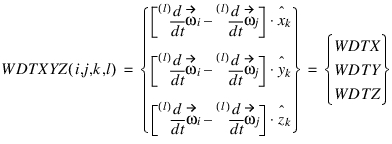
where:
■ is the angular velocity vector of marker i in ground.
is the angular velocity vector of marker i in ground.■ is the angular velocity vector of marker j in ground.
is the angular velocity vector of marker j in ground.■ denotes time differentiation in the reference frame of the l marker.
denotes time differentiation in the reference frame of the l marker.■WDTX is the WDTX measure.
■WDTY is the WDTY measure.
■WDTZ is the WDTZ measure.
■ is the unit vector along the x-axis of marker k.
is the unit vector along the x-axis of marker k.■ is the unit vector along the y-axis of marker k.
is the unit vector along the y-axis of marker k.■ is the unit vector along the z-axis of marker k.
is the unit vector along the z-axis of marker k.Examples
A vector expression for angular acceleration might be used directly in the definition of a vector torque element:
VTORQUE/3, I=310, JFLOAT=9911, RM=310,
, TXYZ = -6.*WDTXYZ(310,9900,310)
, TXYZ = -6.*WDTXYZ(310,9900,310)
See other Vector measures available.