BEAM
The BEAM statement defines a massless elastic beam with a uniform cross section. The beam transmits forces and torques between two markers in accordance with Timoshenko beam theory.
Format
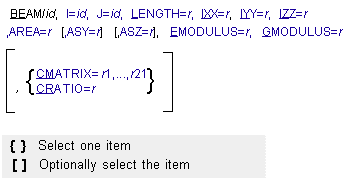
Arguments
AREA=r | Specifies the uniform area of the beam cross section. The centroidal axis must be orthogonal to this cross section. |
ASY=r | Specifies the correction factor (that is, the shear area ratio) for shear deflection in the y direction for Timoshenko beams. 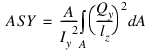 where Qy is the first moment of cross-sectional area to be sheared by a force in the z direction, and lz is the cross section dimension in the z direction. If you want to neglect the deflection due to y-direction shear, ASY does not need to be included in a BEAM statement. Defaults: 0 |
ASZ=r | Specifies the correction factor (that is, the shear area ratio) for shear deflection in the z direction for Timoshenko beams. 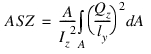 where Qz is the first moment of cross-sectional area to be sheared by a force in the y direction, and ly is the cross section dimension in the y direction. If you want to neglect the deflection due to z-direction shear, ASZ does not need to be included in a BEAM statement. Defaults: 0 Commonly encountered values for the shear area ratio are: Cross-section: (Shear area ratio) Solid rectangular (6/5) Solid circular (10/9) Thin wall hollow circular (2) See also “Roark’s Formulas for Stress and Strain,” Young, Warren C., Sixth Edition, page 201. New York:McGraw Hill, 1989. |
CMATRIX=r1,...,r21 | Establishes a six-by-six damping matrix for the beam. Because this matrix is symmetric, only one-half of it needs to be specified. The following matrix shows the values to input: 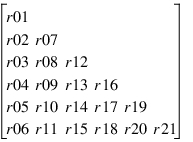 Enter the elements by columns from top to bottom, then by rows from left to right. If you do not use either CMATRIX or CRATIO, CMATRIX defaults to a matrix with thirty-six zero entries; that is, r1 through r21 each default to zero. |
CRATIO=R | Establishes a ratio for calculating the damping matrix for the beam. Adams Solver multiplies the stiffness matrix by the value of CRATIO to obtain the damping matrix. Defaults: 0 |
EMODULUS=r | Defines Young’s modulus of elasticity for the beam material. |
GMODULUS=r | Defines the shear modulus of elasticity for the beam material. |
I=id, J=id | Specifies the two markers between which to define a beam. The J marker establishes the direction of the force components. |
IXX=r | Denotes the torsional constant. This is sometimes referred to as the torsional shape factor or torsional stiffness coefficient. It is expressed as unit length to the fourth power. For a solid circular section, Ixx is identical to the polar moment of inertia,  where r is the radius of the cross-section. For thin-walled sections, open sections, and noncircular sections, you should consult a handbook. |
IYY=r,IZZ=r | Denote the area moments of inertia about the neutral axes of the beam cross sectional areas (y-y and z-z). These are sometimes referred to as the second moment of area about a given axis. They are expressed as unit length to the fourth power. For a solid circular section, Iyy=Izz=  where r is the radius of the cross-section. For thin-walled sections, open sections, and noncircular sections, you should consult a handbook. |
LENGTH=r | Defines the underformed length of the beam along the x-axis of the J marker. |
Extended Definition
To model the effects of a beam, Adams Solver (FORTRAN) uses a linear translational and linear rotational action-reaction force between two markers. The forces the beam produces are linearly dependent on the displacements, rotations, and corresponding velocities between the markers at its endpoints.
The figure below shows the two markers (I and J) that define the extremities of the beam and indicates the twelve forces (s1 to s12) it produces.
Massless Beam
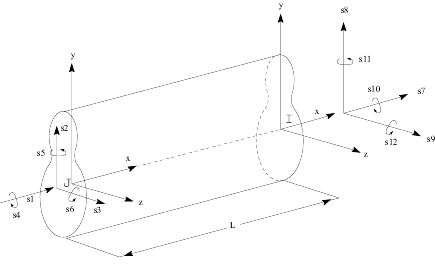
The x-axis of the J marker defines the centroidal axis of the beam. The y-axis and z-axis of the J marker are the principal axes of the cross section. They are perpendicular to the x-axis and to each other. When the beam is in an undeflected position, the I marker has the same angular orientation as the J marker, and the I marker lies on the x-axis of the J marker a distance LENGTH away.
The beam statement applies the following forces to the I marker in response to the relative motion of the I marker with respect to the J marker:
■Axial forces (s1 and s7)
■Bending moments about the y-axis and z-axis (s5, s6, s11, and s12)
■Twisting moments about the x-axis (s4 and s10)
■Shear forces (s2, s3, s8, and s9)
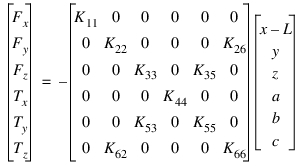
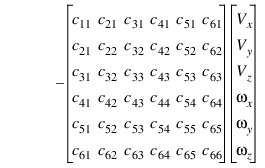
The following constitutive equations define how Adams Solver uses the data for a linear field to apply a force and a torque to the I marker depending on the displacement rotation and velocity of the I marker relative to the J marker.
where:
■Fx, Fy, and Fz are the measure numbers of the translational force components in the coordinate system of the J marker.
■x, y, and z are the translational displacements of the I marker with respect to the J marker measured in the coordinate system of the J marker.
■Vx, Vy, and Vz are the time derivatives of x, y, and z, respectively.
■Tx, Ty, and Tz are the rotational force components in the coordinate system of the J marker.
■a, b, and c are the relative rotational displacements of the I marker with respect to the J marker as expressed in the x-, y-, and z-axis, respectively, of the J marker.
■ ,
,  , and
, and  are the components of the angular velocity of the I marker with respect to the J marker, as seen by the J marker and measured in the J marker coordinate system.
, , and are the components of the angular velocity of the I marker with respect to the J marker, as seen by the J marker and measured in the J marker coordinate system.■Cij are the entries of the damping matrix either specified by the CMATRIX option or computed by using the CRATIO option. All Cij entries default to zero.
Note that both matrices, Cij and Kij, are symmetric, that is, Cij=Cji and Kij=Kji. You define the twenty-one unique damping coefficients when the BEAM statement is written. Adams Solver (FORTRAN) defines each Kij as follows:
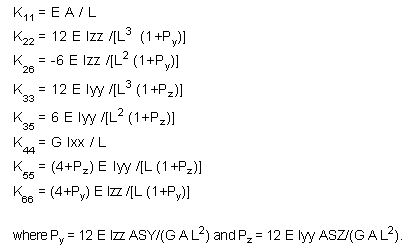
Adams Solver (FORTRAN) applies an equilibrating force and torque at the J marker, as defined by the following equations:
Fj = - Fi
Tj = - Ti - L x Fi
Tj = - Ti - L x Fi
L is the instantaneous vector from the J marker to the I marker. While the force at the J marker is equal and opposite to the force at the I marker, the torque is usually not equal and opposite, because of vector L.
The BEAM statement implements a force in the same way the FIELD statement does, but the BEAM statement requires you to input only the values of the beam’s physical properties, which Adams Solver (FORTRAN) uses to calculate the matrix entries.
Tip: | ■A FIELD statement can be used instead of a BEAM statement to define a beam with characteristics unlike those the BEAM statement assumes. For example, a FIELD statement should be used to define a beam with a nonuniform cross section or a beam with nonlinear material characteristics. ■The beam element in Adams Solver is similar to those in most finite element programs. That is, the stiffness matrix that Adams Solver (FORTRAN) computes is the standard beam element stiffness matrix. ■The USEXP option on the MARKER statement may make it easier to direct the x-axis of the J marker. ■Generally, it is desirable to define the x-axis of the Adams Solver (FORTRAN) beam on the shear center axis of the beam being modeled. |
Caution: | ■The K1 and K2 terms used by MSC.NASTRAN for defining the beam properties using PBEAM are inverse of the ASY and ASZ used by Adams Solver (FORTRAN). ■When the x-axes of the markers defining a beam are not collinear, the beam deflection and, consequently, the force corresponding to this deflection are nonzero. To minimize the effect of such misalignments, perform a static equilibrium at the start of the simulation. ■By definition, the beam lies along the positive x-axis of the J marker. (This is unlike most other Adams Solver force statements, for which the z-axis is the significant axis.) Therefore, the I marker must have a positive x displacement with respect to the J marker when viewed from the J marker. In its undeformed configuration, the orientation of the I and the J markers must be the same. ■The damping matrix that CMATRIX specifies should be positive semidefinite. This ensures that damping does not feed energy into the system. Adams Solver (FORTRAN) does not warn you if CMATRIX is not positive semidefinite. ■When the beam element angular deflections are small, the stiffness matrix provides a meaningful description of beam behavior. However, when the angular deflections are large, they are not commutative; so the stiffness matrix that produces the translational and rotational force components may not correctly describe the beam behavior. If BEAM translational displacements exceed ten percent of the undeformed LENGTH, then Adams Solver issues a warning message. ■By its definition a BEAM is asymmetric. Holding the J marker fixed and deflecting the I marker produces different results than holding the I marker fixed and deflecting the J marker by the same amount. This asymmetry occurs because the coordinate system frame that the deflection of the BEAM is measured in moves with the J marker. |
Examples
A cantilevered stainless steel beam is to be modeled with a circular cross section that has the loading shown in the figure below.
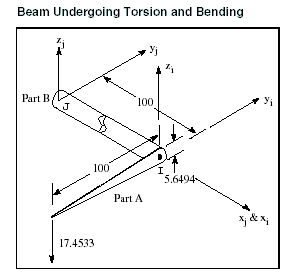
A weight of 17.4533 lbf at the free end of the beam with a 100-inch axial offset in the negative y direction causes torsion to the beam as shown in the figure above. The following statement defines this beam:
BEAM/0201, I=0010, J=0020, LENGTH=100
, IXX=100, IYY=50, IZZ=50, AREA=25.0663
, ASY=1.11, ASZ=1.11, EMOD=28E6, GMOD=10.6E6,
, CRATIO=0.0001
, IXX=100, IYY=50, IZZ=50, AREA=25.0663
, ASY=1.11, ASZ=1.11, EMOD=28E6, GMOD=10.6E6,
, CRATIO=0.0001
The beam lies between Marker 0010 and Marker 0020. The length of the beam is 100 inches; its torsional constant is 100 inch4; its principal area moments of inertia about the y-axis is 50 inch4, and about the z-axis is 50 inch4; its cross-sectional area is 25.0663 inch2; its shear area ratio in the y direction is 1.11; its shear area ratio in the z direction is 1.11; its modulus of elasticity is 28E6 psi; its shear modulus is 10.6 psi; and its damping ratio relative to the stiffness matrix Adams Solver (FORTRAN) calculates is 0.0001. Note that the beam ends belong to different parts.
References
1. Roark's Formulas for Stress and Strain, Young, Warren C., Sixth Edition, page 201. New York: McGraw Hill, 1989.
See other Forces statement available.