UCON
The UCON statement defines a user-written constraint. With a UCON, it is possible to constrain the configuration of the system as well as the motion of the system. Configuration constraints (that is, holonomic constraints) can be:
■Explicit functions of time, in which case, they are referred to as rheonomic.
■Restricted to functions of system displacements, in which case, they are referred to as scleronomic.
Motion constraints (that is, nonholonomic constraints) may be defined in terms of a linear combination of system velocities.
Format
UCON/id, FUNCTION=USER(r1[,...,r30])
[[ ]] Optionally select an item combination |
Arguments
FUNCTION=USER(r1[,...,r30]) | Defines and passes up to thirty constants to a UCOSUB user-written subroutine. These can be part identifiers, variable codes, and other data that the UCOSUB needs to define the constraint (see the UCOSUB subroutine). |
Extended Definition
The UCON statement defines a system constraint as a function of time and as many as thirty variables. Each of these variables must be the displacement or the velocity of a part. For any part at any point in time, six displacements define its position, and six velocities define its motion.
The six displacements are the x, y, and z translations and the three Euler angle rotations. The six velocities are the x, y, and z translational speed and the time derivatives of the three Euler angles. Adams Solver (FORTRAN) measures all of these displacements and velocities at the origin of the principal axes with respect to the global coordinate system. The UCON statement should be used to define only a constraint that is not available in any of the other constraint statements.
Tip: | ■The principal axes are located at the part center of mass. The principal axes of a part are the axes about which products of inertia are zero, that is, for which the inertia matrix is diagonal. ■Adams Solver (FORTRAN) imposes UCONs on the principal coordinate systems of the parts to which they belong. If a part has mass, its principal coordinate system is at its center of mass and is in alignment with the axes of its principal moments of inertia. If products of inertia (xy, xz, or yz) are declared for the IP argument of a PART statement, the principal axes may differ from the center-of-mass marker axes specified with the CM argument. This is because Adams Solver (FORTRAN) changes the Euler angles of the principal axes until the products of inertia disappear. In that case, the origin of the principal axes are located at the origin of the center-of-mass marker axes, but the orientation of the principal axes differ from the orientation of the center-of-mass marker axes. If a part has zero mass, its principal coordinate system is the same as that of its body coordinate system (BCS). |
Caution: | ■The UCON statement should be used only if you are very familiar with Adams Solver (FORTRAN). Velocity-dependent constraints must be expressible in the following form: 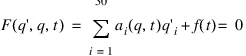 In this equation, the a coefficients must not be velocity dependent. The symbols q’i and ai refer to the ith velocity variable and to its accompanying coefficient. The coefficient can be functionally dependent on displacements and time, but it cannot be dependent on velocities. Note that the equation includes no products involving one velocity variable with another. |
Caution: | ■Inequality constraints cannot be modeled with a UCON statement. ■Because Adams Solver (FORTRAN) applies UCONs to the principal axes of the part and not to the center-of-mass marker, REQUEST statements or the SYSARY or SYSFNC subroutines cannot be used to obtain UCON reaction forces. |
Caution: | ■Adams Solver (FORTRAN) does not warn you if the location of a BCS, as determined by the initial configuration of the part, is inconsistent with the constraint(s) imposed on the part by a UCON statement. Adams Solver (FORTRAN) handles the inconsistency by overriding the initial part configuration and moving the part to conform to the constraint(s) defined in the UCOSUB evaluation subroutine. If you use a UCON statement in the model, you need to check to see if, during initial conditions analysis, Adams Solver (FORTRAN) has altered the location and/or orientation of the part(s) affected by the UCON. One way to do this is to compare the tabular output file for the part(s) initial conditions with the initial part(s) location(s) and/or orientation(s) as defined in the Adams Solver (FORTRAN) dataset or by Adams Solver (FORTRAN) interactive commands. |
Caution: | ■If you use the UCON statement for a velocity-dependent constraint and then use the ABAM integrator to integrate the equations of motion, Adams Solver (FORTRAN) prevents execution. Under these circumstances, use a BDF integrator to integrate the equations of motion. |
See other Constraints available.