UNITS
The UNITS statement sets the appropriate units for an Adams Solver (FORTRAN) analysis. This ensures that force computations, both on input and on output, correctly conforms to your choice of length, mass, and time units.
Format
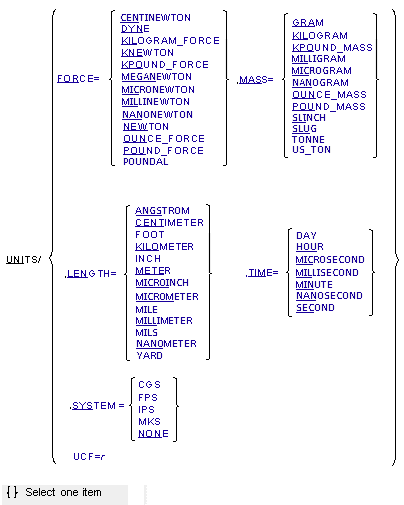
Arguments
FORCE={DYNE,KILOGRAM_FORCE,KNEWTON, KPOUND_FORCE,NEWTON,POUND_FORCE,OUNCE_FORCE} | Selects a predefined unit for forces. Must be used in conjunction with LENGTH, MASS, and TIME. |
LENGTH={CENTIMETER,FOOT,INCH,KILOMETER,METER, MILLIMETER,MILE} | Selects a predefined unit for lengths. Must be used in conjunction with FORCE, MASS, and TIME. |
MASS={GRAM,KILOGRAM,KPOUND_MASS,OUNCE_MASS, POUND_MASS,SLUG} | Selects a predefined unit for masses. Must be used in conjunction with FORCE, LENGTH, and TIME. |
SYSTEM={CGS,FPS,IPS,MKS,NONE} | Selects a predefined units system instead of selecting each unit individually. MKS implies meter, kilogram, second and newton. CGS implies centimeter, gram, second and dyne. FPS implies foot, pound mass, second and pound force. IPS implies inch, pound mass, second and pound force. NONE implies that the dataset is written nondimensionally and that Adams Solver (FORTRAN) sets UCF to 1.0. |
TIME={HOUR,MILLISECONDS,MINUTE,SECOND} | Selects a predefined unit for time. Must be used in conjunction with FORCE, LENGTH, and MASS. |
UCF=r | Specifies a Units Consistency Factor (UCF) when you prefer to work in a system of units not covered by any of the choices listed above. The UCF is the conversion factor from model force units to inertial force units as shown by the following equation. Force • UCF = Mass • Acceleration When using a system of units not covered by any of the choices above, you should use the dimensional analysis equation shown below to determine the correct UCF value to specify.  |
Extended Definition
The UNITS statement sets the appropriate units for an Adams Solver (FORTRAN) analysis and allows Adams View to account for your choice. This ensures that Adams Solver (FORTRAN) both interprets and reports force values in the chosen force units.
In most cases, you select a system of units using the SYSTEM argument or the FORCE, MASS, LENGTH, and TIME arguments. For cases not covered by the predefined choices, specifying the appropriate UCF still allows Adams Solver (FORTRAN) to interpret forces correctly. Adams Solver (FORTRAN) always uses radians as the unit for angular measurements.
To determine the correct UCF, you must solve the following dimensional analysis equation.
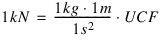
For example, if you want to work in kiloNewtons (kN), kilograms (kg), meters (m) and seconds (s), you would write the following equation:
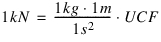
given:

You can substitute these into the equation to get:


If you want to work in tons_force (tf), tons_mass (tm), yard (yd), and minute (min) units you would write the following equation.
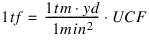
given:

let:
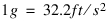
then:
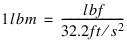
You cna substitute these equations into the equation to get:


Then cancel common terms and solve for UCF:
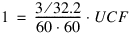

Tip: | Using the UNITS statement with the individual unit arguments or the SYSTEM argument allows Adams View to understand the model's units and give consistent output. Avoid using UCF, if possible. |
Examples
UNITS/FORCE=KILOGRAM_FORCE,
,MASS=KILOGRAM, LENGTH=MILLIMETER, TIME=SECOND
,MASS=KILOGRAM, LENGTH=MILLIMETER, TIME=SECOND
This UNITS statement selects force units of kilogram_force, mass units of kilograms, length units of millimeters, and time units of seconds.
See other Analysis parameters available.