CURVE
The CURVE function evaluates a B-spline or user-written curve that is created with the CURVE statement.
Format
CURVE (alpha, iord, comp, id)
Arguments
alpha | A real variable that identifies the value of the independent parameter,  , at which the CURVE function evaluates the curve. If the curve is a B-spline computed by the CURVE statement, alpha must be in the domain -1 < < 1. If the curve is computed by a CURSUB, alpha must be in the domain MINPAR < < MAXPAR (these are specified in the CURVE statement). , at which the CURVE function evaluates the curve. If the curve is a B-spline computed by the CURVE statement, alpha must be in the domain -1 < < 1. If the curve is computed by a CURSUB, alpha must be in the domain MINPAR < < MAXPAR (these are specified in the CURVE statement). |
iord | An integer variable that specifies the order of the derivative the CURVE function returns. The legal values are: 0 - returns the curve coordinate 1 - returns the first derivative 2 - return the second derivative |
comp | An integer variable that specifies the component that the CURVE function returns. The legal values are: 1 - returns the x coordinate or derivative 2 - returns the y coordinate or derivative 3 - returns the z coordinate or derivative Parameters iord and icomp together allow you to request any one of the following nine return values: 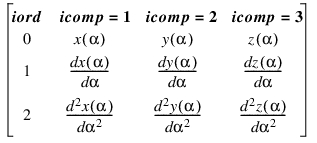 |
id | An integer variable that specifies the identifier of the CURVE statement. |
Examples
VFORCE/1, I=101, JFLOAT=201, RM=99,
, FX=CURVE(.4*TIME - 1, 0, 1, 8)/
, FY=CURVE(.4*TIME - 1, 0, 2, 8)/
, FZ=CURVE(.4*TIME - 1, 0, 3, 8)
, FX=CURVE(.4*TIME - 1, 0, 1, 8)/
, FY=CURVE(.4*TIME - 1, 0, 2, 8)/
, FZ=CURVE(.4*TIME - 1, 0, 3, 8)
This example applies to a VFORCE acting between Markers 101 and 201. The CURVE statement defines the force components as a function of alpha, which varies from -1.0 to 1.0. The term 4*TIME-1 computes the instantaneous value of alpha from the simulation time.
See other Interpolation available.