HAVSIN
The HAVSIN function defines a haversine function. It is used most often to represent a smooth transition between two functions.
Format
HAVSIN (x, x0, h0, x1, h1)
Arguments
x | The independent variable. |
x0 | A real variable that specifies the x value at which the haversine function begins. |
x1 | A real variable that specifies the x value at which the haversine function ends. |
h0 | The initial value of the haversine function. |
h1 | The final value of the haversine function. |
Extended Definition
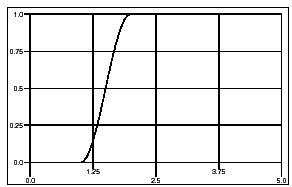
The HAVSIN function is used most often to represent a smooth transition between two functions (see the figure below). As an example, a HAVSIN may be used to smoothly ramp up the motion in a joint from h0 to some constant value h1.
Haversine Function
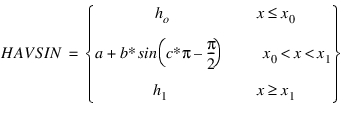
The equation defining HAVSIN is:
a = (h0 + h1)/2
b = (h1 - h0)/2
c = (x - x0)/(x1 - x0)
Tip: | The HAVSIN function behavior is similar to the STEP function. It has a discontinuous second derivative and therefore is not recommended for use in displacement level motions. |
Examples
MOTION/1, JOINT=21, VELOCITY
, FUNCTION=HAVSIN(TIME, 1, 0, 2, 1)
, FUNCTION=HAVSIN(TIME, 1, 0, 2, 1)
This MOTION statement defines a smooth transition in velocity from time 1 to time 2. Note that the motion is specified in velocity rather than displacement.
See other General available.