IC
The IC statement specifies error tolerances and other parameters for the analysis of the initial conditions and for reconciling integrator output.
Format
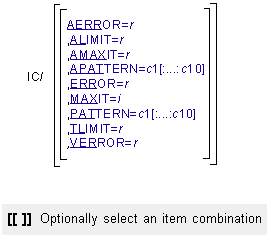
Arguments
AERROR=r | Specifies the maximum acceleration error Adams Solver (C++) is to allow during an initial conditions solution or for reconciling integrator acceleration output. Default: 1.0E-4 Range: AERROR > 0 |
ALIMIT=r | Specifies the maximum angular increment Adams Solver (C++) is to allow while testing trial solutions for a set of consistent initial conditions that satisfy all system constraints. The default units for ALIMIT are radians. To specify ALIMIT in degrees, add a D after the value. Default: 30D Range: ALIMIT > 0 |
AMAXIT=i | Specifies the maximum number of iterations Adams Solver (C++) is to allow for finding accelerations during an initial conditions solution or for reconciling integrator acceleration output. Default: 25 Range: AMAXIT > 0 |
APATTERN=c1[:...:c10] | Specifies as many as ten character strings that together establish the pattern for evaluating the Jacobian matrix during the modified Newton-Raphson solution for the accelerations. For each iteration, T or TRUE indicates that Adams Solver (C++) is to evaluate the Jacobian, and F or FALSE indicates that Adams Solver (C++) is not to evaluate the Jacobian. Thus, cj determines whether or not ADAMS is to evaluate the Jacobian at the jth iteration. If necessary, Adams Solver (C++) repeats the pattern of evaluation until it reaches the maximum number of iterations (AMAXIT). The number of T's or TRUE’s and F’s or FALSE’s together must be at least one and no more than 10. Default: T:T:T:T:T:T:T:T:T:T, that is, to evaluating the Jacobian at every iteration. |
ERROR=r | Specifies the maximum displacement error Adams Solver (C++) is to allow for the assembly process. Default: 1.0E-10 Range: ERROR > 0 |
MAXIT=i | Specifies the maximum number of iterations Adams Solver (C++) is to allow for finding displacements during initial conditions, or when reconciling the position of configuration during integration (interpolate on, or with the WSTIFF integrator), and static analysis. Default: 25 Range: MAXIT > 0 |
PATTERN=ci[:...:c10] | Specifies as many as ten character strings that together establish the pattern for evaluating the Jacobian matrix during the modified Newton-Raphson solution for the displacements. For each iteration, T or TRUE indicates that Adams Solver (C++) is to evaluate the Jacobian, and F or FALSE indicates that Adams Solver (C++) is not to evaluate the Jacobian. Thus, cj determines whether or not ADAMS is to evaluate the Jacobian at the jth iteration. If necessary, Adams Solver (C++) repeats the pattern of evaluation until it reaches the maximum number of iterations (MAXIT). The number of T’s or TRUE’s and F’s or FALSE’s together must be at least one and no more than 10. Default: T:T:T:T:T:T:T:T:T:T, that is, to evaluating the Jacobian at every iteration. |
TLIMIT=r | Specifies the maximum translational increment Adams Solver (C++) is to allow while testing trial solutions during a solution step. Default: 1.0E10 (no limit) Range: TLIMIT > 0 |
VERROR=r | Specifies the maximum velocity error that Adams Solver (C++) is to ignore during an initial conditions solution. Adams Solver (C++) issues a warning if the value of VERROR is exceeded. Adams Solver (C++) issues an error if PREFERENCES/SIMFAIL=STOPCF is chosen. Default: 1.0E-4 Range: VERROR > 0 |
Extended Definition
The IC statement specifies error tolerances and other parameters for the analysis of initial conditions and for reconciling integrator output. By default, WSTIFF reconciles integrator results to be consistent with constraints; GSTIFF does not, unless you set INTERPOLATE=ON.
This statement is used only when requesting a dynamic, static equilibrium, or quasi-static equilibrium analysis, and when one or more of the tolerances and other parameters for the initial conditions analysis from the default values is to be changed.
Use the SIMULATE command to request a dynamic, static equilibrium, or quasi-static equilibrium analysis. Before performing one of these analyses, Adams Solver (C++) automatically does an initial conditions analysis. An initial conditions analysis is not necessary when the system has zero degrees of freedom because the kinematics of the system fully determine its configuration.
The initial conditions analysis ensures that the system satisfies all constraints within the system. If necessary, Adams Solver (C++) moves parts until both parts of each joint are in contact. This analysis involves three separate phases. First, Adams Solver (C++) makes the displacements between all parts and joints in the system physically consistent. This requires the use of Newton-Raphson iteration to solve a set of nonlinear algebraic equations. Once the displacements are consistent, Adams Solver (C++) makes the velocities physically consistent. Since this requires solving a set of linear equations, iteration is not necessary. Finally, Adams Solver (C++) also calculates consistent accelerations and forces. This solution also requires solving a set of nonlinear equations using Newton-Raphson iteration.
When reconciling, the integrator uses the initial conditions solution process at each output step to ensure that velocities, accelerations, and forces are consistent with the system constraints. If you set INTERPOLATE=ON, the integrator also uses the initial conditions solution at each output step to ensure displacements are consistent with the constraints. The IC parameters control those solutions as well as the initial conditions solution.
If you issue neither the IC command nor statement in an Adams Solver (C++) session, the solver uses the default values for AERROR, ALIMIT, AMAXIT, APATTERN, ERROR, MAXIT, PATTERN, TLIMIT, and VERROR when finding initial conditions and reconciling integrator output.
Tip: | Use the ALIMIT and TLIMIT arguments to limit incrementing displacement variables and thus the size of the position change on successive iterations. This tends to prevent Adams Solver (C++) from assembling the mechanism in an undesirable configuration. |
Examples
IC/ALIMIT=10D, ERROR=1.0E-6, MAXIT=45
This statement instructs Adams Solver (C++) to use these values instead of the defaults when performing an initial conditions analysis. It limits the angular increment per iteration to 10 degrees, reduces the displacement error to 1.0E-6, and limits the number of iterations to 45.
See other Analysis parameters available.