OUTPUT
The OUTPUT statement controls the generation of request and graphics files.
The OUTPUT statement has been extended to control generation and format of output files from FEMDATA or REQUEST statements. For example, it lets you generate MATLAB, RPC III and DAC files of Adams Solver (C++) request data.
Format
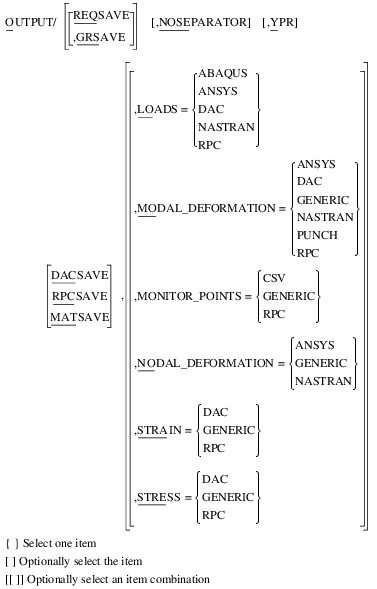
Arguments
ABAQUS | Specifies the output of FEM data to an ABAQUS-readable format. Load data are written out as ABAQUS input commands. |
ANSYS | Specifies the output of FEM data to an ANSYS-readable format. Load data or nodal deformations are written out as ANSYS input commands. Modal deformations are written out to a file format supported by the Adams MSR ANSYS-customized macro, available in Adams Durability |
CSV | Saves all monitor point FEM data to Comma Separator Value (csv) format. This file format can be imported into spreadsheet program like Excel® |
DAC | Specifies the output of FEM data to DAC files. DAC is a file format supported by nCode/nSoft. A DAC file is generated for each component of load, stress or strain, or modal coordinate. |
DACSAVE | Saves all request output in DAC format. If you do not specify DACSAVE, Adams Solver (C++) does not save request data in DAC format. |
GENERIC | Specifies the output of FEM data to a human-readable (ASCII) text file. |
GRSAVE | Saves graphics output in the graphics file so a postprocessor can be used to display graphics. If neither GRSAVE nor GR521SAV is specified, Adams Solver (C++) does not save graphics output in the graphics file. |
LOADS | Controls output of FEM data to the specified format. If you do not specify LOADS, Adams Solver (C++) does not process any FEMDATA/LOADS statements. |
MATSAVE | Saves all request output in MAT file format, a MATLAB file format from Mathworks©. If you do not specify MATSAVE, Adams Solver (C++) does not save request data in MAT file format. |
MODAL_DEFORMATION | Controls output of modal deformation data to the specified format. If you do not specify MODAL_DEFORMATION, Adams Solver (C++) does not process any FEMDATA/MODAL_DEFORMATION statements. |
MONITOR_POINTS | Controls output of monitor point data to specified format. If you do not specify MONITOR_POINTS, no monitor point data will be output. |
NASTRAN | Specifies the output of FEM data to a NASTRAN-readable format. Load data or nodal deformations are written out as NASTRAN input commands. Modal deformations are written out to NASTRAN OUTPUT2 (binary) format. |
NODAL_DEFORMATION | Controls output of nodal deformation data to the specified format. If you do not specify NODAL_DEFORMATION, Adams Solver (C++) does not process any FEMDATA/NODAL_DEFORMATION statements. |
NOSEPARATOR | Specifies that Adams Solver (C++) is not to write separators to the request, graphics, results, and tabular output files when you modify the model topology in the middle of a simulation. You can change the model topology by using interactive commands to activate an element, deactivate an element, change a marker position, or change the type or point of application of a force or constraint during a simulation. When you change the model topology, by default, Adams Solver (C++) writes a separator and new header to the request, graphics, results, and tabular output files. Adams Solver (C++) then writes subsequent simulation output after the new headers. This ensures that the changes are correctly reflected in the output files, but it creates two sets of output that cannot be plotted or animated continuously. The NOSEPARATOR argument prevents Adams Solver (C++) from breaking up the files; instead it creates a continuous set of output that can be plotted and animated from beginning to end. Note: This output may be misleading because the graphics file does not include the effects of any changes in marker, force, or constraint positions during the simulation. While the part motions are correct, the force, joint, and marker graphics remain in their original positions, even if you move them during the simulation. |
PUNCH | Specifies modal deformations to be output to NASTRAN PUNCH (text file) format. |
REQSAVE | Saves request output in the request file so that you can use a postprocessor to display x-y plots. If you do not specify REQSAVE, Adams Solver (C++) does not save the request output in the request file. |
RPC | Saves FEM data output in RPC III format. |
RPCSAVE | Saves all request output in RPC III format. If you do not specify RPCSAVE, Adams Solver (C++) does not save request data in RPC III format. |
STRAIN | Controls output of strain data to the specified format. If you do not specify STRAIN, Adams Solver (C++) does not process any FEMDATA/STRAIN statements. Note: An Adams Durability license is required to output STRAIN. |
STRESS | Controls output of stress data to the specified format. If you do not specify STRESS, Adams Solver (C++) does not process any FEMDATA/STRESS statements. Note: An Adams Durability license is required to output STRESS. |
YPR | Outputs rotational displacement values in yaw, pitch, and roll coordinates, rather than in psi, theta, and phi coordinates. Using dashed lines to represent original orientations and using solid lines to represent new orientations, Figure below shows how these coordinates define a rotational orientation. Figure. Successive Yaw, Pitch, and Roll Rotations 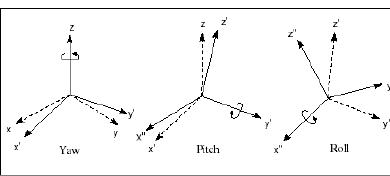 First, Adams Solver (C++) rotates about the z-axis. Next, it makes a negative rotation about the new y-axis (y'), and then about the second new x-axis (x"). If you do not specify YPR, Adams Solver (C++) outputs rotational displacement values in psi, theta, and phi coordinates. YPR only affects rotational displacement output. Adams Solver (C++) always outputs angular velocities and accelerations as vectors, with orthogonal x, y, and z components. |
Extended Definition
The OUTPUT statement controls the generation and format of REQUEST or FEM data. Specifically, the OUTPUT statement controls the following:
■Output of FEMDATA
■Output of Request Data in RPCIII, MAT and DAC Formats
Output of FEMDATA
With LOADS, the ABAQUS, ANSYS, or NASTRAN format option creates a text file of the input commands of the respective FEA package (case control and bulk data in the case of NASTRAN) of all the part forces.
With NODAL_DEFORMATION, the ANSYS or NASTRAN option creates a text file of input commands for defining enforced displacements in the respective FEA package (for example, SPC* cards in the case of NASTRAN).
With MODAL_DEFORMATION, the NASTRAN option produces an OUTPUT2 (NASTRAN binary) file. This file can be imported by NASTRAN for stress recovery on the flexible body with the Adams Durability Modal Stress Recovery DMAP. Note that this file format is machine dependent. NASTRAN will not be able to read the file if it was created on a platform different than the one running NASTRAN.
Alternatively, the PUNCH format option for MODAL_DEFORMATIONS produces a text file that can be imported by NASTRAN for stress recovery. This file format is not as compact as the OUTPUT2 format (see NASTRAN option), but it is machine independent. If NASTRAN is run on a different platform than Adams, the modal deformations can be transferred using this file format for subsequent NASTRAN runs.
Also, with MODAL_DEFORMATIONS, the ANSYS option produces a file of modal deformations. This file can be processed by ANSYS using a custom macro provided by the Adams Durability. Modal deformations can be combined with the modal stress shapes stored in the ANSYS database to recover dynamic stresses in ANSYS using modal superposition.
Output of Request Data in RPCIII, MAT and DAC Formats
You can save request data in RPC III, MAT and DAC format.
■RPC III format- Adams Solver (C++) creates one RPC file of all data components specified in the REQUEST statements.
The RPC III file is named according to the naming convention:
Prefix.rsp
where:
■Prefix is the prefix specified when you set up Adams results.
■MAT file format - Adams Solver (C++) creates one MAT file of all data components specified in the REQUEST statements.
The MAT file is named according to the naming convention:
Prefix.mat
where:
■Prefix is the prefix specified when you set up Adams results.
■DAC format - Adams Solver (C++) can only store one channel of data in a DAC file. Therefore, Adams Solver (C++) creates six DAC files, one per request component. The files are named according to the DAC file naming convention:
prefix_request name_component label.dac
where:
■prefix is the prefix you specified when you set up the Adams results.
■request name is the request name you specified when you created a new request.
■component label is the reserved label assigned to the six components of request data by Adams (one of X, Y, Z, R1, R2, R3).
Examples
OUTPUT/GRSAVE, REQSAVE
This OUTPUT statement causes Adams Solver (C++) to save both graphics and request output.
FEMDATA/1, STRESS, FLEX_BODY=201
, FILE=adams
, NODE=100, 200, 300
OUTPUT/STRESS=DAC
, FILE=adams
, NODE=100, 200, 300
OUTPUT/STRESS=DAC
DAC files are created with the job name adams in the FLEX_BODY_201 subdirectory. Each DAC file contains the time history of one of the six stress components (Sx, Sy, Sz, Txy, Tzx, Tyz) at a node. Since three nodes are specified, a total of eighteen DAC files are created.
OUTPUT/MODAL=NASTRAN, NODAL=GENERIC
A NASTRAN binary file will be created of each FEMDATA statement with modal deformations. No output files will be generated for loads, strain or stress since no OUTPUT specification was given for these types of FEMDATA.
REQUEST/1, DISPLACEMENT, I=201, J= 103, TITLE=REQ01
OUTPUT/DACSAVE
OUTPUT/DACSAVE
This OUTPUT statement causes Adams Solver (C++) to save request output defined in the above REQUEST statement to DAC files only. Adams Solver (C++) creates a total of six DAC files in the current working directory with the following names:
adams_req01_x.dac
adams_req01_y.dac
adams_req01_z.dac
adams_req01_r1.dac
adams_req01_r2.dac
adams_req01_r3.dac
adams_req01_y.dac
adams_req01_z.dac
adams_req01_r1.dac
adams_req01_r2.dac
adams_req01_r3.dac
REQUEST/1, FORCE, I=201, J=103, TITLE=REQ01
REQUEST/2, FORCE, I=202, J=104, TITLE=REQ02
REQUEST/3 FORCE, I=203, J=105, TITLE=REQ03
OUTPUT, RPCSAVE
REQUEST/2, FORCE, I=202, J=104, TITLE=REQ02
REQUEST/3 FORCE, I=203, J=105, TITLE=REQ03
OUTPUT, RPCSAVE
This OUTPUT statement causes Adams Solver (C++) to save request output defined in the three REQUEST statements to an RPC III file. Adams Solver (C++) creates one RPC III file named Adams.rsp, containing 18 channels of data (six per REQUEST statement).
See other Output available.