POINT_MASS
The POINT_MASS statement defines a point mass. Point masses may have mass, position, and translational velocities. They may also have orientation, but this orientation is constant during the course of a simulation. Point masses, unlike parts, may not have inertias or angular velocities. Each POINT_MASS adds three degrees of freedom to a system.
Similarly, translational forces that can be applied to point masses are limited to:
■ACCGRAV
■TRANSLATIONAL SFORCE
■TRANSLATIONAL SPRINGDAMPER
■VFORCE
Format
Arguments
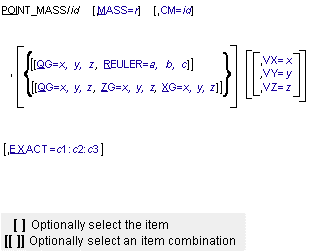
CM=id | Specifies the identifier of the marker that defines the location of the point mass relative to the local body coordinate system (BCS). Default: None Range: Valid fixed MARKER id’s |
EXACT=c1:c2:c3 | Specifies as many as three point mass coordinates that Adams Solver should not change as it iteratively solves for initial conditions which satisfy all constraints. The three coordinates are below. 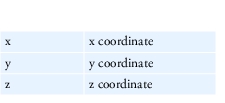 These coordinates can be entered in any order following EXACT. These are not changed by Adams Solver (C++) unless the values specified are inconsistent with initial conditions for a joint or motion. Default: None Range: X, Y, or Z |
MASS=r | Specifies the magnitude of the mass. Default: 0 Range: r > 0 |
QG=x,y,z | Defines the Cartesian initial coordinates of the BCS with respect to the global coordinate system. Default: 0.0, 0.0, 0.0 Range: Any real values |
REULER=a,b,c | Defines the 3-1-3 Euler angles that Adams Solver uses to establish the initial orientation of the BCS with respect to the coordinate system. The a, b, and c rotations are in radians and are, respectively, about the z-axis of ground, the new x-axis, and the new z-axis of the BCS. To input Euler angles in degrees, add a D after each value. Defaults: 0.0, 0.0, 0.0 when REULER, XG, and ZG are omitted Range: Any real values |
VX=x, VY=y, VZ=z | Specifies the initial translational velocities of the CM marker with respect to the ground coordinate system (GCS) along the x-axis (VX), y-axis (VY), and z-axis (VZ) of the global coordinate system. Default: Inexact 0, 0, 0 Range: Any real values |
XG=x,y,z | Defines the coordinates, measured in the global coordinate system, of any point in the positive x-z plane of the part BCS, but not on the z-axis of the part BCS. Default: If ZG is omitted, XG is oriented like the global x-axis Range: Any real values |
ZG=x,y,z | Defines the coordinates measured in the global coordinate system of any point on the positive z-axis of the BCS. Default: If XG is omitted, ZG is oriented like the global z-axis Range: Any real values |
Extended Definition
Although the point mass concept would normally suggest a particle, this is not how a point mass is implemented in Adams. If a particle is subjected to a torque, a singularity ensues. This was not considered a practical behavior for an element in Adams.
Rather than thinking of the point mass as a particle think of it as a rigid body with built-in angular constraints removing any rotational degrees of freedom. It is legal to apply torques to a point mass, and such torques are simply discarded. If one takes care not to apply a torque, the Adams point mass behaves exactly like a particle.
The point mass offers all the computational benefits of a particle without the complications which would arise from forbidding the application of a torque.
Tip: | ■All markers on a point mass that are involved in constraints or are at force application points should be at the point mass CM. Otherwise, Adams Solver issues a warning. Adams Solver does not generate moments due to offsets from CM. ■The CM can be offset from the BCS, but still the markers involved in constraints or at force application points must be at the CM. ■Markers on a point mass to which no constraints or forces are applied (such as markers for only graphics or requests), do not have to be on the CM. ■Function expressions may reference markers associated with point masses. However, Adams Solver rejects expressions that should not refer to point mass markers, such as TM, TX, TY, TZ, and NFORCE. You may use point mass markers in rotational function expressions (such as AX, PSI, WY, and WDTZ), but remember that the orientation of point mass markers is constant and their rotational velocities and accelerations are always zero with respect to the ground coordinate system (GCS). ■Adams Solver permits you to request displacements, velocities, accelerations, and forces between two point mass markers. However, the rotational displacements are always constants, the rotational velocities are always zero, the rotational accelerations are always zero, and the torques are zero. |
See other Inertia and material data statement available.