RESULTS
The RESULTS statement creates a results file that includes all the simulation output from Adams Solver (C++). The results file can be either unformatted (binary) or formatted (ASCII).
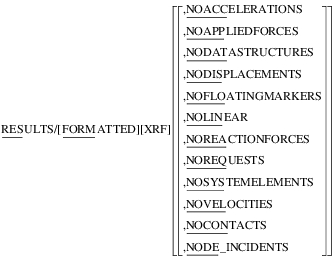
Format
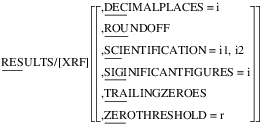
* The following arguments are only available with XRF.

Arguments
DECIMALPLACES=i | This argument is only available with XRF. Specifies how many digits are written after the decimal point for real numbers. The default value is 17 decimal places (full precision for recovery of double-precision numbers). |
FORMATTED | Specifies that the results file is to be a formatted (text) file. The default is an unformatted (binary) file. The formatted results file contains Adams Solver (C++) output in plain text that you can read. You cannot examine an unformatted results file directly. Although the unformatted results file is not user-readable, it is generally preferred for several reasons. The unformatted file is smaller, contains more precise data, and is much quicker for Adams Solver (C++) to write and for a postprocessor to read. Contact incidents can not be part of unformatted (binary) file however the XML type will have that. A formatted file is useful only when you wish to examine the data directly, or when transferring the file between computer systems with incompatible binary formats. |
NOACCELERATIONS | Specifies that the results file is not to include part accelerations. the default is a results file that includes part accelerations. |
NOAPPLIEDFORCES | Specifies that the results file is not to include applied forces. The default is a results file that includes applied forces. |
NODATASTRUCTURES | Specifies that the results file is not to include results from data structures such as variables, plant inputs, plant outputs and user-defined requests. The default is a results file that contains results from data structures. |
NODISPLACEMENTS | Specifies that the results file is not to include part displacements. The default is a results file that includes part displacements. |
NOFLOATINGMARKERS | Specifies that the results file is not to include results for floating markers. The default is a results file that contains results for floating markers. |
NOLINEAR | Specifies that the results file is not to include results from linear analyses. The default is a results file that contains results from linear analyses. |
NOREACTIONFORCES | Specifies that the results file is not to include constraint reaction forces. The default is a results file that includes constraint reaction forces. |
NOREQUESTS | Specifies that the results file not include request output. The default is a results file that includes user-defined request, in the case of a classic results file, or all request data (in the case of an XML-formatted results file (XRF)). |
NOSYSTEMELEMENTS | Specifies that the results file is not to include results for system modeling elements such as user-defined differential equations, linear state equations, general state equations, and transfer functions. The default is a results file that contains results for system modeling elements. |
NOVELOCITIES | Specifies that the results file is not to include part velocities. The default is a results file that includes part velocities. |
NOCONTACTS | Specifies that the results file does not include contact incidents. The default is a results file that includes contact incidents. |
NODE_INCIDENTS | Specifies that the results file includes node incidents for contact on Flex Bodies. The default is a results file that does not include node incidents. |
ROUNDOFF | This argument is only available with XRF. Enables the roundoff feature for real numbers (the default is disabled). The SIGNIFICANTFIGURES argument controls the actual numbers of digits retained during rounding off. |
SCIENTIFICNOTATION=i1,i2 | This argument is only available with XRF. Specifies the boundaries at which the format for real numbers switches from a fixed point format to scientific notation. The values are exponents for the base ten. The default values are -4 and 5, meaning that any number less than or equal to 1.0E-04 or greater than or equal to 1.0E+05 will be written in scientific notation. |
SIGNIFICANTFIGURES=i | This argument is only available with XRF. Specifies how many significant figures of a real number are retained during round off (when round off is enabled). The default is to use ten significant figures. This number is distinct from the number of places actually printed for a real number, which the DECIMALPLACES argument controls. Note: SIGNIFICANTFIGURES includes digits to the left and right of the decimal point. |
TRAILINGZEROS | This argument is only available with XRF. Specifies that trailing zeros are printed for real numbers. The default is not to print trailing zeros. When enabled, all the digits after the decimal point will be printed, whether they are zero or not. When disabled, any zeros at the end of the fractional part of the number will be dropped, leaving the last digit as a non-zero digit. |
XRF | Specifies the format of the results file to be XML. XML (Extensibile Markup Language) is an industry-standard format facilitating structured data representation and web communication. XRF will produce an XML-formatted results file even if the FORMATTED parameter has not been specified. |
ZEROTHRESHOLD=r | This argument is only available with XRF. Specifies the zero threshold value for numbers being written to an output file. If a number has an absolute value smaller than the zero threshold value, then it will be written out as zero. This value is independent of units. |
Extended Definition
The RESULTS statement creates a results file that includes selections of output from an Adams Solver (C++) simulation. This all-purpose file can contain all the simulation output from Adams Solver (C++). The results file can contain any combination of the following information:
■Displacements - Displacements of the BCS with respect to ground and resolved in the ground coordinate system (GCS).
■Velocities - Velocities of the the BCS with respect to ground and resolved in the GCS.
■Accelerations - Accelerations of the BCS with respect to ground and resolved in the GCS.
■Reaction forces - Forces on the I marker required to enforce each constraint, resolved in the GCS.
■Applied forces - Forces on the I marker applied by Adams Solver (C++) force elements, resolved in the GCS.
■Data structures - Values computed for data structures such as variables, plant inputs, plant outputs, and requests defined by expressions in the dataset or by a user-written REQSUB.
■System elements - Inputs, outputs, state variables, and state derivatives defined by system modeling elements such as user-written differential equations, linear state equations, general state equations, and transfer functions.
■Tires - Displacements, velocities, accelerations, forces, and other information about tires.
■Floating markers - Displacements of floating markers.
■Linear - Eigenvectors, eigenvalues, and state matrices computed by a linear analysis invoked by the LINEAR command.
■Contact Incidents - Values computed for individual contact points on Rigid and Flex Bodies in contact.
■Node incidents - Values computed for Flex Body nodes on Flex Bodies in contact.
Tip: | The title specified in the COMMENT argument helps identify the results file. If you do not include the COMMENT argument in the RESULTS statement, Adams Solver (C++) uses a blank line for the title of the results file. Because results files can contain all the information generated by Adams Solver (C++) during a simulation, they may become quite large. The NO... arguments should be used to remove unwanted output and conserve disk space. |
Caution: | The NODATASTRUCTURES argument has superseded the old NOUSERRESULTS argument and the NOSYSTEMELEMENTS argument has superseded the old NODIFF argument. Including Node Incidents for Flex Body Contact may generate a very large results file. |
Examples
RESULTS/FORMATTED, NODATASTRUCTURES, NOSYSTEMELEMENTS
RESULTS/NODISPLACEMENTS, NOVELOCITIES
,NOACCELERATIONS, NODATASTRUCTURES
,NOSYSTEMELEMENTS, NOFLOATINGMARKERS
RESULTS/NODISPLACEMENTS, NOVELOCITIES
,NOACCELERATIONS, NODATASTRUCTURES
,NOSYSTEMELEMENTS, NOFLOATINGMARKERS
See other Output available.