SPRINGDAMPER
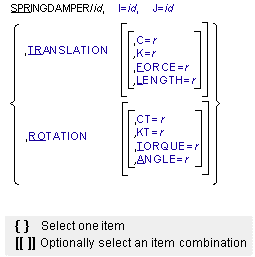
The SPRINGDAMPER statement applies a rotational or a translational springdamper between two markers.
Format
Click the argument for a description.
Arguments
ANGLE=r | Defines the reference angle for the torsional spring. If the reference torque of the spring is zero, ANGLE equals the free angle. Adams Solver (C++) assumes ANGLE is in radians unless a D is added after the value. Default: 0 |
C=r | Specifies the viscous damping coefficient for the force. The force due to damping is zero when the system is at rest. Range: C > 0 |
CT=r | Specifies the viscous damping coefficient for the torque. The torque due to damping is zero when the system is at rest. CT must be in units of torque per radian per unit of time. Range: CT > 0 |
FORCE=r | Specifies the reference force at LENGTH. Default: 0 |
I=id, J=id | Specifies the identifiers of the two markers between which the force or the torque is to be exerted. |
K=r | Specifies the spring stiffness coefficient for the force. Range: K > 0 |
KT=r | Specifies the spring stiffness coefficient for the torque. KT must be in units of torque per radian. Range: KT > 0 |
LENGTH=r | Defines the reference length for the spring. If the reference force of the spring is zero, LENGTH equals the free length. Range: LENGTH > 0 Default: 0 |
ROTATIONAL | Designates a rotational springdamper. |
TORQUE=r | Specifies the reference torque of the torsional spring at ANGLE. Default: 0 |
TRANSLATIONAL | Designates a translational springdamper. |
Extended Definition
The SPRINGDAMPER statement applies a rotational or a translational springdamper between two markers. For a rotational springdamper, the z-axis of the I marker and the z-axis of the J marker must be parallel and must point in the same direction.
Because the springdamper force is always an action-reaction force, the direction of the translational force is along the line segment connecting the I and the J markers. Thus, if the force is positive, the markers experience a repelling force along this line, and if the force is negative, the markers experience an attracting force. The magnitude of the translational force applied to the parts containing the two markers is linearly dependent upon the relative displacement and velocity of the two markers. The following linear constitutive equation describes the force applied at the I marker:
Fa = -C (db/dt) - K(b-LENGTH) + FORCE
The force value is the force on the I marker applied by the J marker; the force on the J marker is equal and opposite. The term b is the distance between the I and the J markers. Adams Solver (C++) assumes that b is always greater than zero. Adams Solver (C++) automatically computes the terms db/dt and b. The following linear constitutive equation describes the torque applied at the I marker:
Ta = -CT (da/dt) - KT(a-ANGLE) + TORQUE
The torque value is applied to the I marker about the positive z-axis of the I marker; the torque on the J marker is equal and opposite to the torque on the I marker. The right-hand rule defines a positive torque. The term a is the angle of the I-marker x-axis relative to the J-marker x-axis, measured about the J-marker z-axis. Adams Solver (C++) takes into account the total number of complete rotations. Adams Solver (C++) automatically computes the terms da/dt and a.
Caution: | ■If the z-axis of the I marker is not parallel to, and/or not pointed in the same direction as, the z-axis of the J marker for a rotational springdamper, the results are unpredictable. ■Since the line-of-sight method determines the direction of a translational springdamper force, the I and the J markers cannot be coincident. |
Examples
SPRINGDAMPER/012, I=25, J=30, K=5, C=.1, L=.01
, TRANSLATION
, TRANSLATION
This SPRINGDAMPER statement describes a force that Marker 30 applies to Marker 25. Marker 25 also applies a force of equal magnitude and opposite direction to Marker 30. The argument TRANSLATION indicates that this is a translational springdamper, rather than a rotational one. Therefore, the magnitude of the force is proportional to the spring free length, to the distance between the two markers, and to the time rate of change of the distance between the two markers. The L argument indicates that the spring free length is 0.01 length units (L is the free length because the FORCE argument defaults to zero). The spring constant K is 5 force units per unit length, and the damping constant C is 0.1 force units-seconds per unit length.
See other Forces available.