Contact Parameters for Parts with Small Mass
This document gives a method for estimating contact stiffness and damping parameters in Adams for parts with small mass.
The default contact stiffness and damping coefficients in Adams are:
■Stiffness = 1.0E+05 N/mm
■Damping = 10.0 N-s/mm
These coefficients were chosen for parts whose mass is on the order of 1.0 Kg and which are made of steel. Call this part the "default part".
For parts with small mass these coefficients should be reduced to optimize Adams Solver performance and to minimize the chance of simulation failure.
In the following discussion, assume that:
■M = Part mass
■R = Average dimension (size) of part (order of magnitude is sufficient)
■g = gravitational acceleration
■G = G force (1 G = M*g)
Since steel has a density of about 8000 Kg/m^3, the default part would have a radius of about 30 mm (assuming it is spherical).
The expression for the contact spring force is:

where:
■F = Contact force
■K = Contact Stiffness
■x = penetration
■e = exponent (default value in Adams is 2.2)
We would like to calculate the contact force in G's on the default part when its penetration is 0.1% of its radius:

We choose a penetration of 0.1% because most well behaved contact models do not exceed this amount.
To compute the appropriate stiffness for a small part, we specify that it should experience the same G force when it has a penetration of 0.1% of its radius.
Assume the following small part properties:
■M = 4.0e-06 Kg
■R = 1 mm
■e = 2.2
We need to solve the following equation for K:
5*M*g = K*(0.001)^2.2
We get:

When both parts in contact are moving, the reduced mass may give a more accurate estimate of stiffness.
The reduced mass is given by:
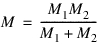
The contact damping coefficient for small parts should be calculated using critical damping.
The expression for critical damping is:

For the small part given above, the damping is:

The values for stiffness and damping are order of magnitude estimates. They can be tuned further (via experiment) to refine performance.