numeric_results create linear_equation
■Have the same number of elements. Otherwise, Adams View issues an error and does not execute the command.
■Be from the same domain: either the time domain or the frequency domain. Otherwise, Adams View issues an error and does not execute the command.
If the two components are complex, the new component will be complex. A component containing the magnitude of the new component is also created and is named name_MAGNITUDE. For example, if the new component is named X, the magnitude component will be named X_MAGNITUDE.
Format:
numeric_results create linear_equation | |
|---|---|
a_multiplier = | real |
b_multiplier = | real |
new_result_set_component_name = | new result_set |
result_set_component_names = | existing result set components |
units = | type of units |
Example:
numerical_results create linear_equation & | |
|---|---|
a_multiplier = | (2*365+7.2) & |
b_multiplier = | 25.7 & |
new_result_set_component_name = | dingdong.bell & |
result_set_component_name = | res101.x, res102.y |
Description:
Parameter | Value Type | Description |
|---|---|---|
A_multiplier | Real | The A_MULTIPLIER parameter is used as a constant coefficient in the linear_equation operation for manipulating numeric results. The linear equation is of the form: A*X + B*Y = Result Where A corresponds to the A_MULTIPLIER. |
B_multiplier | Real | The B_MULTIPLIER parameter is used as a constant coefficient in the linear_equation operation for manipulating numeric results. The linear equation is of the form: A*X + B*Y = Result where B corresponds to the B_MULTIPLIER. This parameter is optional and if not entered, it will default to 1.0. If entered, the B_MULTIPLIER must be a real number. |
new_result_set_component_name | New Result Set Name | Identifies the new result set component. |
result_set_component_names | Existing Result Set Components | Identifies two result set components on which to perform the operation. |
Units | No_units, Calculate, Length, Angle, Mass, Density, Time, Area, Volume, Velocity, Acceleration, Angular_velocity, Angular_acceleration, Inertia, Area_inertia, Damping, Stiffness, Torsion_stiffness, Torsion_damping, Force, Torque, Pressure, Force_time, Torque_time | Specifies the type of units to be used for the new result set component. Once you set the unit type, Adams View can perform the proper unit conversion on the data. |
Extended Definition:
1. The hierarchy of a model's results is shown below with the components of a result set under the result set:
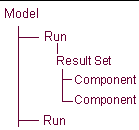
If you want to store the component:
■In an existing result set, the name must include the result set. For example, assume you have a request file called SHIFT.REQ, and it contains the result set REQ1. If you want to store the new result set component in result set REQ1 with the component name NEW, enter:
.SHIFT.REQ1.NEW (It is not necessary to include .SHIFT., if SHIFT is the current analysis_name).
■In a new results set, named REQ99, for example, in the analysis run SHIFT, enter .SHIFT.REQ99.NEW. The number of components to be stored is inferred by the number of components named in this parameter. You can enter multiple names, separated by commas (,).
The component name must be unique, even though it can be stored in an existing result set. A result set name can be of any length and any combination of alphanumeric characters. The leading character must be a letter.
Result sets are associated with an analysis and can be identified as such. A result set associated with request 101 from an analysis named test is often referred to as .test.req101.
The table below illustrates the default names assigned to result sets and result set components, read from request (.req) and results (.res) files.
Result set type | Result set name | Component names | File that result is from |
|---|---|---|---|
part | PARxxx... | x y z e1 e2 e3 e4 mag vx vy vz wx wy wz accx accy accz wdx wdy wdz | results file |
diff | DIFxxx... | q dq | results file |
joint | JOIxxx... | fx fy fz tx ty tz fmag tmag | results file |
jprim | JPRxxx... | fx fy fz tx ty tz fmag tmag | results file |
motion | MOTxxx... | fx fy fz tx ty tz fmag tmag | results file |
gear | GEAxxx... | fx fy fz | results file |
coupler | COUxxx... | fx1 fy1 fz1 tx1 ty1 tz1 fmag1 tmag1 fx2 fy2 fz2 tx2 ty2 tz2 fmag2 tmag2 fx3 fy3 fz3 tx3 ty3 tz3 fmag3 tmag3 | results file |
sforce | SFOxxx... | fx fy fz tx ty tz fmag tmag | results file |
spring damp | SPRxxx... | fx fy fz tx ty tz fmag tmag | results file |
bushing | BUSxxx... | fx fy fz tx ty tz fmag tmag | results file |
beam | BEAxxx... | fx fy fz tx ty tz fmag tmag | results file |
field | FIExxx... | fx fy fz tx ty tz fmag tmag | results file |
user request | UREQxxx... | u1 u2 u3 u4 u5 u6 u7 u8 | results file |
request | REQxxx... | x y z r1 r2 r3 mag amag | request file |
ucon | (not implemented) |
2. If the value for the “units” parameter is calculate, Adams View tries to determine the units to use for this operation. For example, if velocities are added (length/time), then the calculated “units” parameter for the new result set component is velocity (length/time). If the derivative of a velocity is taken, the calculated “units” parameter is acceleration (length/time**2).
Adams View can only handle calculated units with a maximum exponent for the base units (force, length, mass, time) of plus or minus four. For example, if a result set component with the units (length/time**3) is multiplied with a result set component having the same units, it gives the calculated units (length**2/time**6). Because the exponent of time is greater than four, Adams View uses no_units and issues a warning.
Values are: no_units, calculate, length, angle, mass, density, time, area, volume, velocity, acceleration, angular_velocity, angular_acceleration, inertia, area_inertia, damping, stiffness, torsion_stiffness, torsion_damping, force, torque, pressure, force_time, torque_time.