simulation single_run vibration solve
Vibration analysis is a frequency domain simulation of Adams models. This simulation can be a normal modes analysis in which the Eigenvalues and mode shapes for the model are computed. The frequency domain simulation can also be a forced response analysis using the input and output channels along with the vibration.
This is only available when you have Adams Vibration.
Format:
simulation single_run vibration solve | |
|---|---|
model_name = | existing model name |
eigen_name = | new eigen |
state_matrices_name = | new state_matrices_name |
plant_input_name = | existing plant_input |
plant_output_name = | existing plant_output |
plant_state_name = | existing_plant_state |
reference_marker = | existing marker |
number_of_modes = | integer |
Description:
Parameter | Value Type | Description |
|---|---|---|
model_name | Existing Model | Specifies an existing model. |
eigen_name | New Eigen | Enter the name of an eigensolution. The eigensolution must be in a new eigen. |
state_matrices_name | New State_matrices | Enter a new name for the matrix data element that defines the state transition matrix for the linear system. |
plant_input_name | Existing Plant_input | Specifies the plant input that Adams View uses as plant inputs in the state matrices computation. |
plant_output_name | Existing Plant_output | Specifies the plant output that Adams View uses as plant outputs in the state matrices computation. If you do not specify a plant output, Adams View does not output the C and D matrices. |
plant_state_name | Existing Plant_state | Specifies a plant state to be used to define a set of states that are to be used in the linearization scheme. |
reference_marker | Existing Marker | Specifies the reference marker |
number_of_modes | Integer | If you do not specify the number of modes you want to compute, Adams Vibration automatically chooses a suitable number of modes based on the model size. |
Extended Definition:
1. You may identify a model by typing its name or by picking it from the screen. If the model is not visible on the screen, you must type the name.
You may also find it convenient to type the name even if the model is displayed. You must separate multiple model names by commas.
If the model is visible in one of your views, you may identify it by picking on any of the graphics associated with it. You need not separate multiple model picks by commas.
2. If you do not specify a plant input, Adams View does not output the B and D matrices.
3. Plant output defines the set of measured outputs from the system and Plant input defines a set of inputs to the mechanical system. Adams Linear linearizes the system equations to the following form:
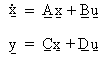
where:
■x is the linearized system state array.
■u is the array of system inputs defined by plant input.
■y is the array of system outputs defined by plant output.
This form is commonly referred to as the state-space form of the system equations in control theory. Adams Solver outputs the A, B, C, and D matrices for use in a control-system design or any other linear system analysis software. If only the A matrix is required, plant input and plant output are not necessary.
4. Adams Linear requires a minimum representation of the system to generate the state matrix from which eigenvalues can be computed. For non-stationary systems, the state matrix is a function of the states used to linearize the system. In Adams Solver (C++), you can define a set of states that are to be used in the linearization scheme. You can specify as many states as there are degrees-of-freedom. If a smaller set of states are provided, then the system will fill in by choosing a set of internally available states for the ones that were not explicitly specified. If too many states are specified, Adams Solver identifies and discards the redundant states.
Plant states are a list of variables. The variables contain expressions that specify the states that are to be used in linearizing the system. Plant state objects are defined in the model. The LINEAR command can instruct Adams Solver (C++) to use a specific plant state object for generating the linear model. A model can contain any number of plant state objects. You can use any one of them with the LINEAR command.
5. The plant outputs with the plant inputs, variables, arrays, transfer functions, linear state equations, and general state equations define the interface between Adams and control design and analysis packages such as MATRIXx and MATLAB.
As shown below, plant inputs and outputs act as socket for input and output to your controller, organizing the variable wires.
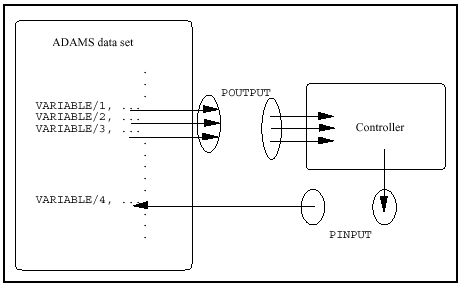
Adams Linear uses plant inputs and outputs to identify which variables to consider system inputs and outputs when generating state matrices. A control design program can use these matrices to design a controller for the system. The resulting controller can then be included in the model using variables, arrays, transfer functions, linear state equations, or general state equations.