LOC_RELATIVE_TO
Returns an array of three numbers representing a location, by transforming a specified location that is relative to a coordinate system object.
Format
LOC_RELATIVE_TO (Location, Frame Object)
Arguments
Location | Array of numbers specifying a location expressed in a coordinate system object. |
Frame Object | Coordinate system object. |
Example
In the following illustration, the LOC_RELATIVE_TO function returns an array of three numbers representing a location:
Function | LOC_RELATIVE_TO({16,8,0}, marker_2) |
Result | -4, 22, 0 |
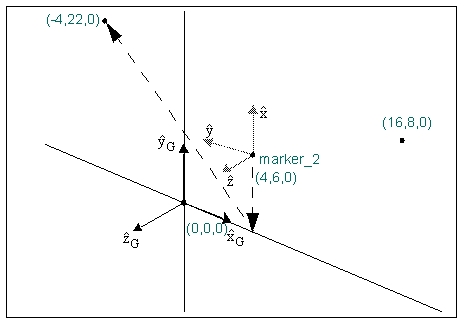
Notes: | Special care should be taken when using the LOC_RELATIVE_TO() function when it involves nested expressions as arguments involving parameters of database entities such as markers. A marker's location is stored relative to the coordinate system of the part that owns the marker and all part locations are stored relative to the coordinate system of the model that owns the parts. So any expression involving LOC_RELATIVE_TO which belongs to the marker database entity will automatically return the location relative to the coordinate system of the part that owns the marker. Consider the following example in which the node_id parameter of a flexible body f1 is parameterized using the following expression: (LOC_TO_FLEXBODY_NODEID(.mod1.f1, LOC_RELATIVE_TO({0.0, 0.0, 0.0}, .mod1.tst))) If this expression is evaluated using the Function Builder, the results produced will be different from the actual evaluation of the node_id expression in the database. This is because the expression evaluation is always relative to the parent expression. In the case of the function builder expression evaluation, there is no parent expression, hence the LOC_RELATIVE_TO() function will return the global location whereas when the same expression is evaluated in the database, the LOC_RELATIVE_TO() will return the location relative to the flexible body f1 which is the parent of the node_id. An alternative to LOC_RELATIVE_TO() in these situations would be to use LOC_LOC() specifying 0 as the third argument as shown below: (LOC_TO_FLEXBODY_NODEID(.mod1.f1, LOC_LOC({0.0, 0.0, 0.0}, .mod1.tst,0))) In this case the location returned by LOC_LOC() will always be without any parent reference frame and hence will return consistent values when evaluated using the function builder or in the database. |