ORI_ALIGN_AXIS_EUL
Returns an orientation that aligns one axis of a coordinate system object with an axis of another. It only aligns one axis and leaves the others in undefined orientations.
Format
ORI_ALIGN_AXIS_EUL (Orientation, Axis Spec)
Arguments
Orientation | An orientation that defines the axes about which the coordinate system object is to be oriented. |
Axis Spec | A character string defining the type of alignment. All of the valid strings are xx, xy, xz, yx, yy, yz, zx, zy, zz, x+x, x+y, x+z, y+x, y+y, y+z, z+x, z+y, z+z, x-x, x-y, x-z, y-x, y-y, y-z, z-x, z-y, and z-z. The first character defines the axis of the result. The last character defines the axis of the frame to which the result is aligned. For example, xy aligns the x-axis of the result with the y-axis of the coordinate system object. You can insert either “-” or “+” as the middle character. For example, if you insert “-” as in z-z, this indicates that the z-axis of the result is to be aligned in the opposite direction of the z-axis in frame. The Axis Spec parameters xx, x+x, yy, y+y, zz, and z+z are identity values, resulting in the global orientation of the coordinate system object. You can, however, compute this orientation more efficiently by using the function ORI_GLOBAL. |
Example
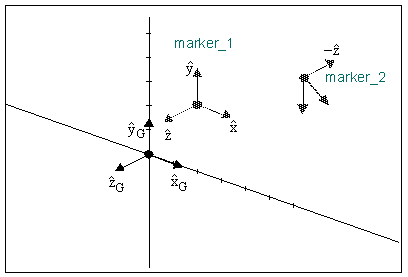
In the following illustration, the ORI_ALIGN_AXIS_EUL function returns all the angles of rotation associated with a body-fixed 313 rotation sequence:
Function | ORI_ALIGN_AXIS_EUL({8,10,0}, “z-z”) |
Result | 188, 170, 90 |