ORI_MIRROR
Returns an orientation by performing a mirroring of the given orientations that reflect the specified axes.
Format
ORI_MIRROR (Body Fixed 313 Angles, Frame Object, Plane Name, Axes Name)
Arguments
Body Fixed 313 Angles | Array of body-fixed 313 Euler rotation sequences, expressed in a coordinate system object. |
Frame Object | Coordinate system object that defines the plane of reflection. |
Plane Name | Character string selecting one of three planes in the coordinate system object. The only possible values are: xy, yx, xz, zx, yz, and zy (character case is insignificant). Character order is insignificant; that is, xy is the same as yx. |
Axes Name | Character string indicating which axes to mirror. The only possible values are: xy, yx, xz, zx, yz, and zy (character case is insignificant). Character order is insignificant; that is, xy is the same as yx. |
Example
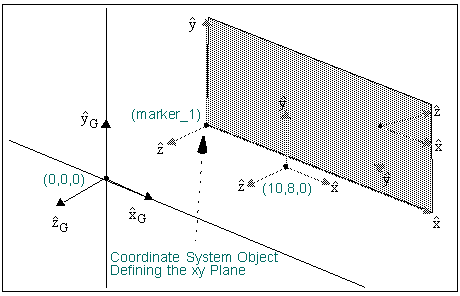
In the following illustration, the ORI_MIRROR function returns an orientation, as specified:
Function | ORI_MIRROR({{10,8,0}}, marker_1, “xy”, “xy”) |
Result | 190, 8, 180 |
Note: | Because complete mirroring would change the right-handedness of the mirrored coordinate system object, only partial mirroring is possible. To perform partial mirroring, you must choose two axes to be mirrored, with the remaining axis pointing in the direction required to maintain a right-handed system. |