ORI_PLANE_MIRROR
Returns a sequence of body-fixed 313 Euler rotations by performing a mirroring of orientations. Using an orientation, ORI_PLANE_MIRROR produces a new sequence describing an orientation that mirrors the specified axes.
Format
ORI_PLANE_MIRROR (Angles, Plane Point Locations, Axes Names)
Arguments
Angles | Array of body-fixed 313 Euler rotation sequences expressed in the global coordinate system. |
Plane Point Locations | 3x3 matrix providing three non-colinear points described in a plane. The points are expressed in the global coordinate system. |
Axes Names | Character string indicating which axes to mirror. xy, yx, xz, zx, yz, and zy are the only possible values (character case is insignificant). Character order is insignificant; that is, xy is the same as yx. |
Examples
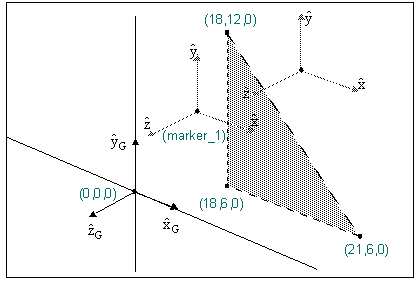
In the following illustration, the ORI_PLANE_MIRROR function returns a sequence of body-fixed 313 Euler rotations:
Function | ORI_PLANE_MIRROR({marker_1.orientation},{{18,6,0},{18,12,0},{21,6,0}}, "xy") |
Result | 0, 0, 0 |
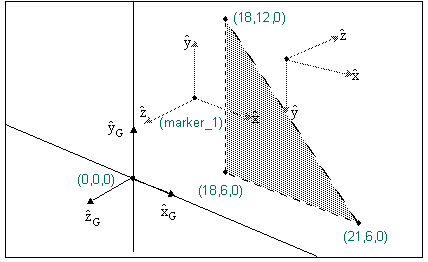
In the following illustration, the ORI_PLANE_MIRROR function returns a sequence of body-fixed 313 Euler rotations:
Function | ORI_PLANE_MIRROR ({marker_1.orientation}, {{18,6,0}, {18,12,0},{21,6,0}}, "yz") |
Result | 180, 180, 0 |
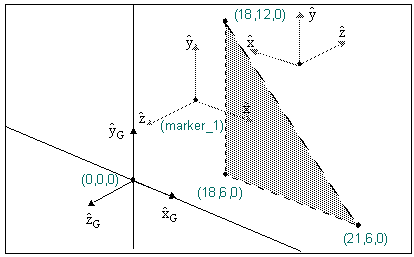
In the following illustration, the ORI_PLANE_MIRROR function returns a sequence of body-fixed 313 Euler rotations:
Function | ORI_PLANE_MIRROR({marker_1.orientation},{{18,6,0},{18,12,0},{21,6,0}}, "xz") |
Result | 0, 180, 0 |
Note: | Because complete mirroring would change the right-handedness of the mirrored coordinate system object, only partial mirroring is possible. To perform partial mirroring, you must choose two axes to be mirrored, with the remaining axis pointing in the direction required to maintain a right-handed system. |
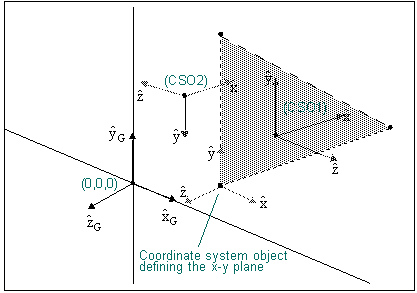
In the example that follows, assume an orientation (CSO1) that points z to the right, x to the back, and y up. Reflecting this orientation about the x-y plane (which is vertical and goes front to back), while specifying a reflection (CSO2) of the xz axes causes z to point to the left, x to the back, and y down.