Translational Torque Vector (TXYZ)
The TXYZ measure returns the net translational torque vector acting on marker i, represented in the coordinate system of marker k. All force and constraint elements acting between markers i and j are included in the calculation of the torque. If j is not specified, TXYZ measures the sum of all force and constraint elements acting on marker i. If k is not specified or if k=0, the torque is represented in the GROUND coordinate system. To specify k without specifying j, use j=0.
Format
TXYZ(i[,j][,k])
Arguments
Applied To Marker (i) | An integer that specifies the identifier of the marker at which the magnitude of the net torque is to be calculated. |
Applied From Marker (j) | A second integer that specifies a marker identifier. All forces acting between the [i,j] pair are to be included in the calculation. Set j = 0 or do not specify if you are interested in all forces acting on marker i. |
Along Marker (k) | An integer that specifies the identifier of a marker (coordinate system) in which the x-component of the torque is to be returned. k defaults to the global coordinate system when it is not specified. |
Extended Definition
Mathematically, TXYZ is calculated as:
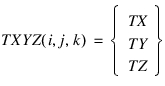
where:
■TX is the Sum of Torques About X (TX) measure.
■TY is the Sum of Torques About Y (TY) measure.
■TZ is the Sum of Torques About Z (TZ) measure.
Examples
The total torque on marker 5, resolved on the x-axis of marker 4.
VARIABLE/1, FUN=TXYZ(5)*UVX(4)
which is alternatively available as TX(5,0,4).