Difference between acceleration vectors (ACCXYZ)
The ACCXYZ measure returns the difference between the acceleration vector of marker i and the acceleration vector of marker j resolved in the coordinate system of marker k. All vector time derivatives are taken in the reference frame of marker l.
Format
ACCXYZ(i[,j][,k][,l])
Arguments
Applied To Marker (i) | The marker whose acceleration is being measured. |
Applied From Marker (j) | The marker with respect to which the acceleration is being measured. If j is not specified, it defaults to the global origin. Specify j = 0 if you want to use this default, then specify k or l. |
Along Marker (k) | The marker in whose coordinate system the acceleration vector is being expressed. If not specified, k defaults to the global coordinate system. Specify k = 0 if you want to use this default, then specify l. |
Reference Frame (l) | The reference frame in which the second time derivative of the displacement vector is taken. Set l = 0 or omit the argument if you want the time derivative to be taken in the global reference frame. |
Extended Definition
Mathematically, ACCXYZ is calculated as follows:
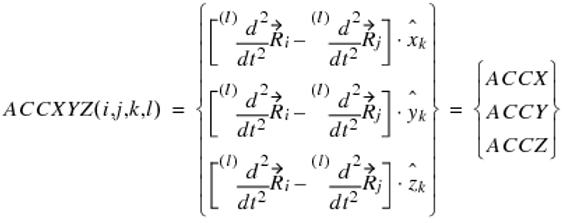
where:
■ is the displacement of marker i with respect to the global origin.
is the displacement of marker i with respect to the global origin.■ is the displacement of marker j with respect to the global origin.
is the displacement of marker j with respect to the global origin.■ denotes two time differentiations in the reference frame of the l marker.
denotes two time differentiations in the reference frame of the l marker.■ACCX is the Acceleration Along X (ACCX) measure.
■ACCY is the Acceleration Along Y (ACCY) measure.
■ACCZ is the Acceleration Along Z (ACCZ) measure.
■ is the unit vector along the x-axis of marker k.
is the unit vector along the x-axis of marker k.■ is the unit vector along the y-axis of marker k.
is the unit vector along the y-axis of marker k.■ is the unit vector along the z-axis of marker k.
is the unit vector along the z-axis of marker k.Examples
Unlike VR, the Adams function expression language does not provide support for radial acceleration (or separation acceleration), ACCR. The following variable shows how this quantity could be computed.
VARIABLE/1, FUNCTION = ACCXYZ(21,11) * UV(DXYZ(21,11))