Using the Webpage Job Monitor with Adams View
1. The files required for this tutorial can be found in the Adams installation at: <install_dir>\aexplore\examples\aview. Copy them to your working directory.
2. Start Adams View.
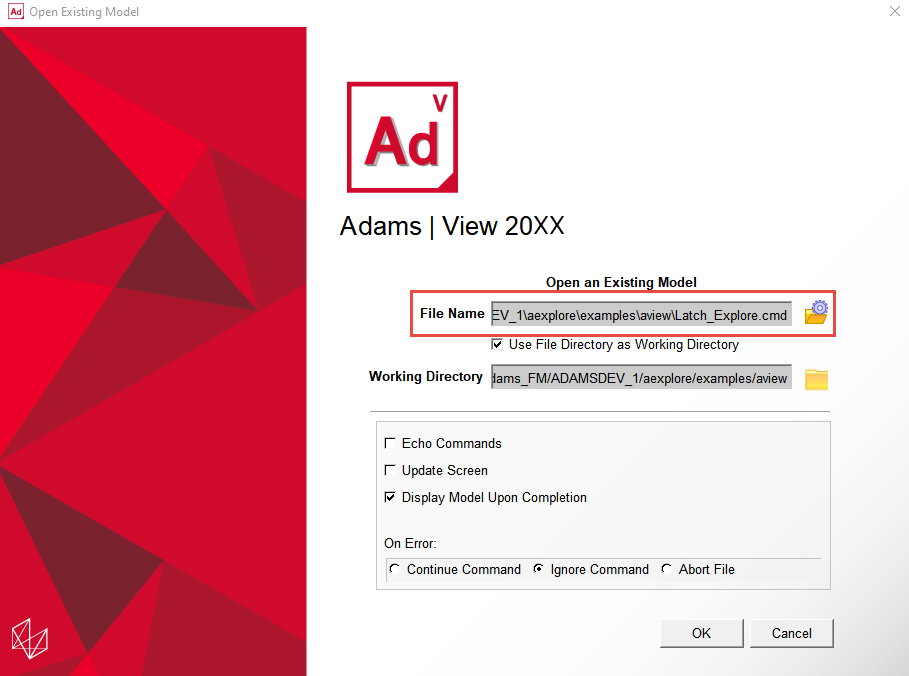
3. Select Existing Model from the startup screen.
The Open an Existing Model dialog box will appear.
4. Open the “Latch_Explore.cmd” from the location where you placed the files accompanying this example.
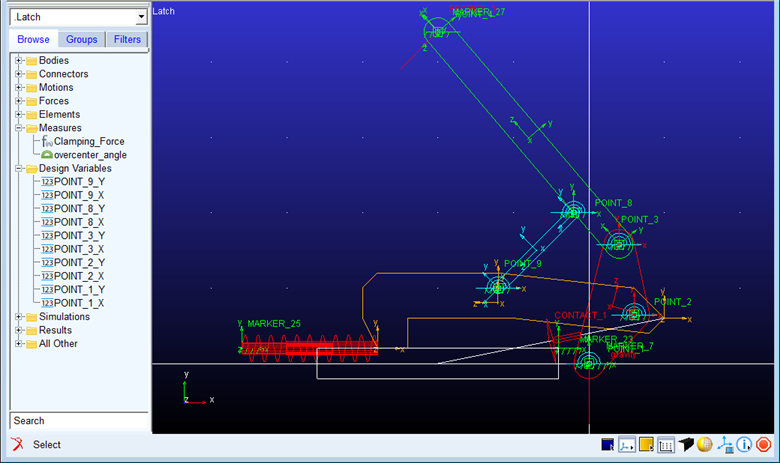
The model will be displayed as shown below:
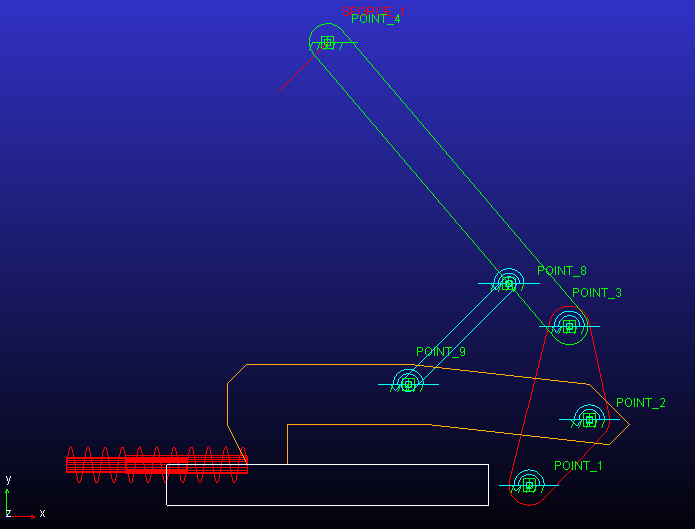
5. Using Adams View points whose coordinates are controlled by design variables, the model is parameterized so that the locations of key pivot points in the mechanism can be easily changed. These points (along with the 80N SFORCE representing the actuation at POINT_4) are shown below:
6. Click the Design Exploration tab on the Adams View ribbon. From to the Explore container, click the Export icon:

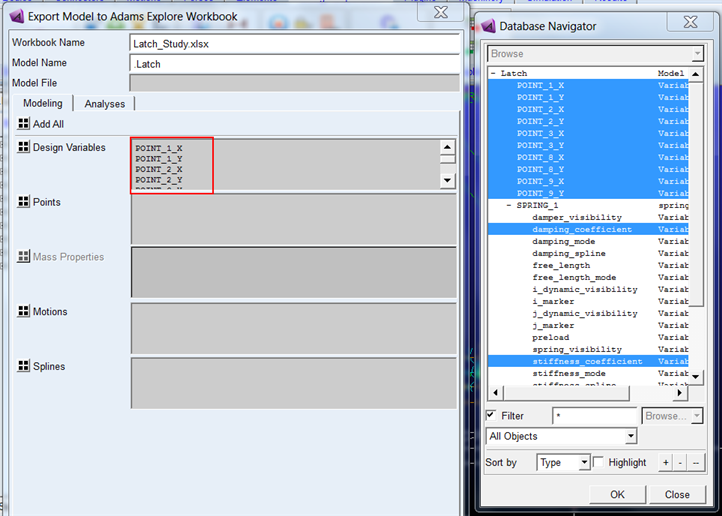
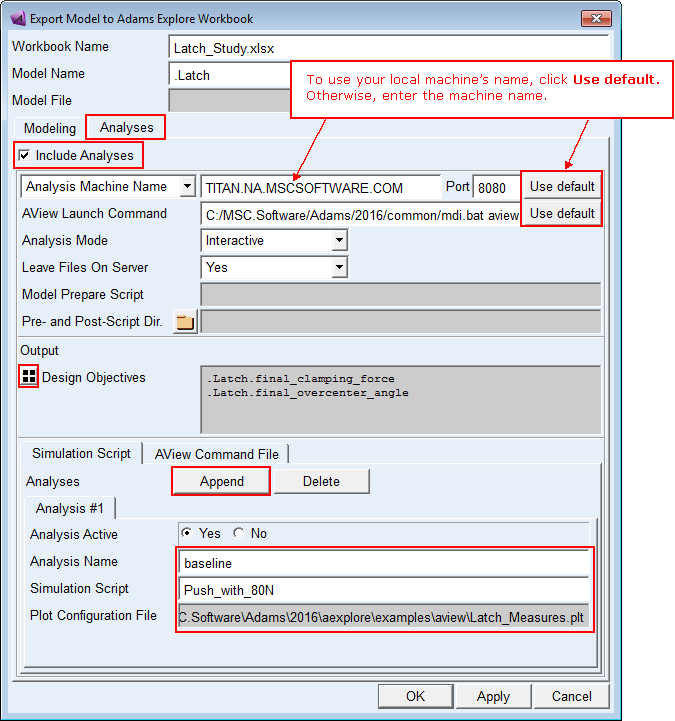
7. Specify the name of the workbook to be exported as “Latch_Study.xlsx” and select the model .Latch.

8. From the Modeling tab various modeling parameters can be chosen for inclusion in the exported spreadsheet. For this exercise select all the design variables pertaining to the hardpoint locations as well as the spring stiffness and damping variables by right-clicking in the “Design Variables” field and Browsing for the variable shown below. (do not click OK yet, you need to fill more tabs)
9. On the Analyses tab:
a. Opt to “Include Analyses”
b. If you intend to use your local machine as the analysis machine on which spreadsheet-launched runs are to be performed, then click “Use Default” for the “Analysis Machine Name” and “Port” fields; otherwise, enter the name and port of the machine you intent to setup to accept spreadsheet-launched runs.
c. For “AView Launch Command” click “Use Default” or enter it directly if the command Adams senses for this installation does not match what you want to use.
d. Under “Output” select all Design Objectives in the model by clicking the select all button next to the field.
e. On the “Simulation Script” tab, click “Append” and fill out the fields as shown below.
Hint: | Use right-click → Guesses to get the Simulation Script and right-click → Browse to get the .plt file |
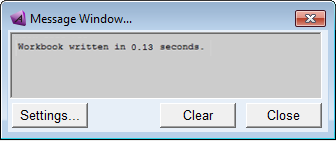
10. Click OK to export the spreadsheet workbook to your current working directory. You will get a message indicating this has been done.
11. From the machine you specified as “Analysis Machine” you need to start the Explore job server and web server so that analyses launched from the spreadsheet workbook can be built (that is, models modified) and executed:
a. Logon to the analysis machine and launch Adams View (of course, if you're hosting jobs this from the same machine from which you just exported the spreadsheet you have already done this)
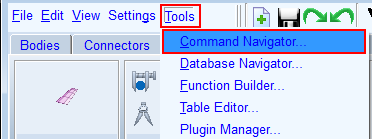
b. Launch the Command Navigator via Tools → Command Navigator
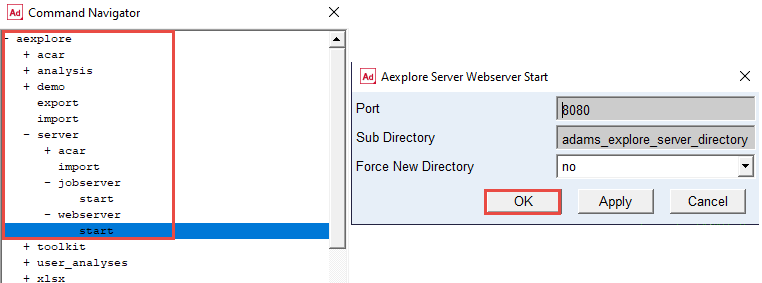
c. From the Command Navigator go to aexplore → server → jobserver and click start
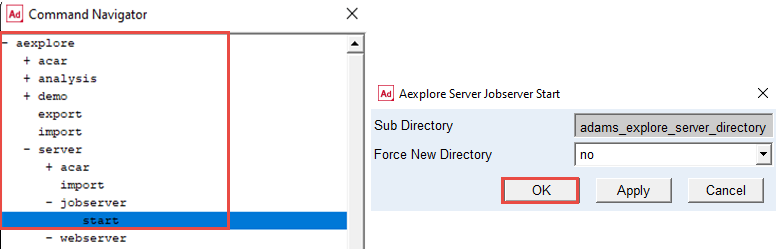
d. From the Command Navigator go to aexplore → server → webserver, click start and then click OK in the ensuing dialog box (unless you know to be using some other port number than 8080, in which case enter that port number then click OK)
e. You will notice some command prompt windows open up logging status of the job server and web server.
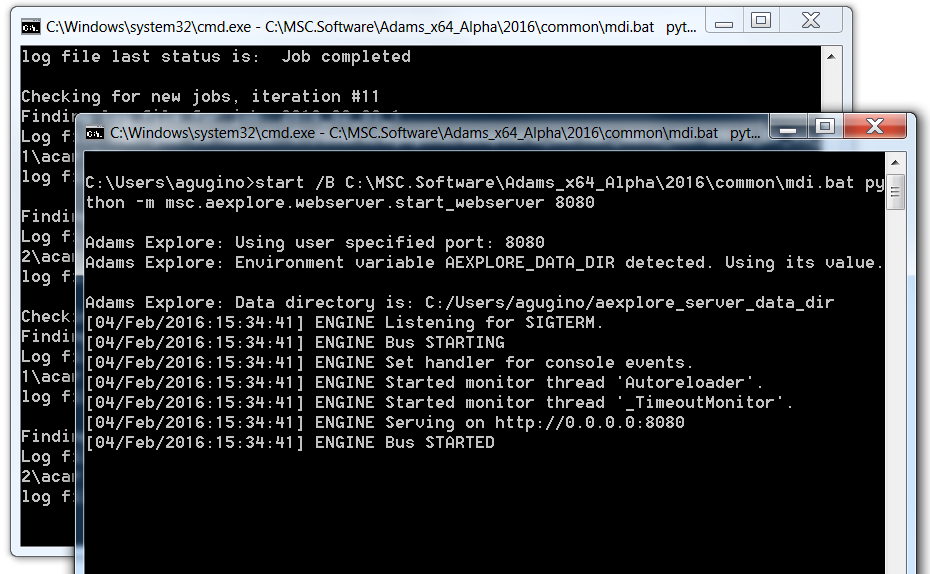
Important: | ■Keep these windows open. Closing them will stop the servers. ■Alternatively these servers can be started from the Adams Command Prompt. ■Launch the Adams Command Prompt. For example, from the Start Menu on Windows machines under Adams 20XX click Command Prompt ■Enter the Adams start command (shown at the top of the window, for example, adams20XX), followed by the arguments "aexplore" and "ru-jobserver" like so: 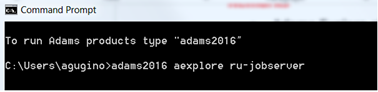 ■This will launch a separate window for the job server as shown earlier in this example ■Enter the Adams start command (shown at the top of the window, for example, "adams20XX"), followed by the arguments "aexplore" and "ru-webserver" like so: 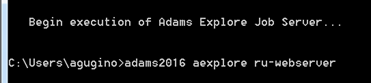 ■This will launch a separate window for the web server as shown earlier. |
12. Navigate to your Adams View working directory and open the exported workbook file “Latch_study.xlsx”. Browse through the tabs to see the information you exported. General model information is presented on the “Model” tab and the other tabs reflect the information requested to be exported.
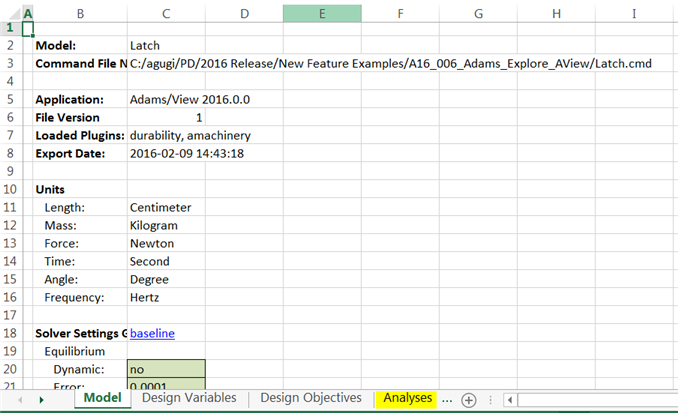
13. On the Analyses tab you'll notice the details of the analysis machine and the simulation script that were specified.
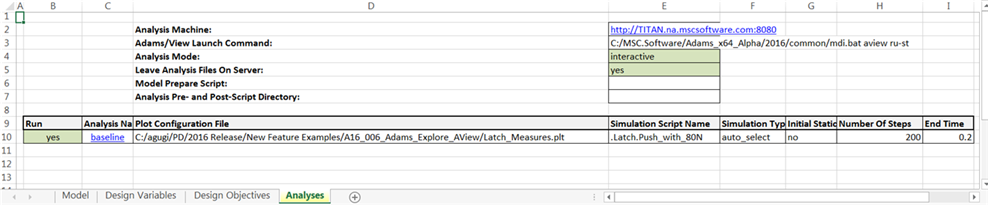
14. Click on the hyperlink next to "Analysis Machine"

15. This will launch the Adams Explore Job Monitor in your default web browser.
Note: | If you are launching the servers on a Linux machine and the webpage is not loading, then please check the firewall status of the Linux machine using command: systemctl status firewalld If the firewall is active, that might prevent the webpage from loading. Stop the firewall using command: systemctl stop firewalld and check if you can load the webpage or not. You can start the firewall back by using command: systemctl start firewalld |
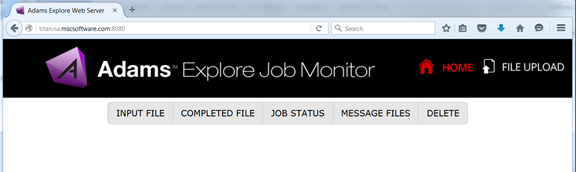
16. From the webpage click File Upload, and browse for "Latch_Study.xlsx" and click Submit File
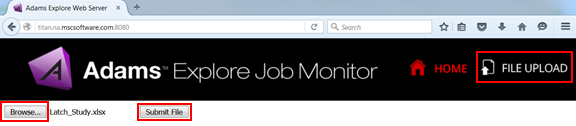
17. The spreadsheet is now uploaded to the analysis machine where the simulations will be setup and executed. You can follow the status on this webpage which will automatically update. You can also manually refresh the page.
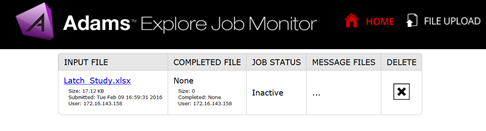
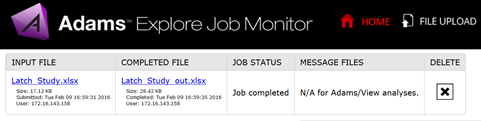
18. Once the analysis is completed click on the file "Latch_Study_out.xlsx" and download it from the analysis machine to your local machine.
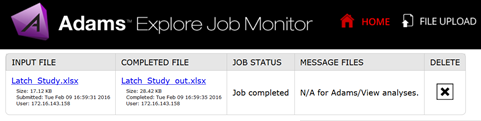
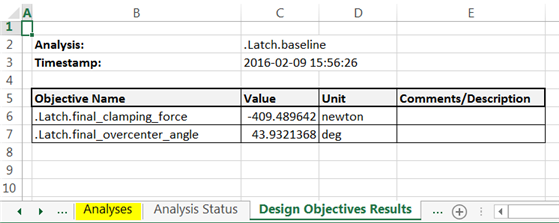
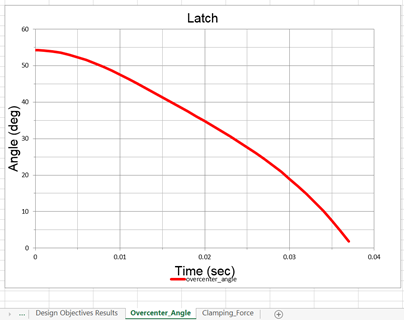
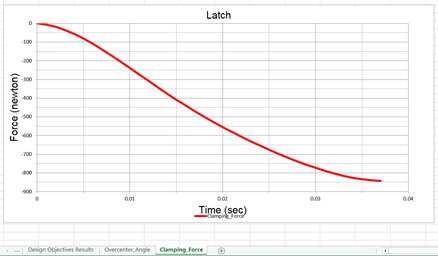
19. Open "Latch_Study_out.xlsx" and browse through the result tabs showing the design objective values and the plots defined in the plot configuration file.
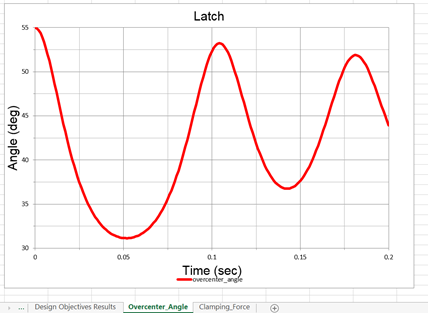
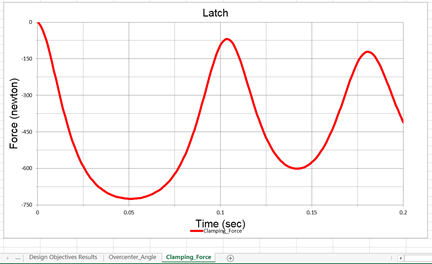
Note: | If you scroll down below each plot you will find columns containing the data points for each curve. |
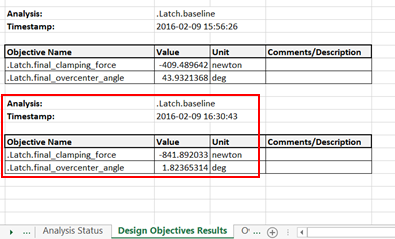
20. This baseline configuration does not meet our objectives. The clamping force fails to reach -800N and the 'overcenter' angle should reach near zero indicating that the latch was able to be fully engaged via the 80N applied force at the handle. What happened here is that spring overpowered the 80N applied force causing the harmonic nature of the curves away from our targets.
21. So, let's try an alternate configuration of the some of the key design points. Go to the "Design Variables" tab and edit point_2_y = 3.0 and point_3_y = 8.0. Throughout the spreadsheet editable cells are green and turn tuirquoise when modified:
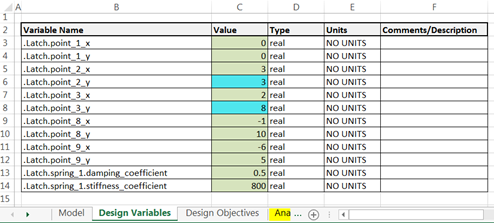
22. Save the workbook under a new name, “Latch_Study_variant.xlsx”
23. Return to the Adams Explore Job Monitor webpage and upload the newly saved workbook:

24. Once the job is completed, click on and download the updated workbook, "Latch_study_variant_out.xlsx"
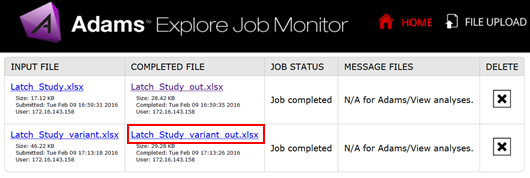
25. Open the downloaded workbook and inspect the new results. Since you supplied a workbook with results from the first run present, a second design objective table has been added (you may need to scroll down to find it). The plots are simply overwritten; in the future, cross-plotting and/or appended plot tabs will be provided. Notice that now both design objectives meet our targets: the clamping force is beyond -800N and the overcenter angle is near zero.
Note: | Adams Explore also allows you to edit an Adams model based on the values of an .xlsx file previously exported against the same model. So, in the above example, the Adams analyst could update the latch model with the better configuration found by the engineer in the .xlsx file using the import button on the ribbon tab:  |