Discrete Fourier Transform (DFT)
Time Windowing and Time Interval
During the DFT the time signal is split into short time signals equal to the Time Interval parameter defined in the DFT tab in the Acoustics Plugin. Each time signal is multiplied by a window, windows other than the rectangular, will reduce the amplitude at over the entire time window. The form of each window is different, rectangular, triangular or other forms, as Hanning, Hamming or Blackman. This is done in order to remove the leakage effect, when the time signal is cut in several parts.
Overlap
Overlap is the percentage intersection of each subsequent time window. Thus when a nonzero overlapping is defined, the number of time windows will increase.
Start and End Frequencies
The end frequency or maximal frequency  depends on the time step size
  through the Nyquist criteria,
 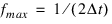 , thus maximal frequency cannot exceed this value. Smaller steps will increase
  . Start frequency can be chosen with zero or a higher frequency, the minimum frequency is only limited by 0 Hz.
depends on the time step size through the Nyquist criteria, , thus maximal frequency cannot exceed this value. Smaller steps will increase . Start frequency can be chosen with zero or a higher frequency, the minimum frequency is only limited by 0 Hz.Minimum frequency is set by default equal to the inverse of the time interval used for DFT purpose:  = 1/t
= 1/t
= 1/t