Understeer Budget Calculations
The Understeer Gradient of a vehicle is produced by several effects: tire stiffness, weight distribution, suspension kinematics, suspension compliance, etc. For the Understeer Budget calculations, we will calculate the individual effects of: Weight and Tires, Roll Steer, Steering System Compliance, and Suspension Compliance.
An effect that is being ignored at this time is the contribution from Aligning Torque on the Rigid Body. This contribution usually amounts to .2 deg/g or less, and is due to tire rotational stiffness. This calculation could possibly be added in the future. Also, the Front and Rear Suspension Compliance Gradients are lumped gradients that include the effects of roll camber and aligning torque deflection steer.
The next sections describe the following:
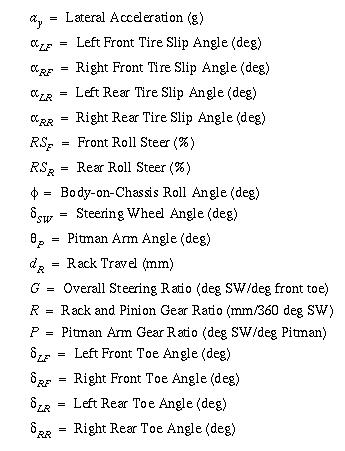
List of Symbols
Overall Steering Ratio
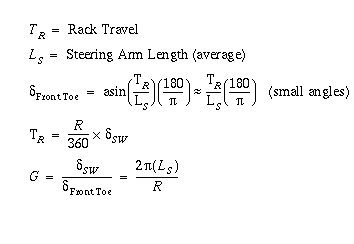
The Overall Steering ratio (kinematic) calculated using simplified calculations: we assume that linkages are nearly perpendicular to each other at design (normally a good assumption). Please note that the overall steering ratio will change with steering wheel angle, but for now we are using the single number calculated at design. In the future more rigorous calculations could be added using an Adams User routine that calculated the kinematic overall steering wheel ratio at each instant. Please see Appendix B for the overall steering ratio calculations for the different steering systems.
Sign Conventions
Lateral acceleration is positive to the right, roll angle is positive to the left. So, in a left turn, lateral acceleration and roll angle are both negative. Positive roll steer percentages, front and rear, indicate toe out for the outside tire, toe in for the inside tire. Therefore, a positive front roll steer percentage is an understeer effect, while a positive rear roll steer percentage is an oversteer effect. Toe-out is negative, toe-in is positive.
Toe Angles
The four toe angles of the vehicle play an important role in calculating the understeer budget gradients. It is only through the toe angles that we can calculate suspension compliance steer. It is important to understand the various components of these toe angles.
When dealing with front toe angles, the assumption is made that the signs of the toe angles won't change during a constant radius maneuver (In a left turn, the right front tire will always be toed in, the left front tire will always be toed out). Because of this, we can calculate average front toe by averaging the absolute values of the front toe angles. This average toe is then used to help calculate the front suspension compliance steer. Figure 1 shows the components of front toe.
Figure 1. Front Toe Angle Components
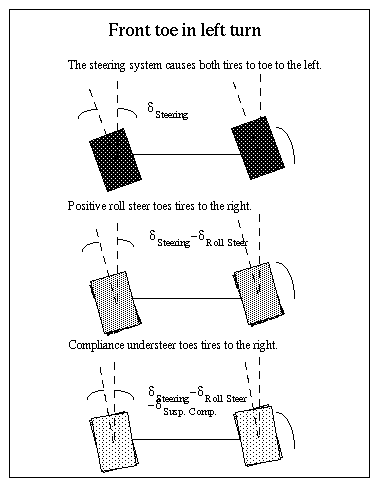
As we can see from Figure 1, if roll steer and lateral compliance are understeer effects, they will act to reduce the average toe angle. Notice that the figure does not include toe angles due to alignment. This is because the understeer budget numbers are gradients, which are the change in various quantities as lateral acceleration changes. An alignment value for toe has no effect on these gradients.
Using Figure 1, we arrive at the following expression for front toe.
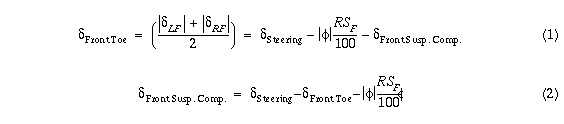 | (1) |
(2) |
Eqn.(2) is set up so that when the individual quantities are positive, they indicate understeer. This is why the absolute value of roll angle is used, RSF is a signed quantity that indicates roll understeer when positive.
For rear toe, we can not make the assumption that the signs of the toe angles won't change. Because of this we need a different way to represent rear average toe. Figure 2 shows the components of rear toe.
Figure 2. Rear Toe Angle Components
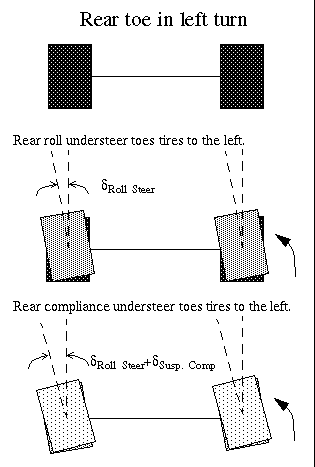
Rear toe angles are a function of roll steer and suspension compliance. Since these can be either understeer or oversteer effects, we can not use absolute values to calculate average rear toe: we must use actual toe values and account for the direction of turn. The sign convention for all toe angles is toe-in is positive, toe-out negative. In a left hand turn something that makes the right rear tire toe-in and left rear tire toe-out has an understeer effect. Using this and the fact that
roll angle is negative in a left turn, we derive the expression 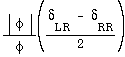 for rear average toe.
for rear average toe. This expression will give a positive value when the rear suspension has overall understeer. Eqns. (3) and (4) are written such that a positive value for dRear Suspension Compliance indicates rear compliance understeer. The roll steer term is signed differently than the front roll steer because a positive value for RSR indicates oversteer.
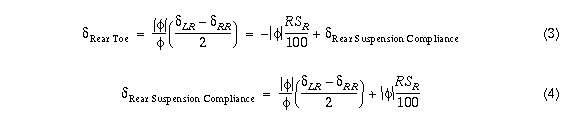 | (3) |
(4) |
Gradient Calculations
All of the understeer budget gradients are calculated so that a positive value indicates an understeer effect on the vehicle. The following sections list the individual gradients, all with units (deg/g), that make up the understeer gradient. The gradients are calculated across .25g by taking the difference between the values at .3g and .2g, and dividing by .1g.
Weight Distribution and Tires
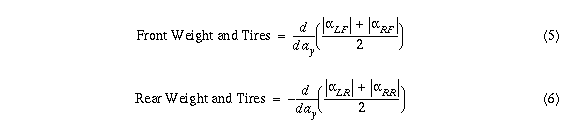 | (5) |
(6) |
Roll Steer
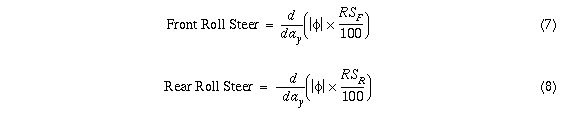 | (7) |
(8) |
Steering System Compliance Steer and Front Suspension Compliance Steer
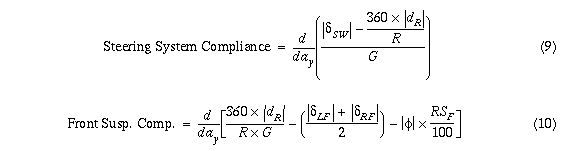
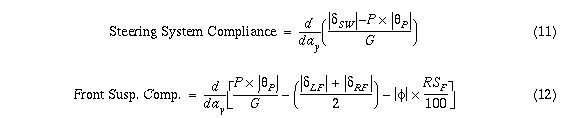
Steering System Compliance Steer is the understeer effect due to upstream steering system compliance, i.e. compliance between the steering wheel and the steering gear. Downstream steering system compliance effects will be lumped into Front Suspension Compliance Steer. For example, understeer effects due to tie rod ball bushing stiffness will show up in the front suspension compliance number.
Rack-and-Pinion Steering System
 | (9) |
(10) |
Pitman, Haltenberger, and Relay Steering Systems
 | (11) |
(12) |
Rear Suspension Compliance Steer
 | (13) |
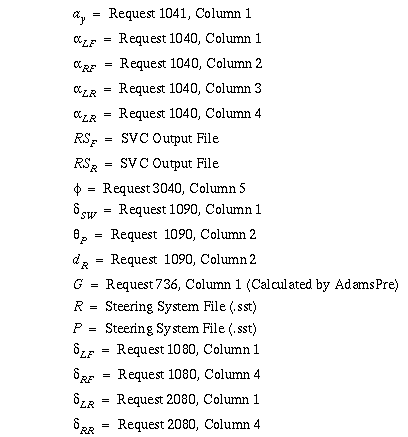
Appendix A: Variable Sources
Appendix B: Overall Steering Ratio Calculations
Rack
Pitman and Haltenberger
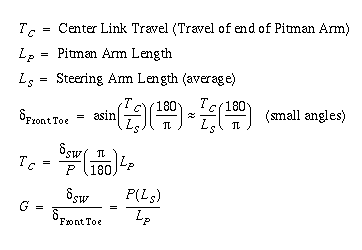
Relay
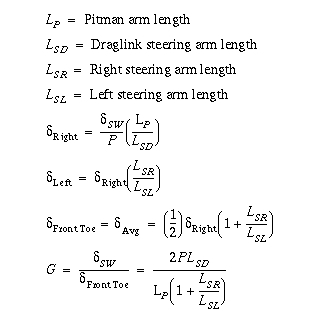
The draglink steering arm length is the distance from the draglink to spindle connection to the kingpin axis. The other steering arm lengths are the distances from the tie rod ends to the kingpin axes.
The above calculations pertain to the draglink attached to the right spindle. For draglink attachment to left spindle, reverse LSR and LSL.