Viscous Coupling
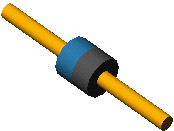
This component represents viscous coupling. A property file determines the viscous characteristics. The component consists of a rotational force acting between the two parts with the location and orientation determined by the selected construction frame. A viscous coupling describes a force-based connection between two parts. A viscous coupling exerts a torque whenever the relative angular velocity between two parts exceeds a certain value. When the relative angular velocity is zero, no torque is transmitted.
Learn about viscous coupling:
Creating or Modifying Viscous-Coupling Components
To create or modify a viscous-coupling component:
1. From the Driveline Components menu, point to Viscous Coupling , and then select New/Modify.
3. Select OK.
About Viscous-Coupling Components
The elements that a viscous-coupling component creates are:
■General spline based on a property file
■Torque function of the 2D general spline
■Cylinder graphics
■Request
The viscous coupling force is defined as follows:
Torque=-SIGN(akispl(ABS(WZ(I mar, J mar, J mar)),0, Spline), WZ(I mar, J mar, J mar))
where:
■T = Resulting torque
■Spline = The two-dimensional spline that defines the slip-speed versus torque characteristic
■I mar = Marker belonging to the I part
■J mar = Marker belonging to the J part
In steady state conditions, equal velocities of the two half shafts produce a 0.0 torque.
In the Standard Interface, you can vary values for the property file, which effectively determines the torque/slip-speed characteristic.
Request Definition
Result name: vcoupling_states
Component: | Component name: | Component units: | Definition: |
|---|---|---|---|
F2 | angular displacement | angle | The angle between the two parts connected with the vcoupling element. |
F3 | velocity | velocity | Relative angular velocity. |
F4 | force | force | Force exerted by the viscous coupling element. |
Subsystem Parameters
Property file (<db_name>/differentials.tbl) (see Viscous Coupling Example Property File)
Note: | The property file slip velocity calculated in terms of rpm and not in rad/s or deg/sec. |
Example Viscous-Coupling Property File
$--------------------------------------------------MDI_HEADER
[MDI_HEADER]
FILE_TYPE = 'dif'
FILE_VERSION = 4.0
FILE_FORMAT = 'ASCII'
$--------------------------------------------------UNITS
[UNITS] LENGTH = 'mm' ANGLE = 'degrees'
FORCE = 'newton'
MASS = 'kg'
TIME = 'second'
$--------------------------------------------------DIFFERENTIAL
[DIFFERENTIAL]
{ slip_speed torque}
0.0 0.0
4.1 868.0556
8.3347 2.2222
12.5 7812.5
16.6 13888