Backlash Components
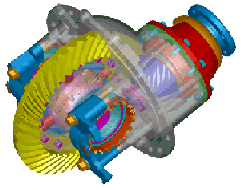
This component represents a backlash gap between two parts. In Adams Driveline you can work with two types of backlash components: rotational and translational backlash.
Learn about backlash:
Creating or Modifying Backlash
To create or modify backlash:
1. From the Driveline Components menu, point to Translational/Rotational Backlash, and then select New/Modify.
3. Select OK.
About Rotational Backlash
A rotational backlash describes a rotational connection between two parts that are connected using a revolute joint and a rotational single-component force that describes the backlash. In addition, Adams Driveline creates a rotational motion to allow the possibility of deactivating the backlash.
Note: | Adams Driveline automatically creates some kinematic joints in this component. |
In the Standard Interface (see Interface Modes), you can use the Driveline Activity Wizard to manage the activity of each backlash element.
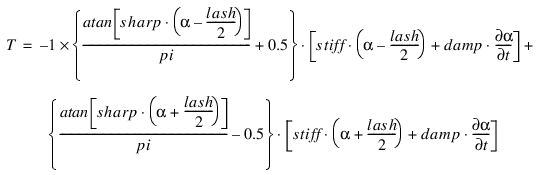
The backlash law is defined with a combination of ATAN functions to guarantee smoothness and derivative continuity
.
where:
■T = Resulting torque
■sharp = Sharpness factor of the backlash
■α = Relative angles of the two markers defining the backlash force
■lash = Backlash (in radians)
■stiff = Stiffness of the gear-to-gear contact
■damp = Damping of the gear-to-gear contact
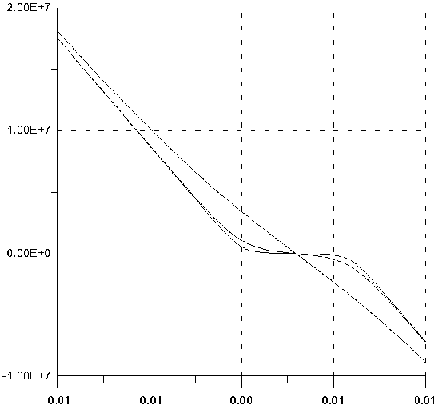
The sharpness factor lets you control how sharp the transition is between the lash region with zero forces and the stiff region.
In this model, the expression of the sharpness factor is as follows:
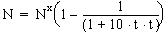
This means that the backlash needs some time to be fully developed with the steady-state value of Nx. This device makes integration easier. Nx is the value you define in the Rotational Backlash Create/Modify dialog box.
Sharpness Factor Development Time
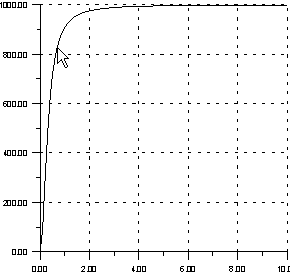
Backlash Force as Function of Sharpness Factor (N=10, 500, 1000)
In the Standard Interface, you can vary values for the following:
■Backlash
■Stiffness
■Damping
■Sharpness factor
Request Definition
Result name: backlash_states
Component: | Component name: | Component units: | Definition: |
|---|---|---|---|
F2 | displacement | angle | The angle between the two parts connected with the backlash element. |
F3 | angular_velocity | angular velocity | The relative rotational velocity between the two parts connected by the backlash element. |
F4 | force | force | Force exerted by the backlash element. |
Subsystem Parameters
■Backlash flag
■Backlash
■Stiffness
■Damping
■Sharpness factor
About Translational Backlash
A translational backlash describes a translational connection between two parts that are connected using a translational joint and a translational single-component force that describes the backlash. In addition, Adams Driveline creates a translational motion to allow the possibility of deactivating the backlash.
Note: | Adams Driveline automatically creates some kinematic joints in this component. |
In the Standard Interface (see Interface Modes), you can manage the activity of each backlash element using the Activity Wizard.
The backlash law is defined with a combination of ATAN functions to guarantee smoothness and derivatives continuity.
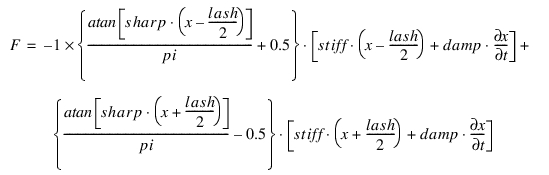
where:
■F = Resulting force
■sharp = Sharpness factor of the backlash
■x = Relative displacement of the two markers defining the backlash force
■lash = Backlash in mm
■stiff = Stiffness of gear-to-gear contact
■damp = Damping of the gear-to-gear contact
The sharpness factor lets you control how sharp the transition is between the lash region with zero forces and the stiff region.
In this model, the expression of the sharpness factor has been defined as follows:
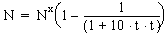
This means that the backlash needs some time to be fully developed with the steady-state value of Nx. This device makes integration easier. Nx is the value you select in the appropriate dialog box.
Sharpness Factor Development Time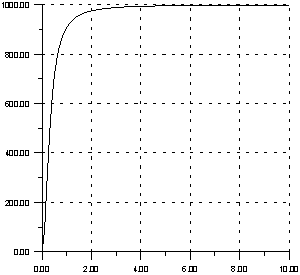
Backlash Force as Function of Sharpness Factor (N=10, 500, 1000)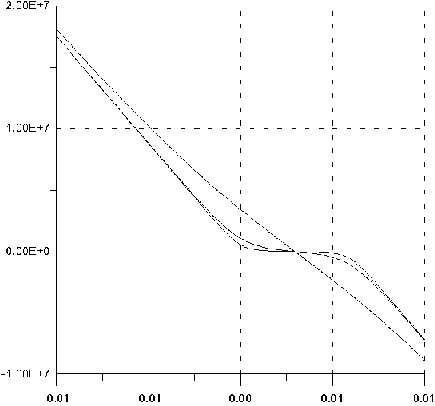
In the Standard Interface, you can vary values for the following:
■Backlash
■Stiffness
■Damping
■Sharpness factor
Request Definition
Result name: backlash_states
Component: | Component name: | Component units: | Definition: |
|---|---|---|---|
F2 | displacement | length | The angle between the two parts connected with the backlash element. |
F3 | velocity | velocity | The relative rotational velocity between the two parts connected by the backlash element. |
F4 | force | force | Force exerted by the backlash element. |
Subsystem Parameters
■Backlash flag
■Backlash
■Stiffness
■Damping
■Sharpness factor