Stress Recovery Analysis
There are many ways to calculate the flexibility effect of complex machine members. Adams uses a modal synthesis method. This approach is very effective because it allows you to drastically reduce the total number of degrees of freedom (DOFs) of a typical FE component used for detailed stress analysis, while preserving its local deformations with high level of accuracy (assuming that the modal component synthesis procedure is performed correctly). Flexible structural component motion with N DOF and defined boundaries is described by a combination of P normal modes (normal constrained modes) and S constraint modes (static correction modes).
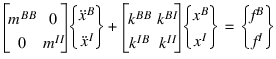
The system DOFs are partitioned between internal and boundary DOFs, so the flexible body motion equation becomes:
 | (1) |
with I internal DOFs (equal to N – S) and B boundary ones (equal to S).
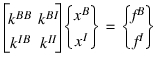
From a static equilibrium analysis, assuming that interior forces are set to zero, equation (1) becomes:
 | (2) |
and led to extract the constrain modes matrix as  :
:
: | (3) |
Moreover, from an eigenvalue analysis, you have:
 | (4) |
yielding the normal modes matrix  :
:
: | (5) |
From equation (5), a subset of the N normal modes is considered, and the physical coordinates are calculated as a linear combination of the mode shapes.
 | (6) |
where:
■{x} is the vector of physical displacements
■{q} is the vector of modal coordinates
■[ ]=[{
]=[{ },...,{
 }] is the modal matrix that includes both P normal and S constraint modes
]=[{},...,{}] is the modal matrix that includes both P normal and S constraint modesNow, equation (1) can be rewritten as:
 | (7) |
An ortho-normalization of the reduced system described by equation (7) is performed while translating from each FE output file into the Adams modal neutral file (MNF). The effect is to obtain a diagonal model and to associate a frequency content to the static correction modes as well.
FEM structural analysis obtains the modal and static information needed to perform modal reduction, in a sequence of static load cases with varying boundary conditions, as described in equation (1).
Adams assembles and solves fully inertially coupled equation of motion of the mechanical system including the flexible part(s). It also adds the generalized modal coordinates as unknowns. Adams Solver manages the full set of equations giving the parts rigid body coordinates and modal coordinates as a result. Adams Solver also computes the reaction forces acting on the flexible component through algebraic constraint or external forces.
Once Adams Solver has computed the set of modal coordinates, it is possible to recover stress in the FE code using equation (6) and pass the physical displacements to the FE code. Strains and stresses would then be recovered in the FE code from the solution of  by:
by:
by: | (8) |
 | (9) |
where:
■ is the strain vector
is the strain vector■ is the stress vector
is the stress vector■ is a function matrix of the FE geometry relating strains to displacements
is a function matrix of the FE geometry relating strains to displacements■ is the stress-strain relationship (constitutive equation based on the material properties)
is the stress-strain relationship (constitutive equation based on the material properties)Note that this can be a very inefficient solution for large meshes and when a large number of time steps are involved. In addition, this method is dependent on the Adams solution and, therefore, not conducive to system studies, such as DOE or optimization.