What Is Experimental Design?
This section covers the following topics:
Overview
Experimental design (also called Design of Experiment (DOE)) is a collection of procedures and statistical tools for planning experiments and analyzing the results. In general, the experiments measure the performance of a physical prototype, the yield of a manufacturing process, or the quality of a finished product.
Although experimental design techniques were originally developed for physical experiments, they also work very well with virtual experiments. In the case of Adams Insight, the experiments help increase the reliability of your conclusions, get you answers faster than trial-and-error or testing factors one at a time, and help you better understand and refine the performance of your mechanical system.
For simple design problems, you can explore and optimize the behavior of your mechanical system using a combination of intuition, trial-and-error, and brute force. As the number of design options increase, however, these methods become ineffective in formulating answers quickly and systematically. Varying just one factor at a time does not give you information about the interactions between factors, and trying many different factor combinations can require multiple simulations that leave you with a great deal of output data to evaluate. To help remedy these time-consuming tasks, Adams Insight provides you with the planning and analysis tools for running a series of experiments. Adams Insight also helps you to determine relevant data to analyze, and automates the entire experimental design process.
Process
The experimental design process includes five basic steps:
■Determine the purpose of the experiment. For example, you might want to identify which variations most affect your system.
■Choose a set of factors for the system that you are investigating and develop a way to measure the appropriate system responses.
■Determine the values for each factor (called Levels), and plan a set of experiments (called runs or trials) in which you vary the factor values from one trial to another. The combination of actual runs to perform is called the design.
■Execute the runs, recording the performance of the system at each run.
■Analyze the changes in performance across the runs, and determine what factors most affect your model.
An experiment configured using this process is called a designed experiment, or matrix experiment. The runs are described by the design matrix, which has a column for each factor and a row for each run. The matrix entries are the levels for each factor per run.
Experiments with two or three factors might only require five or ten runs. As the number of factors and levels grows, however, the number of runs can quickly escalate to dozens, even hundreds. As a result, a good design is critical to the success of the experiment. It should contain as few runs as possible, yet give enough information to accurately depict the behavior of your system. The best design depends on the number of factors and levels, the nature of the factors, assumptions about the behavior of the product or process, and the overall purpose of the experiment. Adams Insight lets you combine all of these requirements into an efficient, effective design for your problem, and help you make accurate analyses of the results.
Analysis
The type of analysis you’ll run depends on the purpose of the experiment. Common analyses include Analysis of Variance (ANOVA), which determines the relative importance of the factors, and Linear Regression, which fits an assumed mathematical model to the results.
Example
If a simple experiment includes two factors, each with three Levels and four runs, the design matrix for the experiment might look like this:
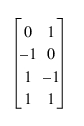
Each row of the matrix represents a run, and each column represents a factor. A -1 indicates the first level for the factor, a 0 the second, and a +1 the third.
If the levels for the first factor are 9, 10, and 11, and the levels for the second factor are 85, 90, and 95, then the matrix would give the following runs:
Run | Factor 1 | Factor 2 |
|---|---|---|
1 | 10 | 95 |
2 | 9 | 90 |
3 | 11 | 85 |
4 | 11 | 95 |