Introducing the Tutorial
Overview
This section introduces you to the tutorial and gets you started. The tutorial guides you through the process of using Adams Insight with Adams Car to investigate transient dynamic response of a vehicle front-suspension model.
The sections in this tutorial are:
 This tutorial takes about one hour to complete.
About the Tutorial
In this tutorial, you design an experiment and analyze results for a front suspension assembly. You’ll run the assembly through a number of simulations that you set up in an experiment; fit your data to a polynomial to determine which factors most affect performance of the assembly; and publish results to an HTML page that you can view with a Web browser.
We’ll begin by importing the suspension from the Adams Car shared database. The suspension assembly contains a Short Long Arm (SLA) independent front suspension that you will exercise through its range of motion while steering input is held constant in the straight-ahead position. You’ll monitor aspects of the assembly while you make modifications to it. Table 1 describes the model modifications used.
Table 1 Modifying and Monitoring Your Model
Parameters you’ll modify: | Performance attributes you’ll monitor: | Description of event: |
|---|---|---|
Outer tie-rod location | You’ll track the changes in toe angle as the suspension moves through its range of motion from jounce to rebound. Toe angle is the projected angle the wheel plane makes with the ground when viewed from above the vehicle. Toe-in is considered positive, and toe-out is considered negative. | You’ll determine how modifying the geometric location of the outer tie-rod affects toe angle. A real-world application for this event includes: ■Determining if exaggerated changes in toe angle result in aggressive tire wear. ■Assessing your model against a manufacturing variation. ■Assessing packaging requirements for your model. |
Starting Adams Car
The section provides instructions on how to start Adams Car on Linux and Windows.
Note: | On Windows, you may need to set the permissions to Full Control to edit the tutorial files. |
To start Adams Car on Linux:
1. Create a new working directory, acar.
Note: | You can skip this step if you previously used the Help‡Copy Examples To feature to copy all of the tutorials for Adams Insight. Your working directory is ain_examples/acar. |
2. Change to your working directory.
3. Type the command to start the Adams Toolbar at the command prompt and press Enter.
4. Select the Adams Car tool  .
.
.The Adams Car main window appears.
To start Adams Car on Windows:
1. From the Start menu, point to Programs, point to Adams 2024.1, and then select Adams Car.
2. Select OK in the Adams Car welcome window.
3. From the File menu, select Select Directory to display the Select Directory dialog box.
4. Navigate to the drive and directory that you want to use as your working directory. If you need to create a new directory, select New Folder, enter acar, and then press Enter. Then, double-click the new acar.
Note: | If you previously used the Help‡Copy Examples To feature to copy all of the tutorials for Adams Insight, your working directory is ain_examples/acar. |
5. Select OK.
Creating the Model
In this section, you create the suspension assembly used in this tutorial.
To create the suspension assembly:
1. From the File menu, point to New and then select Suspension Assembly to display the New Suspension Assembly dialog box.
2. In the Assembly Name text box, type ainsight_susp.
3. Right-click in the Suspension Subsystem text box, point to Search, and then select the <acar_shared>subsystems.tbl database.
4. From the Select a File dialog box, select TR_Front_Suspension.sub, and then select Open.
5. Select the Steering Subsystem check box and right-click in the Steering Subsystem text box, point to Search, and then select the <acar_shared>subsystems.tbl database.
6. From the Select a File dialog box, select TR_Steering.sub, and then select Open.
7. Select OK in the New Suspension Assembly dialog box. When the assembly completes loading, close the Message Window. The main window should look like the image in Figure 1.
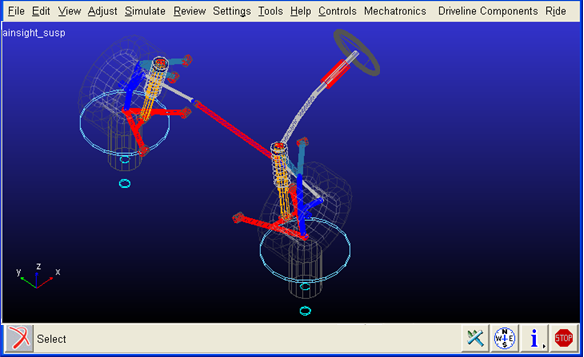
Figure 1 Suspension Assembly
Running a Simulation
Before you create your experiment, you’ll simulate the suspension model in Adams Car to run a baseline parallel travel analysis. There are three important reasons to run a simulation before beginning your DOE analysis. They are:
■Running a simulation sets up the assembly for the type of analysis you will perform in Adams Insight. This is important because the topology of the assembly can change slightly depending on the type of analysis performed.
■Running the simulation creates a simulation script that you use in the Adams Insight experiment.
■You need to determine whether or not you can analyze the assembly in its current configuration.
To simulate the model:
1. From the Simulate menu, point to Suspension Analysis and then select the Parallel Wheel Travel. This displays the Suspension Analysis: Parallel Travel dialog box.
2. The Suspension Assembly text box should say ainsight_susp. In the Output Prefix text box, enter baseline.
3. In the Number of Steps text box, enter 30.
4. Set Mode of Simulation to interactive.
5. In the Bump Travel text box, enter 50.
6. In the Rebound Travel text box, enter -50.
7. Select OK to close the dialog box and begin the analysis. When the analysis has completed, close the Message Window.
Creating a Design Objective in Adams Car
In this section, you’ll create a design objective that will be used as a response within Adams Insight. For more information about objective objects that you are using in this section, refer to the Adams View online help.
To create a design objective based on a request component:
1. From the main menu in Adams Car, point to Simulate, point to DOE Interface, point to Design Objective, and then select New to display the Create Design Objective dialog box.
2. Modify the Name text box to: .ainsight_susp.toe_angle_objective.
3. Use the Definition by drop-down to select Existing Result Set Component (Request).
4. Right-click the Result Set Comp text box, select Result_Set_Component, and then select Browse to display the Database Navigator. In the Database Navigator, expand baseline_parallel_travel, expand testrig, expand toe_angle, select left, and then select OK.
Note: | Adams Car places the full object hierarchy as part of the name in the Result Set Comp. text box. |
5. Set Design Objective’s value is the to maximum absolute value during simulation.
You are interested in the maximum value of the toe because this is the value that you want to minimize as a result of your experiments.
6. Select OK.
Starting Adams Insight
In this section, you’ll open Adams Insight from Adams Car and begin creating an experiment to measure the performance of a suspension model.
To start Adams Insight from Adams Car:
1. From the main menu in Adams Car, point to Simulate, point to DOE Interface, point to Adams Insight, and then select Export.
The Export Insight Experiment dialog box appears.
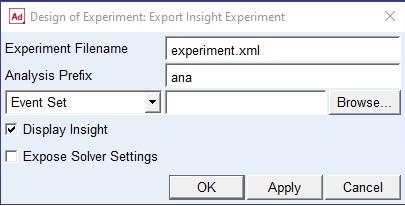
Figure 2 Export to Adams Insight
2. Set Event Set to .EVENT_SETS.default using the Browse button.
3. In the Experiment FileName text box, enter a name for your experiment or use the default.
4. Select OK.
Adams Car launches Adams Insight and the Adams Insight main window appears.
Adams Insight Interface
This section describes what you see when Adams Insight first opens. Figure 3 shows the main window as it appears when you first launch Adams Insight. It includes the following items:
■Menu bar - Contains pull-down menus for File, Edit, Define, Simulation, Tools, and Help.
■Toolbars - Contain commonly used tools for accessing files, and creating and modifying designed experiments.
■Treeview - Displays a hierarchical list of objects that you can include in an experiment. The tree is especially useful for selecting and identifying objects when you are creating a design matrix.
■Viewport - The area of the window that displays parameters for modifying the objects you select from the treeview.
■Status bar - Displays messages and issues prompts during your Adams Insight session.
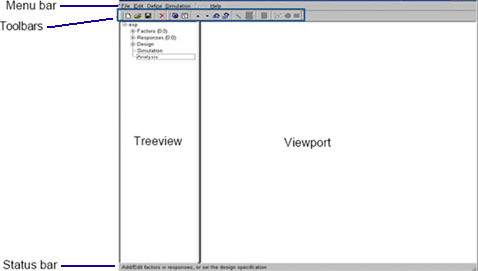
Figure 3 Adams Insight Main Window
Adams Insight Toolbars
The Adams Insight main window has four toolbars:
■Main (Experiments) toolbar - Lets you execute basic commands.
■Adams Insight (Experiments Contents) toolbar - Helps you build and execute your experiment.
■Work Space toolbar - Lets you execute commands on the work space.
■Report toolbar - Lets you generate and export a report.
If you hold your mouse pointer over any tool, tip text appears giving a short description of the tool.
Tools in toolbars are arranged in the order that you’ll use them in the process of creating and executing your designed experiment. Depending on where you are in the process of creating an experiment, Adams Insight enables or disables the tools (you can always display and undisplay them if you need to). This feature alerts you to the correct order of procedures to follow. For example, the Run simulations tool is disabled until you define required elements for a design matrix.
For more information on the toolbars, see the Adams Insight online help.