Elliptic Trapezoidal Pulley
You can perform tolerance studies by making the pulley elliptic instead of circular. To make the pulley elliptic, you specify the deviation from the pitch circle to the major and minor semiaxes of the ellipse.
The belt demands an equal spacing between the teeth on the pulley, even for the elliptic pulley. This means that the circumference (perimeter) of the elliptic pulley must be the same as for the circular pulley. The deviation on the minor semiaxis is calculated based on this. The formula to calculate the perimeter of an ellipse can be approximated by:
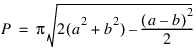
where:
■P is the perimeter
■a is the major semiaxis
■b is the minor semiaxis
Angle Offset
You can specify an angle offset for the pulley. The offset angle rotates the entire pulley, and therefore, the orientation of the elliptic deviation. The wrapping of the belt may change this angle slightly (within the angle span of one pulley tooth) to fit the pulley teeth with the belt teeth.
Graphical Display of Elliptic Pulley
The graphics of the trapezoidal pulley will not reflect the elliptic input. When an elliptic input is used, however, a small ellipse will be displayed on the side of the pulley, showing the relative deviation (x5) and showing the orientation of the ellipse.
Solver Calculation of the Elliptic Pulley
When adding the deviation to the trapezoidal pulley, the teeth of the pulley are moved to the elliptic pitch line (Figure 40), maintaining the spacing between the teeth by maintaining the pitch length of the reference pulley. The shape of the teeth is not changed compared to a normal pulley, which means that the tooth profile is still based on the involute function and with that, on a circle. The circle center or circle reference system is simply moved such that a line from that location through the reference point on the ellipse is normal to the ellipse. This results in locations as illustrated in Figure 41.
For a trapezoidal pulley with 18 teeth, pitch diameter of 54.1622 mm, and a deviation on the major semiaxis of 0.1 mm, the pitch ellipse looks as follows:
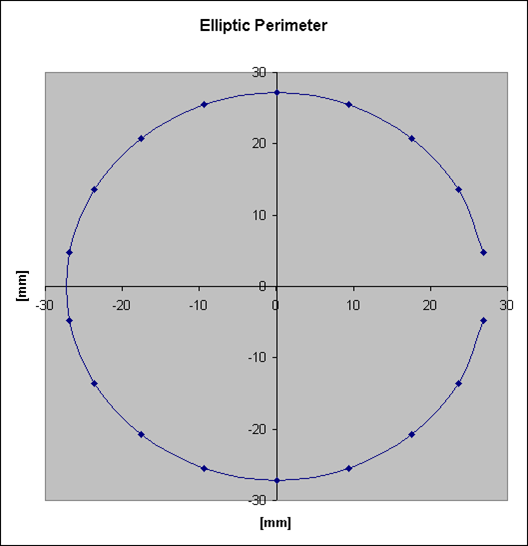
Figure 40 Elliptic Perimeter
The associated circle center references for the teeth are shown next:
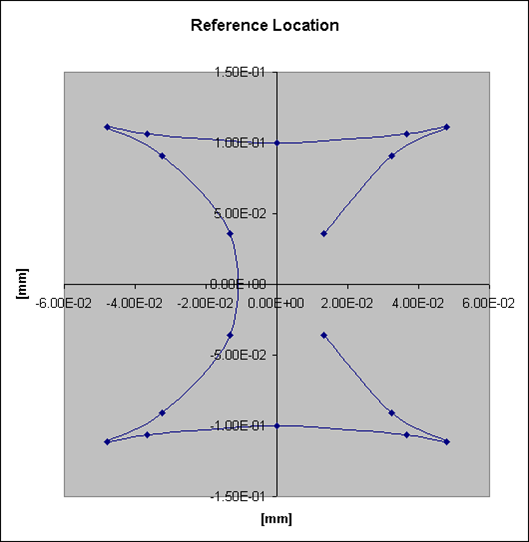
Figure 41 Reference Location