Preprocess Axial Cylindrical Roller Bearing FE Mesh
Bearing AT has a built-in catalogue of many bearings, and after selecting any bearing based on the internal diameter, the macro-geometry of the selected bearing is automatically calculated. In Create mode you define a new property file by selecting one of available bearings from catalogue and calculating the macro-geometry by using Compute geometry button. This can be also done by entering the basic bearing dimensions (inner diameter, outer diameter, bearing width) and the static load rating. In Edit mode it is possible to load already existing property file and change the macro-geometric parameters of the bearing manually. How to proceed not only in the Edit mode case, is explained in the following steps in Bearing AT Online Help. Meaning of all required input parameters is explained below. In both modes, it is possible to make a preview of bearing macro-geometry. There are also sketches, which show the meaning of each macro-geometry parameter. This dialog box allows you to create axial cylindrical roller bearing property file (*.rpf) or modify existing one. There are geometrical data of a bearing stored in this file. This preprocessing step will automatically generate FE meshes of bearing inner and outer ring and rolling element and submit Nastran computation (SOL101) which provides intermediate results (*.PCH) required for contact preprocessing.
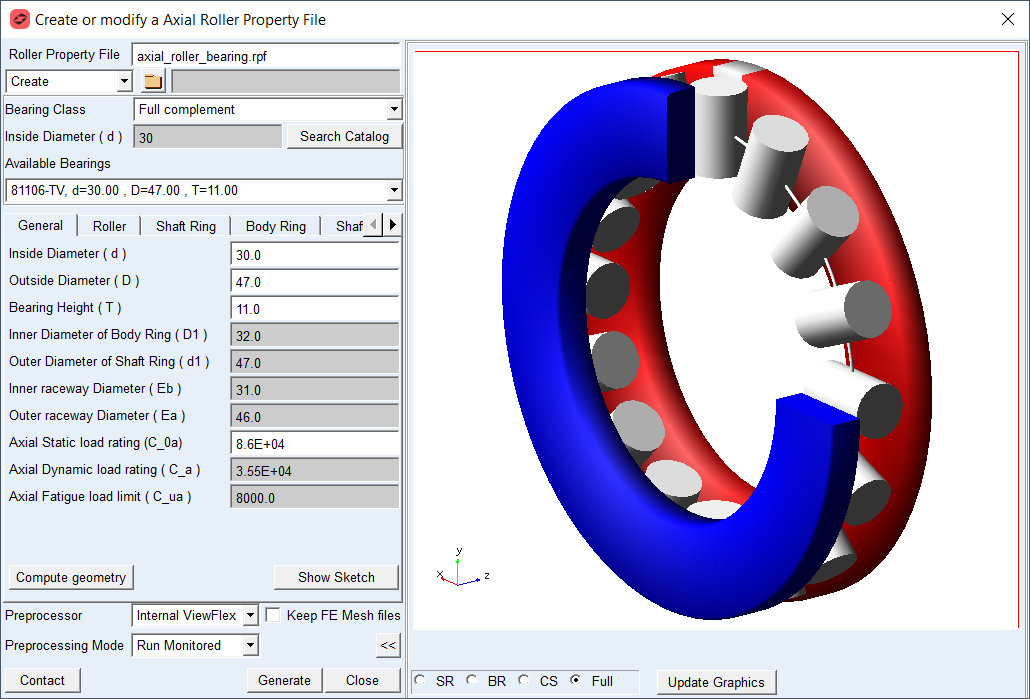
Figure 104 Axial cylindrical roller bearing - geometry preview
Main
For the options | Do the following |
|---|---|
Roller Property file | Enter the name or browse for the axial roller property file (*.rpf). It contains input for geometry and material data. |
Create/Edit mode | Choose one of the options. In Create mode you can choose from a wide range of catalogue bearings. In Edit mode you can load existing *.rpf file and adjust bearing macro-geometrical parameters. |
Destination folder | It is possible to select the destination folder for saving the property files via the button with the folder icon |
Bearing Class | Select from available classes. ■Full complement – consists of shaft ring, rollers with cage assembly and body ring ■Rollers and cage assemblies – a role of shaft ring is taken by shaft and role of body ring by housing body (or wheel body) Note: For contact preprocessing to be possible, it is necessary for every bearing class to have defined both the shaft and body ring. |
Inside Diameter (d) | Enter the required inner diameter of the bearing |
Search Catalogue | Click on this button after the internal diameter of the bearing has already been entered |
Available Bearings | From option menu select one of required bearings |
Compute geometry | Click on Compute geometry button - all required values in all tabs will be calculated |
Preview >> | Show preview of bearing geometry after filling all parameters |
Preprocessor | Select one of following options. ■External ViewFlex: use this option when there is no Nastran installation available. On background there is SOL101 running by Adams embedded Nastran Solver ■External Nastran: use this option when you have Nastran installation available. This option allows you to continue working since standalone Nastran is executed in external shell window hence the main window remains active. Please note that additional Nastran license is required. It makes use of Nastran SMP license if available. This option is not available on linux ■Internal Nastran: use this option when you have Nastran installation available. It makes use of Nastran SMP license if available ■Mesher Only: use this option to verify that FE Mesh is valid before running SOL101 |
Preprocessing Mode | Select one of following options for running mesh pre-processor. ■Run Quiet: executes mesher without any output to the screen ■Run Monitored: executes mesher with output to the screen ■Files Only: the batch file is created but not submitted to execution, one has to launch it manually |
Contact | Open contact preprocessing dialog box after FE meshes are created and Nastran SOL101 is completed |
Roller
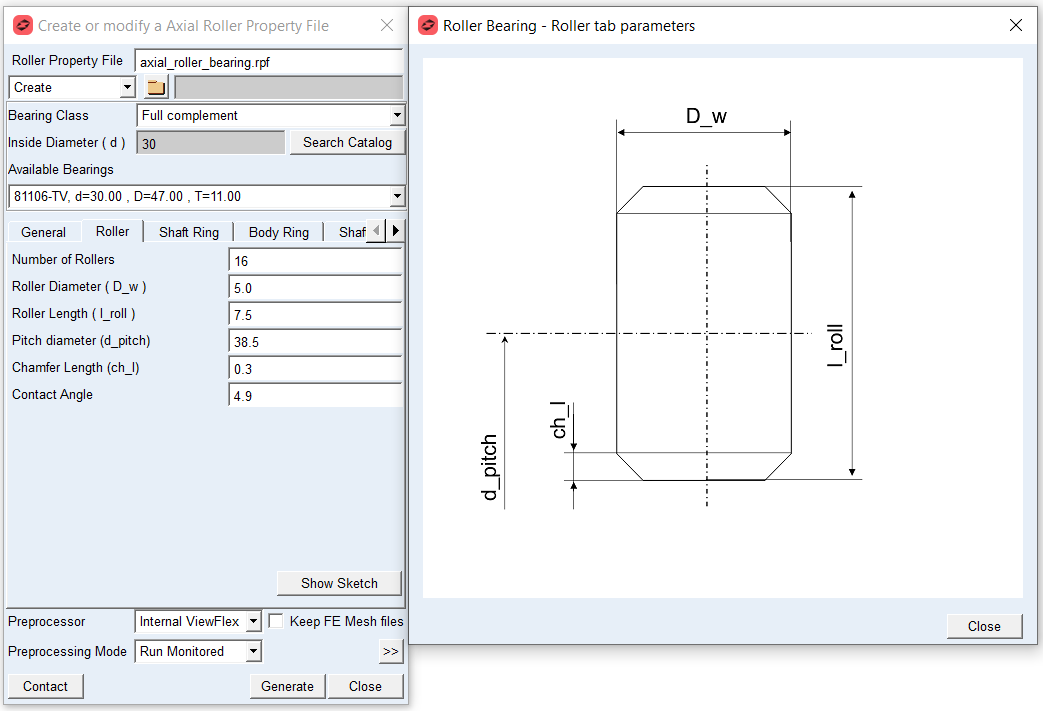
Figure 105 Axial roller tab and geometry
For the options | Do the following |
|---|---|
Number of Rollers | Enter the number of virtual rolling elements for the bearing element |
Roller Diameter (D_w) | Enter the roller diameter |
Length of Roller (l_roll) | Enter the length of roller. It defines the total length of the roller along its rotational axis |
Pitch diameter (d_pitch) | In the design position all centres of the rollers are located on the pitch centers diameter |
Chamfer length (ch_l) | Enter the chamfer length |
Contact Angle | Enter the value of roller contact angle |
Shaft Ring
To enable contact preprocessing, it is necessary to define the dimensions of the shaft ring geometry for each bearing class. For the Rollers and cage assemblies bearing class, the rolling element makes contact with a part of the shaft, which is defined as the shaft ring geometry in the Shaft Ring tab of the dialog box for contact computation in Bearing AT. It should be noted that neither the shaft ring geometry nor the inertia will be applied in the Adams model once a bearing element is created with the aforementioned bearing classes.
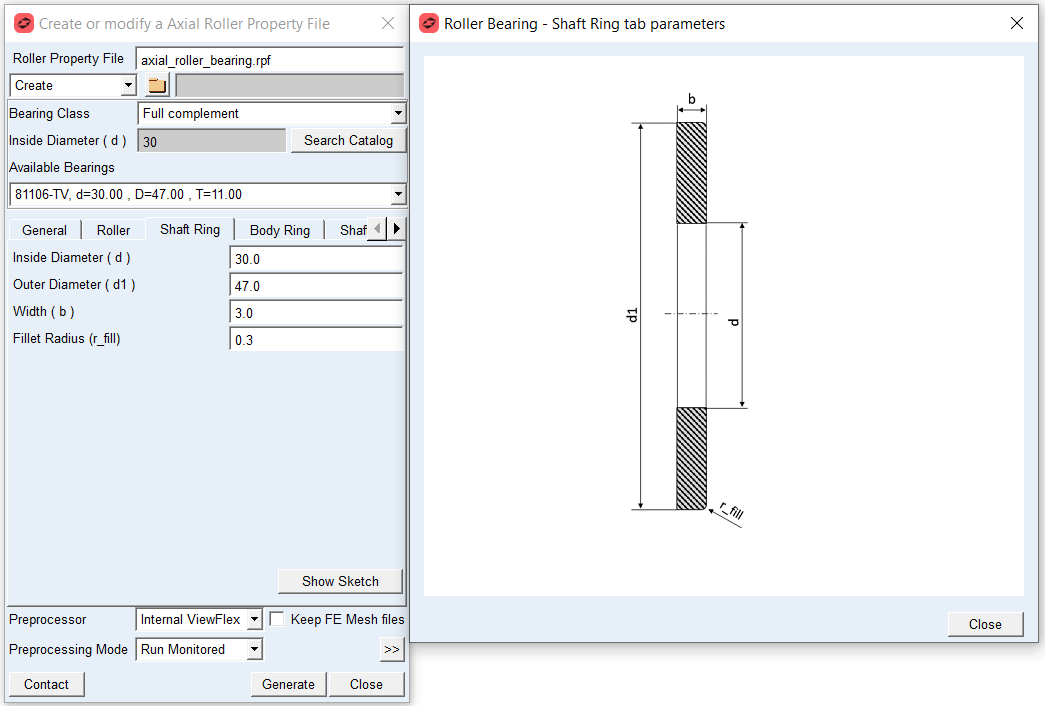
Figure 106 Shaft ring tab and geometry
For the options | Do the following |
|---|---|
Inside Diameter (d) | Enter the inside ring diameter of shaft ring |
Outer Diameter (d1) | Enter the outer diameter of shaft ring |
Width (b) | Enter the width of shaft ring. In case of Rollers and cage assemblies bearing class it represents wall thickness of the shaft body. In general, it should not be thicker than double size of roller diameter. |
Fillet radius (r_fill) | Enter the value of fillet radius |
Body Ring
In order to enable contact preprocessing, it is necessary to define the dimensions of the body ring geometry for each bearing class. For the Rollers and cage assemblies bearing class, the rolling element contacts a part of the body, which is defined as the body ring geometry in the Body Ring tab of the dialog box for contact computation in Bearing AT. It should be noted that neither the body ring geometry nor the inertia will be applied in the Adams model once a bearing element is created with the aforementioned bearing classes.
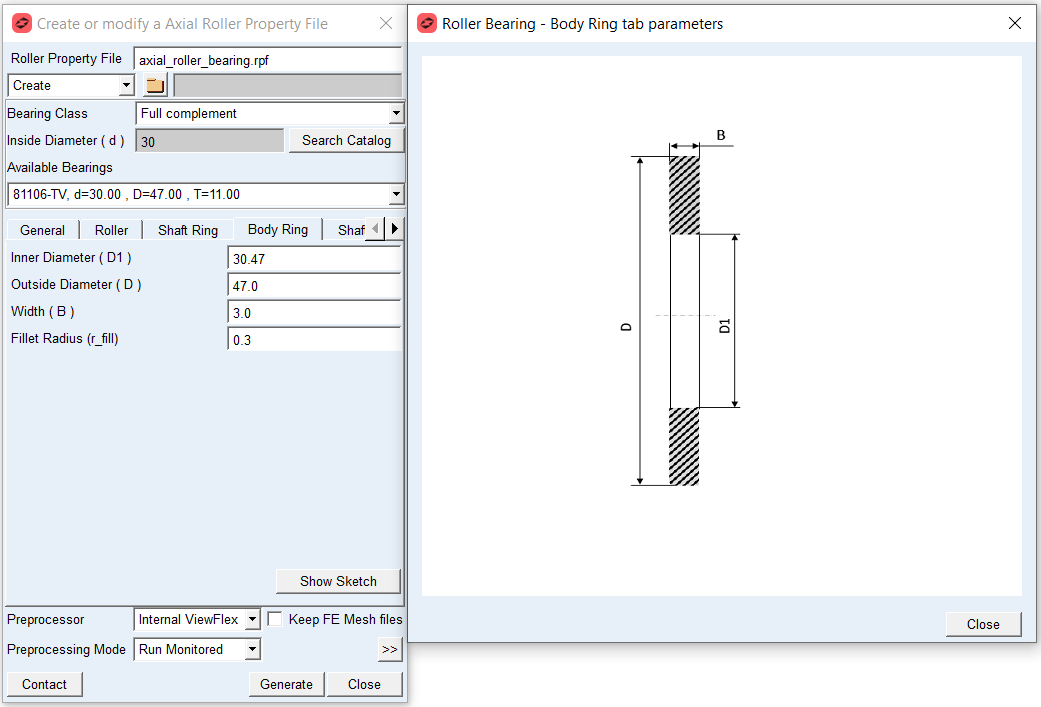
Figure 107 Body ring tab and geometry
For the options | Do the following |
|---|---|
Inner Diameter (D) | Enter the inner ring diameter of body ring |
Outside Diameter (D1) | Enter the outside diameter of body ring |
Width (B) | Enter the width of body ring. In case of Rollers and cage assemblies bearing class it represents wall thickness of the housing body. |
Fillet Radius (r_fill) | Enter the value of fillet radius |
Shaft and Body Ring Mass
The Shaft Ring Mass and Body Ring Mass card allows you to define the mass of the shaft and body ring, respectively, based either on the Geometry and Material Type or by specific User Input. In the former case the mass, center of mass and inertia tensor is computed later on by the mesher based on FE mesh volume. In the latter case enter all required data in current model units. In either case, inertia data are written to the *.rpf file and applied to the bearing element when created.
Note: | In case of Rollers and cage assemblies bearing class the inertia properties will be set to zero values for both, the shaft and body ring parts once a bearing element is created in Adams. |
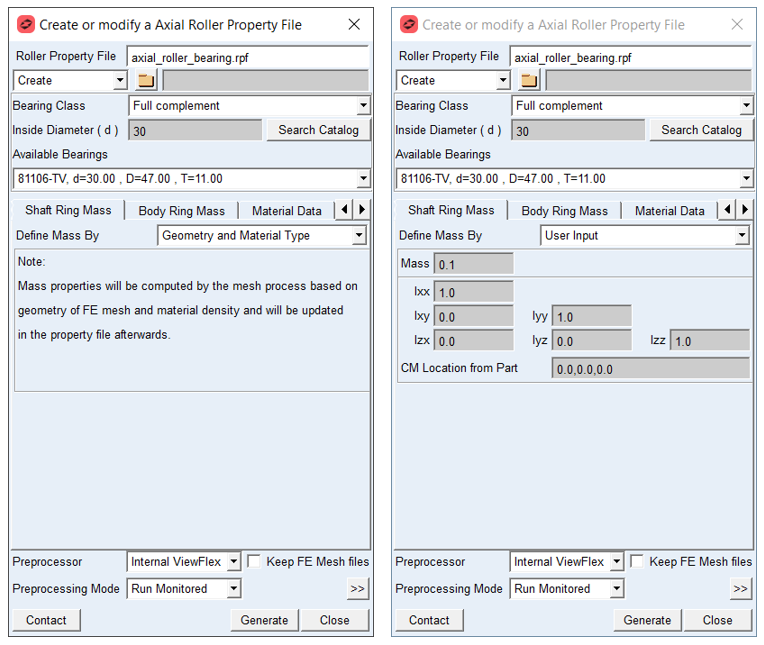
Figure 108 Mass tab (for shat ring and body ring)
For the options | Do the following |
|---|---|
Define Mass by | Set to: ■Geometry and Material Type ■User input |
For the option Define Mass by the Geometry and Material Type: Mass properties of a ring will be computed by the mesh process based on a ring geometry FE mesh and material density entered in the Material Data tab and will be updated in the property file data block. | |
For the option Define Mass by the User Input: Enter value of Mass, the principal mass moments of inertia (lxx, lyy, lzz) and cross-products of inertia (lxy, lzx, lyz). Note that you still need to define material parameters in the Material Data tab to define FE model of bearing properly | |
Mass | Enter the mass of the part |
Moments of inertia | Enter values of the bearing ring mass moments of inertia tensor expressed in local part reference frame (bearing reference marker) |
CM Location from Part | Enter location vector of centre of mass expressed in local part reference frame (bearing reference marker) |
Material Data
You can define different materials for rolling elements, shaft ring and body ring. When defining via the Material Type option, you can use predefined materials from the library or you can create a new one. Using the User Input option, it is necessary to enter values of Young’s Modulus, Poisson’s Ratio and Density appropriate for the material you require.
Note that in either case the Young’s modulus, Poisson’s ratio and density of chosen material will be stored in the property file.
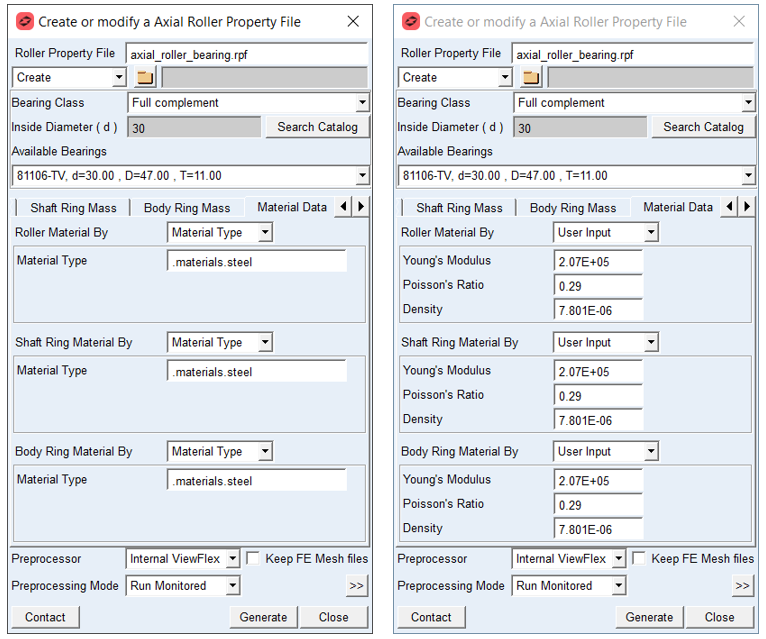
Figure 109 Material Data tab
For the options | Do the following |
|---|---|
Define Material by | Set to: ■Material Type ■User Input |
For the option Define Material by the Material Type: | |
Material Type | Choose material type either from predefined material library - right click the field and go to Material – Browse or create a new one. Note that material of steel is set by default |
For the option Define Material by the User Input: Enter value of Young’s Modulus, Poisson’s Ratio and Density appropriate for the material you require | |
Young’s Modulus | Enter Young‘s Modulus value of the bearing material It defines the relation between tensile strain e and tensile stress S by Hooke’s law; see equation below. For more detailed information: see literature about ‘theory of elasticity’ S = E * e Young's modulus for steel is around 2.1E5 N/mm^2 |
Poisson’s Ratio | Enter Poisson's Ratio value of bearing material An extension ex of a linear elastic material is accompanied by lateral strains ey and ez. Poisson's ratio defines this relation by following equations ey = - ν * ( ex / E ) ez = - ν * ( ex / E ) Poisson's ratio can also be derived from the shear modulus G, please look at the literature for more details. G = E / ( 2 * ( 1 + ν) ) Poisson's ratio for steel is around 0.3. |
Mass Density | Enter Mass Density value of bearing material The mass m of a solid body is computed from its volume V multiplied by the Mass Density rho. m = V * rho Mass Density for steel is around 7.8E-6 kg/mm^3 |
FE Data
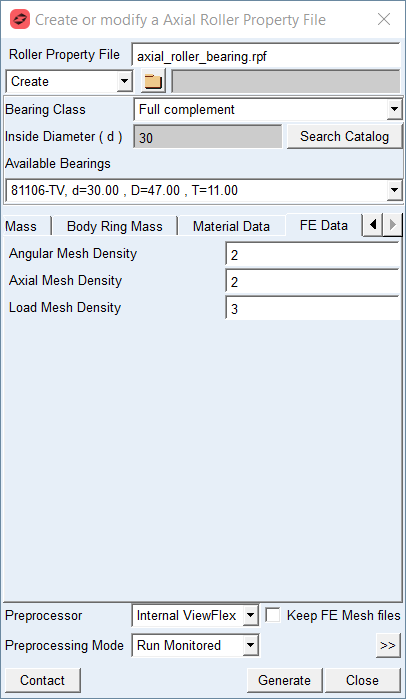
Figure 110 FE Data tab
For the options | Do the following |
|---|---|
Angular Mesh Density | Enter value of Angular Mesh Density Angular Mesh Density (supported values are 1 to 6) defines the number of elements along the Contact Angle of the roller (Figure 32). The values of 1 to 6 correspond to 10, 12, 14, 16, 18 and 20 elements. A higher value will result in a finer FE-mesh. Cone and cup have the same Angular Mesh Density. Default = 2.0 |
Axial Mesh Density | Enter value of Axial Mesh Density Axial Mesh Density controls the approximate number of elements in axial direction of the contact surface of the roller; supported values are 1 to 5. A low value means a low number of elements in axial direction. The element length in axial roller direction is a multiple of the element length in tangential direction (see Contact Angle and Angular Mesh Density); the multiplication factor decreases with increasing Axial Mesh Density. Default = 2.0 |
Load Mesh Density | Enter value of Load Mesh Density Load Mesh Density controls the fineness of the contact computations, what influences the CPU-time for the FEA-analysis and for the compliance analysis. Supported input values are 1 to 5. A high value of load mesh density means more finite elements per load element in axial direction. Default = 3.0 |