Create Belt - 3D Simplified
Machinery → Create Belt
For the option | Do the following |
|---|---|
Belt Name | Enter the belt name. |
Axis of Rotation | Axis of Rotation can be one of the following: ■Orientation ■Pick (Marker) ■Global Z ■Global X ■Global Y |
Reference Location | Enter the value for reference location. |
Friction Coefficient | The belt can slide laterally across the pulley. Enter the value of the dynamic friction coefficient between the belt and pulley. |
Friction Transition Velocity | Enter the value for the lateral belt-pulley friction transition velocity. A dynamic friction force between the belt and pulley is applied starting from zero to its maximum as the relative belt-to-pulley velocity increases from zero to this value. |
Width | Enter the belt width. |
Mass Per Unit Length | Also known as the belt running mass. This is the mass of the belt per unit length. |
Young's Modulus | Enter the value for the equivalent Young's modulus of the belt which will be used to determine its overall axial stiffness. |
Cross-Sectional Area | Enter the value for the equivalent cross-sectional area of the belt which to be used to determine its overall axial stiffness. |
3D Simplified Belt Requests
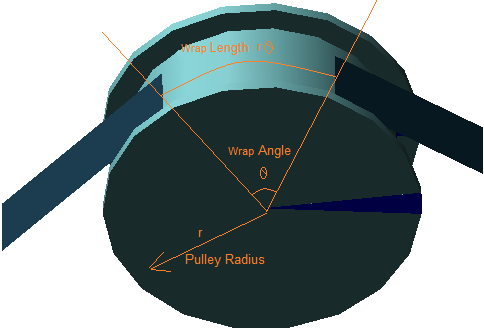
Terminology of Belt element is shown in the figure below:
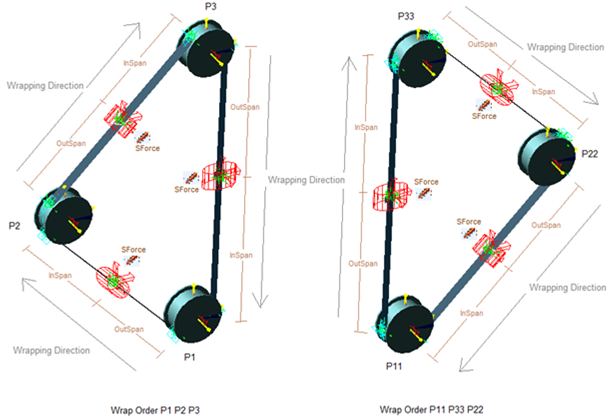
1. OUTWARD and INWARD belts segments
Each pulley is associated with two belt span (one incoming and the other outgoing)
The terms incoming and outgoing may change with respect to direction of motion, hence, these are fixed as per wrap-order. The wrapping order from one pulley to another will decide the 'OUT' and ‘IN' belt segments on each pulley as shown below:
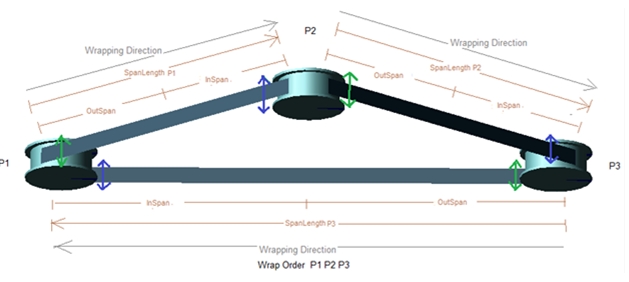
2. Span Length associated with each pulley
Span length associated each pulley is illustrated below:
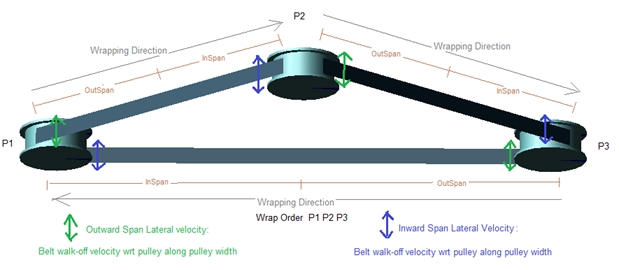
3. Outward and Inward lateral Velocity of belt
Belt may walk-off or slide along the width of pulley based on misalignment of pulleys. The sliding velocity of belt is illustrated below:
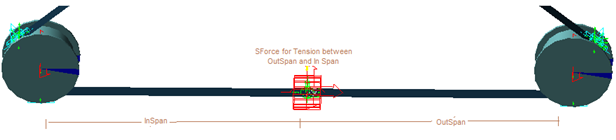
4. Span Tension
Each belt segment is bisected along the length between two adjacent pulleys by a SFORCE, Bushing and Inertia Force as shown below, which generates tensional force between two segments of a belt span referring to adjacent pulleys.
5. Wrap Angle and Wrap Length
■Wrap angle is the angles subtended by belt on pulley (θ).
■Wrap Length is the belt length associated with wrap length (rθ).