REQUEST
The REQUEST command redefines and/or lists the data for a REQUEST statement, and/or redefines the function expressions for a REQUEST statement.
Format
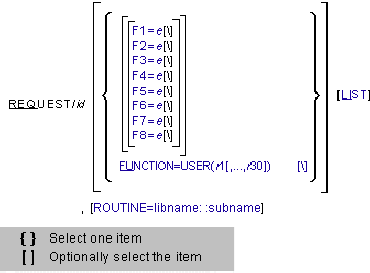
Arguments
F1=e | Redefines the first component of the request that is being specified. If the F1 argument is used, it must either be the last argument in the REQUEST statement or be followed by a backslash (\) (not a comma). Adams Solver (FORTRAN) writes the expression value to the corresponding column of the tabular output file, but not to the request file. |
F2=e | Redefines the second component of the request that is being specified. If the F2 argument is used, it must either be the last argument in the REQUEST statement or be followed by a backslash (\) (not a comma). Adams Solver (FORTRAN) writes the expression value to the corresponding column of the tabular output file and to the request file. |
F3=e | Redefines the third component of the request that is being specified. If the F3 argument is used, it must either be the last argument in the REQUEST statement or be followed by a backslash (\) (not a comma). Adams Solver (FORTRAN) writes the expression value to the corresponding column of the tabular output file and to the request file. |
F4=e | Redefines the fourth component of the request that is being specified. If the F4 argument is used, it must either be the last argument in the REQUEST statement or be followed by a backslash (\) (not a comma). Adams Solver (FORTRAN) writes the expression value to the corresponding column of the tabular output file and to the request file. |
F5=e | Redefines the fifth component of the request that is being specified. If the F5 argument is used, it must either be the last argument in the REQUEST statement or be followed by a backslash (\) (not a comma). Adams Solver (FORTRAN) writes the expression value to the corresponding column of the tabular output file, but not to the request file. |
F6=e | Redefines the sixth component of the request that is being specified. If the F6 argument is used, it must either be the last argument in the REQUEST statement or be followed by a backslash (\) (not a comma). Adams Solver (FORTRAN) writes the expression value to the corresponding column of the tabular output file and to the request file. |
F7=e | Redefines the seventh component of the request that is being specified. If the F7 argument is used, it must either be the last argument in the REQUEST statement or be followed by a backslash (\) (not a comma). Adams Solver (FORTRAN) writes the expression value to the corresponding column of the tabular output file and to the request file. |
F8=e | Redefines the eighth component of the request that is being specified. If the F8 argument is used, it must either be the last argument in the REQUEST statement or be followed by a backslash (\) (not a comma). Adams Solver (FORTRAN) writes the expression value to the corresponding column of the tabular output file and to the request file. |
FUNCTION=USER(r1[,...,r30])[/] | Redefines and passes constants (r1[,...,r30]) to the user-written subroutine REQSUB to define the request (see REQSUB Using Adams Solver Subroutines). If the FUNCTION argument is used, it must either be the last argument in the REQUEST statement or be followed by a backslash (\). All eight columns of the data that can be defined in a REQSUB are written in the tabular output file. Only columns 2, 3, and 4 and columns 6, 7, and 8 are written in the request file. |
LIST | Lists the current values of the data in the REQUEST statement. |
ROUTINE=libname::subname | Specifies an alternative library and name for the user subroutine REQSUB. Learn more about the ROUTINE Argument. |
Examples
REQUEST/21, F4=DX(2110, 409)/F8=DX(2115, 409)
This REQUEST command changes the fourth and eighth expressions for REQUEST/21. The other function expressions remain as they were.
See other Output available.