JPRIM
The JPRIM statement describes a joint primitive, which constrains one, two, or three degrees of either translational or rotational freedom. JPRIMs do not usually have a physical analogue and are predominantly useful in enforcing standard geometric constraints.
Format
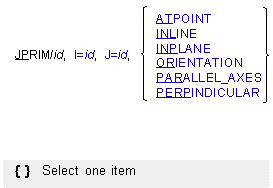
Arguments
ATPOINT | Indicates a three-degree-of-freedom primitive that allows only rotational motion of one part with respect to another (see the figure below). For an atpoint primitive, Adams Solver (FORTRAN) constrains all three translational displacements so that the I and J markers are always superimposed. Atpoint Primitive 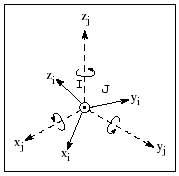 |
I=id,J=id | Specifies the identifier of one fixed marker in each part the primitive connects. Adams Solver (FORTRAN) connects one part at the I marker to another at the J marker. |
INLINE | Indicates a four-degree-of-freedom primitive that allows one translational and three rotational motions of one part with respect to another (see the figure below). For an inline primitive, Adams Solver (FORTRAN) imposes two translational constraints, which confine the translational motion of the I marker to the line defined by the z-axis of the J marker. Inline Primitive 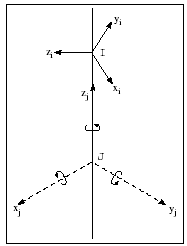 |
INPLANE | Indicates a five-degree-of-freedom primitive that allows both translational and rotational motion of one part with respect to another (see the figure below). For an inplane primitive, Adams Solver (FORTRAN) imposes one translational constraint, which confines the translational motion of the I marker to the x-y plane of the J marker. Inplane Primitive 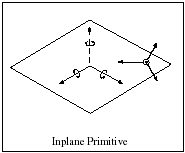 |
ORIENTATION | Indicates a three-degree-of-freedom primitive that allows only translational motion of one part with respect to another (see the figure below). For an orientation primitive, Adams Solver (FORTRAN) imposes three rotational constraints to keep the orientation of the I marker identical to the orientation of the J marker. Orientation Primitive 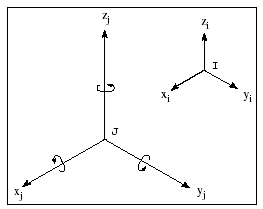 |
PARALLEL_AXES | Indicates a four-degree-of-freedom primitive that allows both translational and rotational motion of one part with respect to another (see the figure below). For a parallel axes primitive, Adams C++Solver imposes two rotational constraints so that the z-axis of the I marker stays parallel to the z-axis of the J marker. This primitive permits relative rotation about the common z-axis of I and J and permits all relative displacements. Parallel Axes Primitive 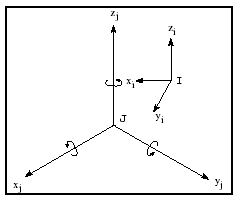 |
PERPENDICULAR | Indicates a five-degree-of-freedom primitive that allows both translational and rotational motion of one part with respect to another (see the figure below). For a perpendicular primitive, Adams Solver (FORTRAN) imposes a single rotational constraint on the I and the J markers so that their z-axes remain perpendicular. This allows relative rotations about either z-axis, but does not allow any relative rotation in the direction perpendicular to both z-axes. Perpendicular Primitive 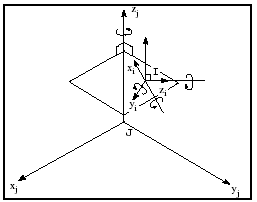 |
Extended Definition
The JPRIM statement describes a joint primitive, which constrains one, two, or three degrees of either translational or rotational freedom. The joint primitives, in general, do not have physical counterparts. The next figure shows the degrees of freedom each joint primitive allows.
In these and subsequent joint primitive figures, thick solid arrows show permissible motions of the I marker with respect to the J marker, thick dashed arrows show forbidden motions of the I marker with respect to the J marker, and thin solid lines show the I marker. Ghost constructs suggest spatial relationships.
In these and subsequent joint primitive figures, thick solid arrows show permissible motions of the I marker with respect to the J marker, thick dashed arrows show forbidden motions of the I marker with respect to the J marker, and thin solid lines show the I marker. Ghost constructs suggest spatial relationships.
Summary of Joint Primitive
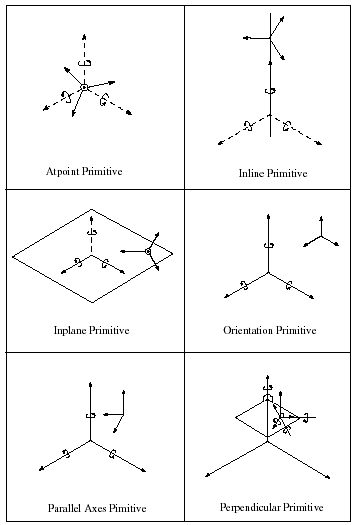
The table below lists the number of translational or rotational constraints each joint primitive imposes.
Primitive Constraints
This type of Joint Primitive: | Removes No. Translational DOF | Removes No. of Rotational DOF | Removes Total Number DOF |
|---|---|---|---|
Atpoint | 3 | 0 | 3 |
Inline | 2 | 0 | 2 |
Inplane | 1 | 0 | 1 |
Orientation | 0 | 3 | 3 |
Parallel Axes | 0 | 2 | 2 |
Perpendicular | 0 | 1 | 1 |
The reaction force on the part containing the I marker always acts at the I marker. The reaction force on the part containing the J marker acts at the instantaneous location of the I marker; that is, the point of application can vary with time if the I and J markers translate with respect to one another. The reaction force on the part containing the J marker is always equal and opposite to the reaction force on the part containing the I marker.
Joint primitives can be combined to define a complex constraint. In fact, they can be used to create any of the recognizable joints (except for RACKPIN and SCREW). However, motions cannot be applied on joint primitives as they can be on recognizable joints. For more information on recognizable joints, see JOINT.
Joint primitives can be combined to define a complex constraint. In fact, they can be used to create any of the recognizable joints (except for RACKPIN and SCREW). However, motions cannot be applied on joint primitives as they can be on recognizable joints. For more information on recognizable joints, see JOINT.
Tip: | The atpoint primitive is identical to the spherical joint |
Caution: | The two markers that define a joint primitive must be in two different parts. |
Examples
JPRIM/0101, INLINE, I=0140, J=0240
This JPRIM statement indicates that Adams Solver (FORTRAN) is to use an inline joint primitive to connect one part to another. This connects the first part at Marker 0140 to the second at Marker 0240.
See other Constraints available.