MREQUEST
The MREQUEST statement specifies multiple sets of data that you want Adams Solver (FORTRAN) to write in the tabular output file and request file. You can request sets of displacements, velocities, accelerations, or forces for system elements such as parts, joints, joint primitives, or applied forces in the system.
Format
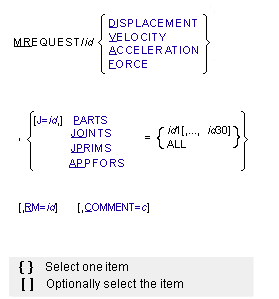
Arguments
ACCELERATION | Generates acceleration requests that output the accelerations for the markers that define part centers of mass, joints, joint primitives, or applied forces. This argument generates nine headings and nine columns of output for each part, joint, joint primitive, or applied force. The columns in the Tabular Output file include the time (TIME), the translational magnitude (ACCM), the x component (ACCX), the y component (ACCY) the z component (ACCZ), the rotational magnitude (WDTM), the rotational x component (WDTX), the rotational y component (WDTY), and the rotational z component (WDTZ). The same data without the magnitude are written in the Request file. 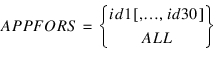 Indicates that you want to output displacements, velocities, accelerations, or forces for as many as thirty BEAM, BUSHING, FIELD, GFORCE, NFORCE, SFORCE, SPRINGDAMPER, VFORCE, and VTORQUE statements or for all of these statements. For action-reaction forces, Adams Solver (FORTRAN) measures the force that the J marker applies on the I marker. For action-only forces, Adams Solver (FORTRAN) measures the external forces acting on the I marker. If a MREQUEST statement is issued with an APPFORS argument that requests information for an identifier that is used for two or more applied force statements, Adams Solver (FORTRAN) outputs information for the first applied force statement with that identifier. To avoid problems, you may want to use a different identifier for each applied force statement in the dataset. |
COMMENT=c | Specifies a title for the top of each set of information the MREQUEST statement outputs. The entire comment must be on one line. Because the COMMENT argument can be only eighty characters long at most, the title can be from seventy-two characters long (if you do not abbreviate COMMENT=) to seventy-eight characters long (if you abbreviates COMMENT= to C=). Blank spaces and all alphanumeric characters can be used. However, the comma (,), the semicolon (;), the ampersand (&), and the exclamation point (!) cannot be used. |
DISPLACEMENT | Generates displacement requests that output the displacements for the markers that define part centers of mass, joints, joint primitives, or applied forces. This argument generates eight headings and eight columns of output for each part, joint, joint primitive, or applied force. The columns in the tabular output file include the time (TIME), the translational magnitude (MAG), the x component (X), the y component (Y), the z component (Z), the psi angle (PSI), the theta angle (THETA), and the phi angle (PHI). The same data without the magnitude are written in the Request file. For joints, joint primitives, and applied forces, the psi, theta, and phi angles are the Euler angle displacements of the I marker with respect to the J marker. For parts, the psi, theta, and phi angles are the Euler rotations of the part center-of-mass marker with respect to the ground coordinate system (GCS) or with respect to a J marker you specify. |
FORCE | Generates force requests that output the forces for the markers that define joints, joint primitives, or applied forces. This argument generates nine headings and nine columns of output for each joint, joint primitive, or applied force. The columns in the Tabular Output file include the time (TIME), the translational force magnitude (FM), the translational x component (FX), the translational y component (FY), the translational z component (FZ), the rotational force magnitude (TM), the rotational x component (TX), the rotational y component (TY), and the rotational z component (TZ). The same data without the magnitudes are written to the Request file. The FORCE argument cannot be used with the PARTS argument. |
J=id | Specifies a single base marker for measuring the displacements, velocities, or accelerations of the center-of-mass of the parts. Adams Solver (FORTRAN) makes all measurements for parts on the center-of-mass marker on each part with respect to the J marker you specify. The J marker defaults to the ground coordinate system (GCS). 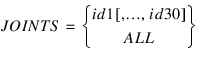 Indicates that you want to output displacements, velocities, accelerations, or forces for as many as thirty JOINT statements or for all JOINT statements. Adams Solver (FORTRAN) makes these measurements on the I marker with respect to the J marker. 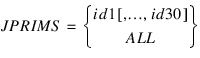 Indicates that you want to output displacements, velocities, accelerations, or forces for as many as thirty JPRIM statements or for all JPRIM statements. Adams Solver (FORTRAN) makes these measurements on the I marker with respect to the J marker. 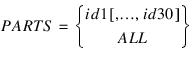 Indicates that you want to output displacements, velocities, or accelerations for as many as thirty center-of-mass of parts in the model (to which the PART statement identifiers refer) or for the centers of mass of all parts (except the ground part). Adams Solver (FORTRAN) makes these measurements on the center-of-mass marker of the part with respect to the marker specified by the J argument. The PARTS argument cannot be used for massless parts. The PARTS argument cannot be used with the FORCE argument. |
VELOCITY | Generates velocity requests that output the velocities for the markers that define part centers of mass, joints, joint primitives, or applied forces. This argument generates nine headings and nine columns of data for each part, joint, joint primitive, or applied force. The columns in the tabular output file include the time (TIME), the translational magnitude (VM), the x component (VX), the y component (VY), the z component (VZ), the rotational magnitude (WM), the rotational x component (WX), the rotational y component (WY), and the rotational z component (WZ). The same data without the magnitudes are written in the request file. |
RM=id | Identifies the reference marker with respect to which you want to resolve information. RM defaults to zero, which causes Adams Solver (FORTRAN) to resolve components in the ground coordinate system (GCS). |
Extended Definition
The MREQUEST statement indicates multiple sets of data you want Adams Solver (FORTRAN) to write in the tabular output file and request file. You can request sets of displacements, velocities, accelerations, or forces for system elements such as parts, joints, joint primitives, or applied forces in the system.
Adams Solver (FORTRAN) calculates all time derivatives in the ground coordinate system (GCS), although you can specify that the data be resolved in another reference frame. This is of no importance in the case of force data, but it can be very important in the case of velocities and accelerations. For example, joint velocities are actually translational and rotational velocity difference vectors of the joint I marker and the joint J marker in ground. Joint accelerations are actually translational and rotational acceleration difference vectors of the joint I marker in ground and the joint J marker in ground.
Because two markers (I and J) define each joint, joint primitive, and applied force, Adams Solver (FORTRAN) measures the request information for one of these at the I marker with respect to the J marker. Because a center-of-mass marker is the only marker that is necessary to define a part, Adams Solver (FORTRAN) measures the request information for a part at its center-of-mass marker with respect to ground or with respect to an alternative marker you specify. Regardless of the system information you want, a reference marker (RM) can be used to resolve the component information into any coordinate system you wish.
Caution: | ■Note that the units for rotational displacement data in the request output of the tabular output file default to degrees. The units for all other angular output data default to radians. |
■For any argument =ALL, Adams Solver (FORTRAN) ignores any invalid selections. | |
■Applied forces and torques are those generated by beams, bushings, fields, general forces (GFORCEs), n-component forces (NFORCEs), single-component forces (SFORCEs), springdampers (SPRINGDAMPERs), vector forces (VFORCEs), and vector torques (VTORQUEs). Adams Solver (FORTRAN) outputs the applied forces and torques acting at the request I marker (which may be either the applied force I marker or the applied force J marker). The magnitude and point of force application on the part containing the applied force J marker varies with the type and source of the force. ■For springdampers, action-reaction single-component forces, general forces, vector forces, and vector torques, the forces and torques acting at the J marker are equal and opposite to the forces and torques acting at the I marker. ■For action-only single-component forces, no force or torque acts at the applied force J marker. ■For beams, fields, bushings, and multi-point forces, the forces acting at the applied force J marker are equal and opposite to the forces acting at the applied force I marker. As long as the applied force I marker and the applied force J marker are coincident, the torques acting at the applied force J marker are equal and opposite to the torques acting at the applied force I marker. If there is a finite separation distance between the I and J markers, the torques acting at the applied force J marker are not necessarily opposite or equal, to the torques acting at the applied force I marker. | |
■Reaction forces and torques are those generated by constraint-inducing elements. For revolute, spherical, and universal joints and for atpoint, orientation, parallel axes, and perpendicular joint primitives, Adams Solver (FORTRAN) outputs the reaction forces and torques acting at the request I marker (which may be either the constraint I marker or the constraint J marker). Depending on the type of constraint, some or all of the torques acting at the I marker are zero. The force and torque acting at the request J marker are equal and opposite to the force and torque acting at the request I marker. | |
■Determining reaction forces-and torques for cylindrical, planar, rack-and-pinion, screw, and translational joints and for inline and inplane joint primitives is more complex. If the request I marker corresponds to the constraint I marker, then Adams Solver (FORTRAN) outputs the force and torque acting at the constraint I marker. If the request I marker corresponds to the constraint J marker, then Adams Solver (FORTRAN) outputs the force and torque acting at the instantaneous location of the constraint I marker, but on the part containing the constraint J marker. The force translated to the constraint J marker is the same as computed above. If the I and J markers are coincident, the torque translated to the constraint J marker is the same as computed above. But if there is a finite separation between the I and J markers, the torque translated to the constraint J marker is different from the one computed above (because of the moments contributed by the reaction forces). | |
■The MREQUEST statement is not scheduled to be supported in Adams Solver (C++). You are encouraged to migrate away from this statement and use the REQUEST statement instead. |
Examples
MREQUEST/01, DISPLACEMENT, PARTS=1014,1013,1012
This MREQUEST statement requests displacement data for Parts 1014, 1013, and 1012. For each of the three parts, Adams Solver (FORTRAN) outputs eight headings and eight columns of data to the tabular output file. The same information also goes to the request file. Because this statement does not supply arguments J and RM, Adams Solver (FORTRAN) measures the displacements with respect to the ground coordinate system (GCS), and resolves the displacements in the global coordinate system.
MREQUEST/04, FORCE, JOINTS=ALL
This MREQUEST statement requests the force data for all the joints in the dataset. For each joint, Adams Solver (FORTRAN) outputs nine headings and nine columns of data to the tabular output file with the same information going to the request file.
See other Output available.