PTCV
The PTCV statement defines a point-to-curve constraint, which restricts a fixed point defined on one part to lie on a curve defined on a second part. This is an instance of a higher pair constraint.
Format
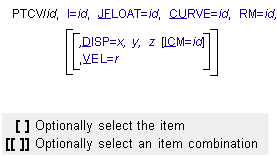
Arguments
CURVE=id | Specifies the identifier of a CURVE statement that defines the contour or shape on which the fixed marker can move. The x, y, z values associated with the curve are the coordinates of points lying on the curve and are calculated in the coordinate system of the RM marker. |
DISP=x,y,z | Specifies the initial point of contact on the curve. If the point specified is not exactly on the curve, Adams Solver (FORTRAN) uses a point on the curve nearest to that specified. By default, DISP is specified in the RM marker coordinate system. If another coordinate system is more convenient, you may supply the ICM argument and enter DISP in ICM marker coordinates. If you supply DISP, Adams Solver (FORTRAN) assembles the system with the I marker at the specified point on the curve. If you do not supply DISP, Adams Solver (FORTRAN) assumes the initial contact is at the point on the curve closest to the initial I marker position. However, it may adjust that contact point to maintain other part or constraint initial conditions. |
I=id | Specifies the identifier of a fixed MARKER that Adams Solver (FORTRAN) constrains to lie on the curve defined by CURVE and RM. The I and RM markers must belong to different parts. |
ICM=id | Specifies the identifier of a fixed MARKER defining the coordinate system in which the values for DISP are specified. The ICM marker must be on the same part as the RM marker. |
JFLOAT=id | Specifies the identifier of a floating marker. Adams Solver (FORTRAN) positions the origin of the JFLOAT marker at the instantaneous point of contact on the curve. Adams Solver (FORTRAN) orients the JFLOAT marker such that the x-axis is tangent to the curve at the contact point, the y-axis points outward from the curve's center of curvature at the contact point, and the z-axis is along the binormal at the contact point. |
RM=id | Specifies the identifier of a fixed marker on the J part containing the curve on which the I marker must move. The RM marker is used to associate the shape defined by the CURVE identifier to the part on which the RM marker lies. The curve coordinates are therefore specified in the coordinate system of the RM marker. The JFLOAT and RM markers must belong to the same PART. |
VEL=r | Specifies the magnitude initial tangential velocity of the I marker with respect to the part containing the curve. This is the speed at which the I marker is initially moving relative to the curve. VEL is negative if the I marker is moving towards the start of the curve, positive if the I marker is moving toward the end of the curve, and zero if the I marker is stationary on the curve. If you supply VEL, Adams Solver (FORTRAN) gives the I marker the specified initial tangential speed along the curve. If you do not supply VEL, Adams Solver (FORTRAN) assumes the initial tangential velocity is zero, but may adjust that velocity to maintain other part or constraint initial conditions. Default: 0 |
Extended Definition
The PTCV statement defines a point-to-curve constraint. The part containing the I marker is free to roll and slide on the curve that is fixed to the second part. Lift-off is not allowed, that is, the I marker must always lie on the curve.
is located at the contact point on the curve; its orientation is defined by the tangent, normal and binormal at the contact point (see Figure 5).
Figure 6 shows a schematic of the point-to-curve constraint.
A PTCV statement removes two translational degrees-of-freedom from the system. Adams Solver (FORTRAN) restricts the origin of the I marker to always lie on the curve. The I marker may translate only in one direction relative to the curve, along the instantaneous tangent. The I marker is free to rotate in all three directions.
Figure 5 Geometric Interpretation of the Orientation of the JFLOAT Marker
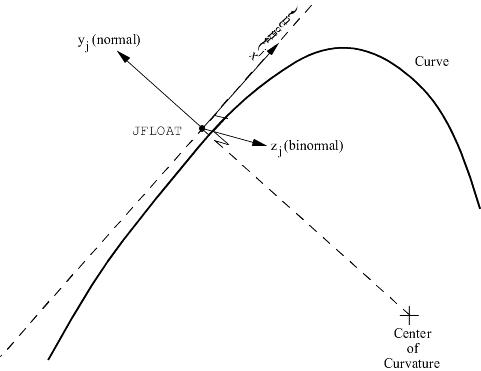
Figure 6 Point-To-Curve Constraint
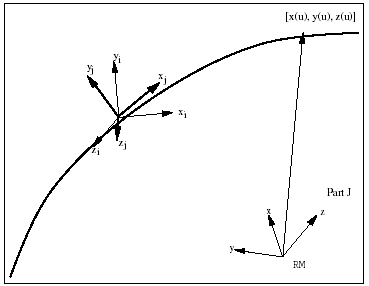
Note: | More than one PTCV statement may reference the same CURVE statement. If the mechanism contains several similar contacts, you may enter just one CURVE statement, then use it with several PTCV constraints, each with a different RM marker. |
Caution: | ■VEL is specified relative to the part containing the RM marker. In other words, VEL is the tangential speed of the I marker relative to the part containing the curve. This means that if the I marker is stationary relative to ground, but the curve is moving relative to ground, then VEL is still nonzero. ■Adams Solver (FORTRAN) applies a restoring force tangent to the curve at the contact point if the contact point moves off the end of an open curve. The magnitude of the force applied is defined as: Force = COSH(MIN(200,500*DELTA)) - 1, if DELTA > 0 ■where DELTA is a normalized penetration of the end of the curve, defined as: DELTA = (ALPHA-MAXPAR)/ABS(MAXPAR-MINPAR), if ALPHA > MAXPAR or DELTA = -(ALPHA-MINPAR)/ABS(MAXPAR-MINPAR), if ALPHA < MINPAR This force is intended to prevent solution problems when unexpected situations occur, and should not be relied upon intentionally. You should make sure the CURVE statement defines the curve over the expected range of motion. ■The initial conditions arguments, DISP and VEL, impose constraints that are active only during an initial conditions analysis. Adams Solver (FORTRAN) does not impose these initial conditions during subsequent analyses. ■For a kinematic analysis, the initial conditions are redundant. Do not use the DISP or VEL arguments on the PTCV statements for systems with zero degrees of freedom. ■It is easy to accidentally over-constrain a system using the PTCV constraint. For instance, in a cam-follower configuration, the cam should usually be rotating on a cylindrical joint, not a revolute joint. If the follower is held by a translational joint and the cam by a cylindrical joint, the PTCV constraint between the follower and cam prevents the cam from moving along the axis of rotation (that is, the axis of the cylindrical joint). A revolute joint would add a redundant constraint in that direction. |
Examples
PTCV/55, I=201, JFLOAT=301, CURVE=10, RM=302
This statement creates a point-curve constraint between Marker 201 and a curve on the part containing floating Marker 301 and fixed Marker 302. CURVE/10 defines the x, y, z coordinates curve in the coordinate system of Marker 302. Because the statement does not specify initial conditions, Adams Solver (FORTRAN) assumes that the initial position of the contact point on the curve is set to be the minimum distance between the specified I marker and the curve. Adams Solver (FORTRAN) also assumes the velocity of Marker 201 with respect to the curve is zero, meaning it is initially stationary on the curve. Adams Solver (FORTRAN) may adjust these assumed initial conditions in order to enforce other part or constraint initial conditions.
PTCV/55, I=201, JFLOAT=301, CURVE=10, RM=302,
, DISP=2.,3.,0., VEL=-5.
, DISP=2.,3.,0., VEL=-5.
This statement is the same as the last example, except it contains initial conditions. Adams Solver assembles the system with Marker 201 at the point on the curve nearest to coordinates (2.,3.,0.) in the Marker 302 coordinate system. Adams Solver imposes an initial speed of -5.0 on Marker 201 with respect to the curve, meaning Marker 201 is moving towards the start of the curve.
Applications
The simplest point-curve constraint application is a pin-slot connection as illustrated in Figure 7 below.
Figure 7 Slot and Pin Reciprocating Mechanism
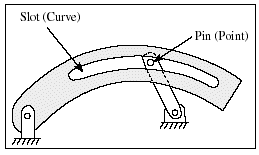
The point-curve constraint keeps the center of the pin in the center of the slot, while allowing it to move freely along the slot and rotate in the slot. Note that the point-curve constraint does not stop the pin at the end of the slot. If the travel of the pin must be restricted, a force element, such as an SFORCE with an IMPACT function, must be used.
A point-curve constraint may also represent a point follower on a cam, where the follower has a very small radius compared to the curvature of the cam. Figure 8 below illustrates a point follower on a cam.
If the CURVE statement specifies a closed curve, Adams Solver (FORTRAN) automatically moves the point across the closure as needed. This means the cam may rotate as many times as needed during the simulation.
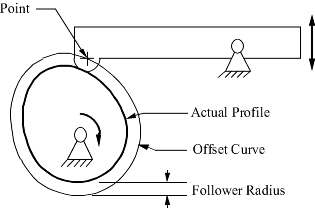
In some cases, the PTCV statement may be used to model a circular follower on a curve. This requires you to construct a curve offset from the actual profile by a distance equal to the radius of the follower. Figure 9 illustrates the follower, original profile, and offset curve.
Figure 8 Point-Follower Mechanism
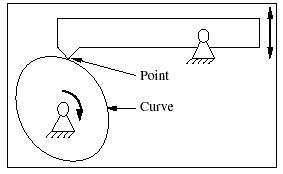
Figure 9 Modeling a Circular Follower Using an Offset Curve
To model more complex cam-follower applications, see the CVCV statement. In the CVCV statement, both the follower and cam can be represented as curves.
Because PTCV is a constraint, the point always maintains contact with the curve, even when the dynamics of the system would actually lift the point off the profile. You may examine the constraint forces to determine if lift-off should have occurred. If an accurate simulation of intermittent contact is required, you should model the contact forces directly using a VFORCE.
Unlike the CVCV statement, the PTCV statement is not restricted to planar curves. PTCV can model three-dimensional slots and cams, as well as mechanisms riding on nonplanar tracks, or a robot end-effector following a three-dimensional path in space.
See other Constraints available.