BISTOP
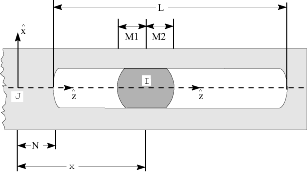
The BISTOP function models a gap element (see Figure 1).
Format
BISTOP (x, ,x1, x2, k, e, cmax, d)
,x1, x2, k, e, cmax, d)Arguments
x | The distance variable you want to use to compute the force. For example, if you want to use the x displacement of Marker 0201 with respect to 0301, then x is DX(0201,0301,0301). |
 | The time derivative of x to BISTOP. For example, if x is DX(0201,0301,301) then is VX(0201,0301,0301,0301). |
x1 | The lower bound of x. If x is less than x1 Adams Solver (FORTRAN) calculates a positive value for the force. The value of x1 must be less than the value of x2. |
x2 | The upper bound of x. If x is greater than x2 Adams Solver (FORTRAN) calculates a negative value for the force. The value of x2 must be greater than the value of x1. |
k | A non-negative value that specifies the stiffness of the boundary surface interaction. |
e | A positive value that specifies the exponent of the force deformation characteristic. For a stiffening spring characteristic, e > 1.0. For a softening spring characteristic, 0 < e < 1.0. |
cmax | A non-negative variable that specifies the maximum damping coefficient. |
d | A positive real variable that specifies the penetration at which the full damping coefficient is applied. |
Extended Definition
The BISTOP function models a gap element. Figure 1 below illustrates the BISTOP force. The gap element consists of a slot which defines the domain of motion of a Part I located in the slot. As long as Part I is inside the slot and has no interference with the ends of the slot, it is free to move without forces acting on it. When Part I tries to move beyond the physical definition of the slot, impact forces representing contact are created by the BISTOP function. The created force tends to move Part I back into the slot.
The BISTOP force has two components: A stiffness component dependent on the penetration of Part I into the restricting Part J and a damping or viscous component that may be used to model energy loss.
Figure 1 Example of the BISTOP Function
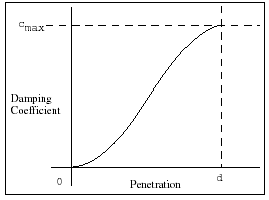
To prevent a discontinuity in the damping force at zero penetration, the damping coefficient is defined as a cubic step function of the penetration. Thus at zero penetration, the damping coefficient is always zero. The damping coefficient achieves a maximum, cmax, at a user-defined penetration, d. Even though the points of contact between the floating part and the restricting part may change as the system moves, Adams Solver (FORTRAN) always exerts the force between the I and the J markers.
Figure 2 Damping Coefficient versus Penetration
Caution: | When e is < 1, the defined force contains a slope discontinuity that may casue difficulty for the integrator. |
Examples
You may model a slider in a slot with a BISTOP function as depicted in Figure 1. Assume a translational joint constrains the slider to move in a slot. The line of translation is along the colinear z-axes of the I and the J markers, I belonging to the slider and J to the part containing the slot. You can use an SFORCE statement together with the BISTOP function to restrict the movement of the slider in the slot and model the gap.
In Figure 1:
■x is the instantaneous distance between the I and the J markers.
■N is the distance between the J marker and the left end of the slot.
■M1 is the distance between the I marker and the left edge of the floating part.
■L is the length of the slot.
■M2 is the distance between the I marker and the right edge of the floating part.
■x1 is the instantaneous distance between the I and the J markers when the floating part first comes into contact with the left end of the slot.
■x2 is the instantaneous distance between the I and the J markers when the floating part first comes into contact with the right end of the slot.
Therefore, the parameters for BISTOP for this example are:
x = DZ(I,J,J) and  = VZ(I,J,J,J)
= VZ(I,J,J,J)x= N + M1 for the left end of the slot and
x = N + L - M2 for the right end of the slot or
x1 = N + M1, and
x2 = N + L - M2
x = N + L - M2 for the right end of the slot or
x1 = N + M1, and
x2 = N + L - M2
Note that when:
■x1 < x < x2, there is no penetration and the force is zero (penetration p = 0).
■x < x1 penetration occurs at the end closer to the J marker and the force is > 0 (penetration p = x1 - x).
■x > x2 penetration occurs at the end farther away from the J marker, and the force is < 0 (penetration p = x - x2).
Also note that when p < d the instantaneous damping coefficient is a cubic step function of the penetration, p; when p > d the instantaneous damping coefficient is cmax.
The BISTOP function for this example is:
BISTOP(DZ(I,J,J,J), VZ(I,J,J,J), x1, x2, k, e, cmax, d)
The values of k, e, cmax, and d depend on the materials used in the two parts and on the shapes of the parts and are used to define the contact force. The BISTOP force can be mathematically expressed as follows:

See other General available.