Joint types
Translational Joint
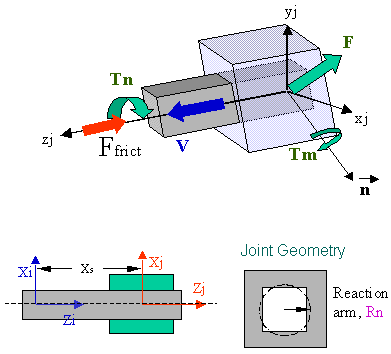
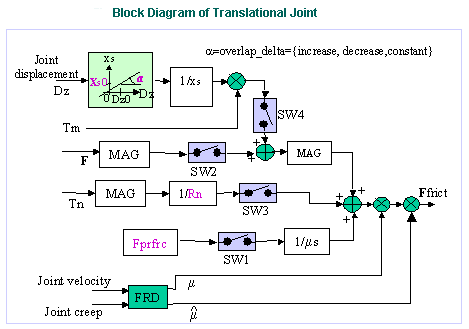
Joint reaction force (F), bending moment (Tm), torsional moment (Tn), and force preload (Fprfrc) are used to compute the frictional force in a translational joint. You can individually turn off the force effects using switches SW1 through SW4. The bending moment (Tm) is converted into an equivalent force using the Xs block. Similarly, torsional moment is converted into an equivalent joint force using the friction arm (Rn). Frictional force (Ffrict) is applied along the axis of translation in the direction that the FRD block computes. For more information, see the Block Diagram of the Translational Joint.
Note: | Adams Solver (C++) computes DZ0 (the initial joint displacement) after the first successful assembly of the model (initial conditions or first static simulation. |
Revolute Joint
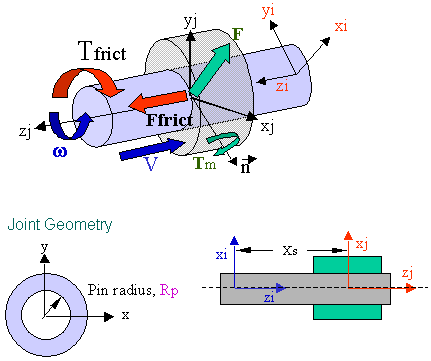
Joint reactions (Fa and Fr), bending moment (Tr), and torque preload (Tprfrc) determine the frictional torque in a revolute joint. You can turn off one or more of these force effects using switches SW1 through SW3. The joint reactions (Fa and Fr) are converted into equivalent torques using the respective friction arm (Rn) and pin radius (Rp). The joint bending moment (Tr) is converted into an equivalent torque using pin radius (Rp) divided by bending reaction arm (Rb). The frictional torque (Tfrict) is applied along the axis of rotation in the direction that the FRD block computes. See the Block Diagram of the Revolute Joint.
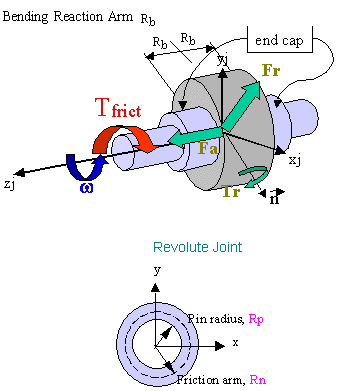
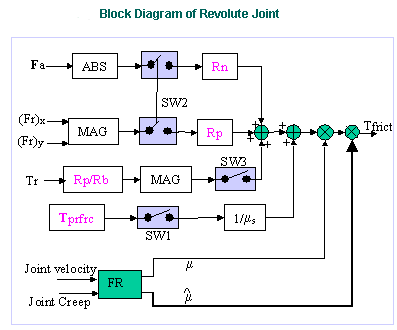
In general, the pin radius (Rp) will be radius of the physical pin in the revolute joint. This accounts for the contact along the length of the physical pin with the inner cylindrical surface of the sleeve (excluding the end surface.) The normal force (Frd) on the joint times the pin radius (Rp) estimate a torque due to this interaction.
The friction arm (Rn) accounts for the contact between the end circular surface of the physical pin and the inner surface the sleeve touching the end of the pin. The friction arm (Rn) times the axial load (Fa) estimate a torque due to this interaction.
The torque (Tr) times the pin radius (Rp) divided by the bending reaction arm (Rb) estimate a torque due to the reaction torque on the joint.
All three torque contributions above are used to estimate the frictional torque on the joint.
Cylindrical Joint
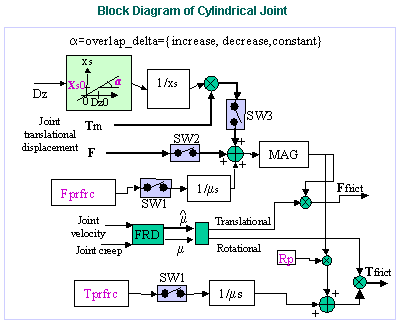
Joint reaction (F) and reaction torque (Tm) combined with force preload (Fprfrc) and torque preload (Tprfrc) yield the frictional force and torque in a cylindrical joint. As the block diagram indicates, you can turn off one or more of these force effects using switches SW1 through SW3. The frictional force in a cylindrical joint acts at the mating surfaces of the joint. The FRD block determines the direction of the frictional force. Based on the frictional coefficient direction, the surface frictional force is broken down into an equivalent frictional torque and frictional force acting along the common axis of translation and rotation. See the Block Diagram of the Cylindrical Joint.
Universal/Hooke Joint
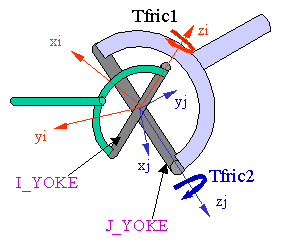
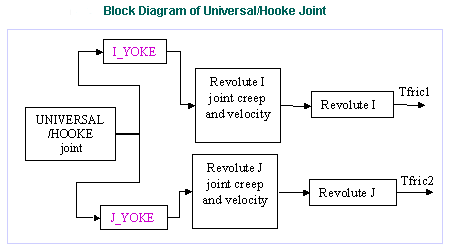
The universal/hooke joint contains two yokes (I_YOKE and J_YOKE) that are modeled independently. An equivalent revolute joint represents each yoke. Frictional torques are applied along the axes of rotation of the two yokes. See the Block Diagram of the Universal/Hooke Joint.
Spherical Joint
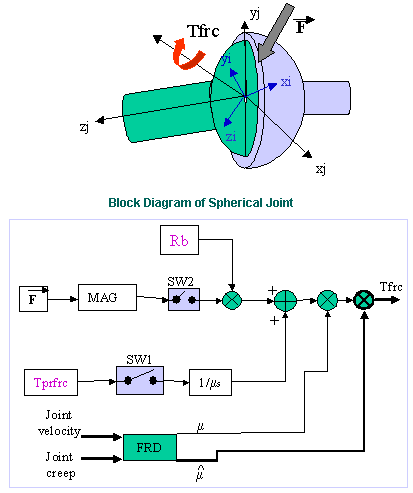
The reaction force (F) and the preload frictional torque (Tprfrc) are the two forcing effects used in computing the frictional torque on a Spherical joint. The ball radius is used to compute an equivalent frictional torque. The FRD block determines the direction of the frictional torque. See the Block Diagram of the Spherical Joint.