About Axis Systems and Sign Conventions
Tire Input and Output
For tire input and output data, the tire axis systems and sign conventions are identical to those described in About Axis Systems and Sign Conventions, in Learning Adams Tire. Tire output descriptions are also included.
Internal Force Computations and Equation Descriptions
However, all "internal" force computations (and documentation descriptions of the force computations) are based upon a coordinate system that is identical to that defined by the Society of Automotive Engineers (SAE).
From the tire spin axis vector, the tire geometric center location and velocity, and the knowledge of the local road element location and orientation, the SAE tire coordinate system may be defined. This is a right-handed orthogonal triad with the origin located at the center of the tire/road contact patch. For a graphical representation of this coordinate system, see the Figure 1. Note that this coordinate system is determined jointly by the wheel orientation and the road. A wheel, by itself, does not contain enough information to define this coordinate system.
The definitions that follow the Figure 1, SAE Tire Coordinate System are based on the SAE document "Vehicle Dynamics Terminology" (Society of Automotive Engineers, Inc., "Vehicle Dynamics Terminology SAE J670e," [1978]).
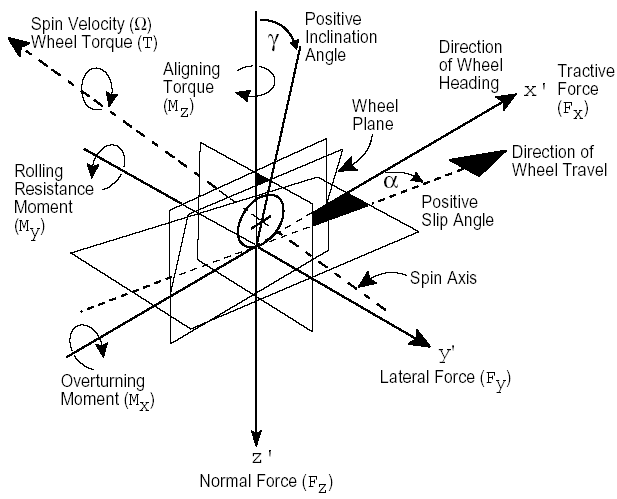
Figure 1 SAE Tire Coordinate System
Symbol | Description |
|---|---|
α | Slip Angle. The angle formed between the direction of travel of the tire contact patch center and the x'-axis.  is positive if the wheel travel direction has a component in the +y'-direction. This produces a negative Lateral force (Fy). Note that the steer angle, or the vehicle attitude angle, plays no part in defining the slip angle. is positive if the wheel travel direction has a component in the +y'-direction. This produces a negative Lateral force (Fy). Note that the steer angle, or the vehicle attitude angle, plays no part in defining the slip angle. |
γ | Inclination Angle. The angle formed between the x'-z' plane and the wheel plane. Inclination angle is positive if the wheel plane has a component lying in the +y'-direction. |
Fx | Longitudinal Force. The x'-component of the resultant force acting on the tire by the road. |
Fy | Lateral Force. The y'-component of the resultant force acting on the tire by the road. Lateral Force may be produced by slip angle, inclination angle, conicity, plysteer, or any combination of the above. |
Fz | Normal Force. The z'-component of the resultant force acting on the tire by the road. The direction of this force is up, but this nomenclature requires that Fz be negative whenever the tire is in contact with the road, as the positive z'-axis is directed downward. |
Mx | Overturning Moment. The moment of the forces at the contact patch acting on the tire by the road with respect to the x'-axis. |
My | Rolling Resistance Moment. The moment of the forces at the contact patch acting on the tire by the road with respect to the y'-axis. |
Mz | Aligning Torque. The moment of the forces at the contact patch acting on the tire by the road with respect to the z'-axis. |
Spin Axis | The axis about which the wheel rotates. Perpendicular to the Wheel Plane, not necessarily about the y'-axis (only if inclination angle is zero). |
Spin Velocity (  ) ) | The angular velocity of the wheel on which the tire is mounted, about its spin axis. |
T | Wheel Torque. The external torque applied from the vehicle about the spin axis of the wheel. |
Vertical Load | The normal reaction of the tire on the road which is equal to the negative of Normal Force. This is always a positive quantity when the tire is in contact with the road, otherwise it is zero. |
Wheel Plane | The central plane of the tire and wheel, normal to the wheel spin axis. |
+x' | Direction of wheel heading along ground. The intersection of the wheel plane and the road plane in the neighborhood of the Tire Axis System origin. This is not the same as the direction in which the wheel is traveling. If the tire reverses its direction, the axis system flips 180 degrees about the z'-axis. |
+y' | To the right along the ground, as viewed from behind a forward rolling tire. Chosen to be Right-Hand Orthogonal to the definitions of x' and z'. |
+z' | Perpendicular to the road in the neighborhood of the Tire Axis System origin with positive direction down. (If the road is flat and in the x-y plane, this is negative Global Z.) |