Force Modify Element Like Beam
Right-click beam → Modify
After you’ve created a beam, you can modify the following:
■Markers between which the beam acts.
■Stiffness and damping values.
■Material properties of the beam, such as its length and area.
Learn more about Beams.
For the option: | Do the following: |
|---|---|
Tips on Entering Object Names in Text Boxes. | |
Beam Name | Enter the name of the beam to modify. |
New Beam Name | Enter a new name for the beam, if desired. |
Adams Id | Assign a unique ID number to the beam. See Adams Solver ID. |
Comments | Enter any comments about the beam that might help you manage and identify it. See Comments. |
Ixx | Enter the torsional constant. The torsional constant is sometimes referred to as the torsional shape factor or torsional stiffness coefficient. It is expressed as unit length to the fourth power. For a solid circular section, Ixx is identical to the polar moment of inertia J=  . For thin-walled sections, open sections, and non-circular sections, you should consult a handbook. . For thin-walled sections, open sections, and non-circular sections, you should consult a handbook. |
Iyy/Izz | Enter the area moments of inertia about the neutral axes of the beam cross sectional areas (y-y and z-z). These are sometimes referred to as the second moment of area about a given axis. They are expressed as unit length to the fourth power. For a solid circular section, Iyy=Izz=  . For thin-walled sections, open sections, and non-circular sections, you should consult a handbook. . For thin-walled sections, open sections, and non-circular sections, you should consult a handbook. |
Area of Cross Section | Enter the uniform area of the beam cross-section geometry. The centroidal axis must be orthogonal to this cross section. |
Y Shear Area Ratio/ Z Shear Area Ratio | Specify the correction factor (the shear area ratio) for shear deflection in the y and z direction for Timoshenko beams. If you want to neglect the deflection due to shear, enter zero in the text boxes. For the y direction: 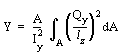 where: ■Qy is the first moment of cross-sectional area to be sheared by a force in the z direction. ■lz is the cross section dimension in the z direction. For the z direction: 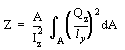 where: ■Qz is the first moment of cross-sectional area to be sheared by a force in the y direction. ■Iy is the cross section dimension in the y direction. ■Common values for shear area ratio based on the type of cross section are: ■Solid rectangular - 6/5 ■Solid circular - 10/9 ■Thin wall hollow circular - 2 Note: The K1 and K2 terms that are used by MSC.Nastran for defining the beam properties using PBEAM are the inverse of the y shear and z shear values that Adams View uses. |
Young's Modulus | Enter Young’s modulus of elasticity for the beam material. |
Shear Modulus | Enter the shear modulus of elasticity for the beam material. |
Beam Length | Enter the undeformed length of the beam along the x-axis of the J marker on the reaction body. |
Damping Ratio/Matrix of Damping Terms | Select either: ■Damping Ratio and enter a damping value to establish a ratio for calculating the structural damping matrix for the beam. To obtain the damping matrix, Adams Solver multiplies the stiffness matrix by the value you enter for the damping ratio. ■Matrix of Damping Terms and enter a six-by-six structural damping matrix for the beam. Because this matrix is symmetric, you only need to specify one-half of the matrix. The following matrix shows the values to input: 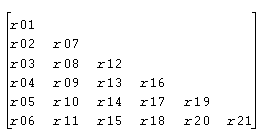 Enter the elements by columns from top to bottom, then from left to right. The damping matrix defaults to a matrix with thirty-six zero entries; that is, r1 through r21 each default to zero. The damping matrix should be positive semidefinite. This ensures that damping does not feed energy into the model. Adams Solver does not warn you if the matrix is not positive semidefinite. |
I Marker/ J marker | Specify the two markers between which to define a beam. The I marker is on the action body and the J marker is on the reaction body. The J marker establishes the direction of the force components. By definition, the beam lies along the positive x-axis of the J marker. Therefore, the I marker must have a positive x displacement with respect to the J marker when viewed from the J marker. In its undeformed configuration, the orientation of the I and the J markers must be the same. When the x-axes of the markers defining a beam are not collinear, the beam deflection and, consequently, the force corresponding to this deflection are calculated. To minimize the effect of such misalignments, perform a static equilibrium at the start of the simulation. When the beam element angular deflections are small, the stiffness matrix provides a meaningful description of the beam behavior. When the angular deflections are large, they are not commutative; so the stiffness matrix that produces the translational and rotational force components may not correctly describe the beam behavior. Adams Solver issues a warning message if the beam translational displacements exceed 10 percent of the undeformed length. |
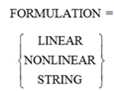 | Specifies the theory to be used to define the force this element will apply. By default the LINEAR theory is used. If the NONLINEAR option is used, the full non linear Euler-Bernoulli theory is used. If the STRING option is used, a simplified non linear theory is used. The simplified non linear theory may speed up your simulations with little performance penalties. |