Akima Fitting Method (AKISPL)
Returns either a derivative of a curve or an interpolated value from a curve or surface. The curve is fit exactly through a set of discrete data points using an Akima spline fitting method.
Format
AKISPL (First Independent Variable, Second Independent Variable, Spline Name, Derivative Order)
Arguments
First Independent Variable | (Required) Real variable that represents the first independent variable in the spline. |
Second Independent Variable | (Optional) Real variable that represents the second independent variable in the spline. |
Spline Name | (Required) The name of the existing data element spline modeling entity that defines the set of discrete data points to be used for the interpolation. |
Derivative Order | (Optional) The order of the derivative to be taken at the interpolated point (integer). The legal values are: ■0 - returns the curve coordinate value ■1 - returns the first derivative ■2 - returns the second derivative Note: Derivative Order may not be specified when interpolating on a surface; that is, when the Second Independent Variable = 0. |
Example
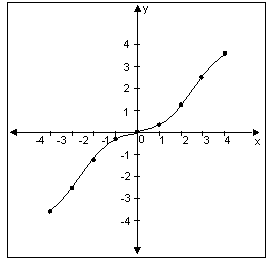
A spline, spline_1, is defined with discrete data as shown in the following table. The data is then used to generate the interpolation function using the Akima spline fitting method. Since the spline defines a curve rather than a surface, the Second Independent Variable must be set to 0.
In the following example, given the tabular data and a value for the independent variable, the AKISPL returns the interpolated value for the dependent variable:
f = AKISPL(DX(marker_1, marker_2, marker_2), 0, spline_1)
Independent variable (x): | Dependent variable (y): |
|---|---|
-4.0 | -3.6 |
-3.0 | -2.5 |
-2.0 | -1.2 |
-1.0 | -0.4 |
0.0 | 0.0 |
1 | 0.4 |
2 | 1.2 |
3 | 2.5 |
4 | 3.6 |
Spline Defined Based on Tabular Data